New teachers
PE Lesson Plan Template, Field by Field
A PE lesson plan has to work while you stand in a gym with a whistle around your neck, so one page beats three.
Good PE lesson plans usually fit on one page and answer a few practical questions: what students should be able to do by the end, how you will know, and how the space is set up. A plan that names its objective and its backup holds up on days when the schedule or the gym changes.
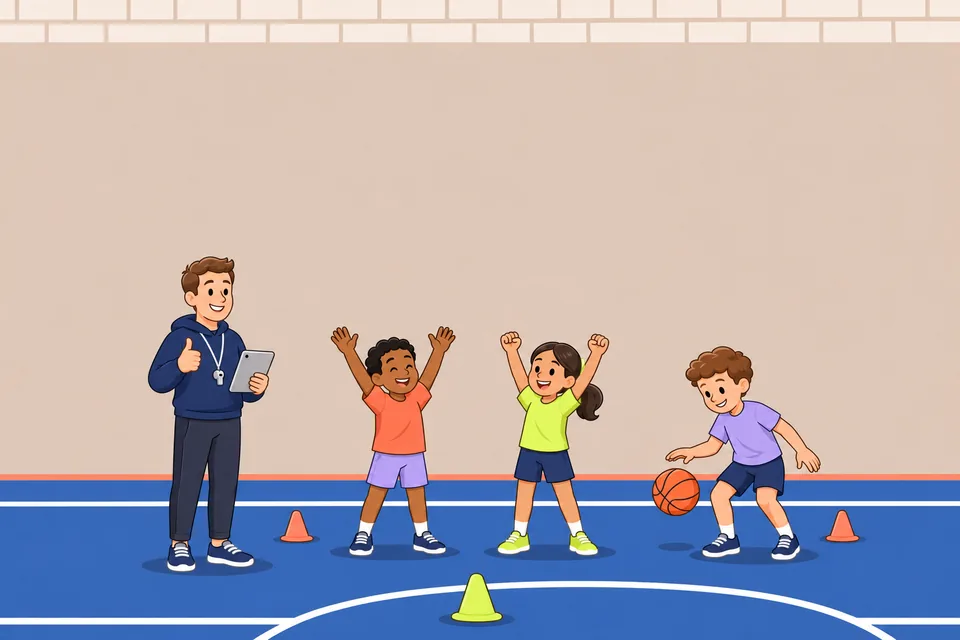
Start with one objective students can show you, then choose a check for it. Add a few activities that keep every student moving, sketch the space and equipment you really have, and note your safety routines. Finish with a backup activity. Write it on one page so you, or a substitute, can teach from it without guessing.
A plan answers a handful of questions before class starts. Work through them in this order, because each answer limits the next one.
One objective per lesson is the usual advice because your cues, activities and check then all point at the same skill. If you want to tie the lesson to a standard, add the tag once the objective is clear.
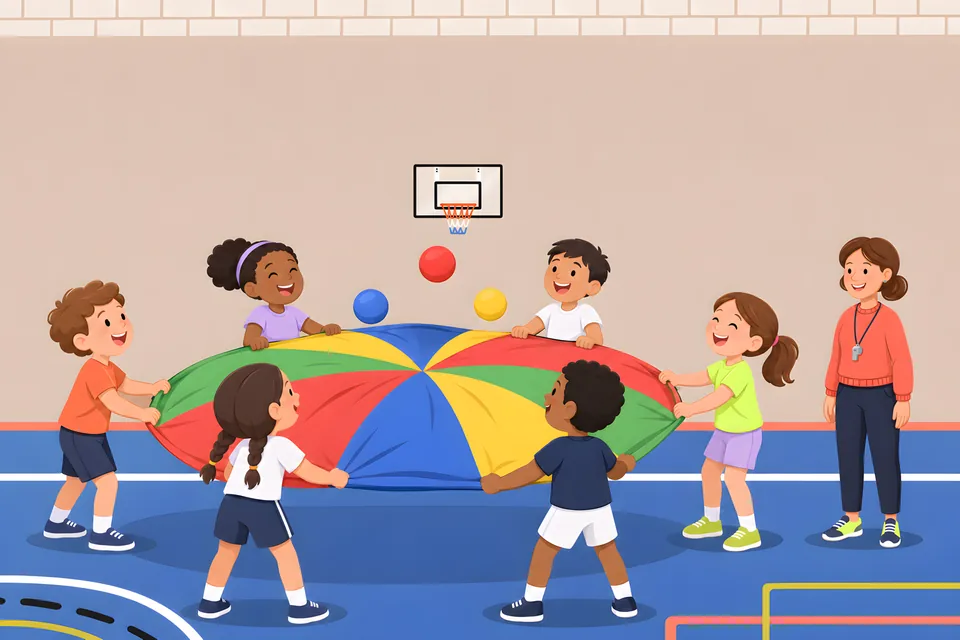
Unit plans for PE cover a few weeks on one topic, such as volleyball, jump rope or dance. A lesson plan covers one class. Plan lessons without the unit and you tend to repeat the same beginner drills each week, then run out of time for the game or performance the unit was building toward.
Plan the unit backward. Decide what students should be able to do on the last day and how you will assess it. Then spread the skills across the weeks: introduce a skill, practice it with changes, add decisions and opponents, and apply it in a modified game or performance. Each lesson starts by recalling the cue words from the day before.
A PE unit plan also holds what stays the same from lesson to lesson: boundaries, signals, how equipment goes out and comes back, and the standards you are teaching toward. The current SHAPE America National Physical Education Standards (2024 edition) have four standards, S1 to S4: motor skills, movement and fitness concepts, social skills and personal skills. They replaced the 2013 edition, which had five standards (S1–S5), so check which version your district still uses for curriculum reviews. The guide on aligning lessons with SHAPE America standards explains how to tag a lesson. For units at the middle school level, see middle school PE unit plans.
Take a Grades 3–4 class learning to dribble with the dominant hand while walking. The objective: students dribble below the waist with their fingertips and look up part of the time. The standard is S1, motor skills. The check is a walk-by where you note who keeps the ball under control. Three cue words carry the skill: fingertips, push, eyes up.
For the setup, every student gets a ball and a spot inside a boundary marked with cones, with a clear walkway between the boundary and the walls. Before anyone dribbles, practice the stop signal: on your whistle, students trap the ball under one hand and freeze.
Mark a start line and a far line, set cones at the corners and stand at the side between the two lines, so the whole group stays in view.
A game that fits is Red Light, Green Light. Students stand along one end line, each with a ball. On “green light” they dribble toward the opposite line at a walking pace. On “red light” they stop and hold the ball still. A student whose ball rolls away walks after it when the path is clear and starts again from the start line; so does anyone who keeps moving on red. There are no points: the goal is to reach the far line with the ball under control. The round ends when every student has crossed. Everyone then walks back to the start line holding the ball, and the next round begins. To change the task, switch hands or add “yellow light” for slow motion.
Add timing last, once you see how the first class handles the ball. Student teachers can also read the lesson plan guide for student teachers. For more examples by grade, see elementary PE lesson plans for Grades K–5.
Teach routines before skills, especially in the first weeks with a new group. Before you ask for anything complicated, students should know where to enter, where to gather, what your stop signal means and how equipment goes out and comes back.
Once class is moving, a few habits matter more than any single activity:
| Problem in class | Likely cause | Fix for the next lesson |
|---|---|---|
| Students wait in long lines | One ball or one station for too many students | Add stations and let pairs share a ball |
| Students ignore the stop signal | The signal was never practiced | Practice it before the first activity in every lesson of week one |
| A few students dominate the game | Unbalanced teams or groups that are too large | Balance teams by skill and play small-sided games, such as 3 vs 3 |
| Time runs out before the game | Too many drills and long explanations | Cut to two activities and demonstrate once |
| Students lose interest after a few minutes | The task is too easy | Add a harder level, a smaller target or a defender |
Keep one activity and vary the task. Offer choices at the same station: a closer or farther target, a larger or smaller ball, with or without a defender. Let students pick a level and move up when they are ready. When you build teams, balance them by skill so games stay close. The Team Creator in the PhysEdPrep app can balance teams by skill from your saved class rosters.
Shrink the play area before you cut the activity. Run more stations with fewer students at each one, so more students are active at once, and share equipment in pairs. Mark boundaries with cones or floor tape, and keep fast running games out of cramped spaces. If another class shares the gym, agree on boundaries with that teacher and leave a buffer between groups.
Classroom lessons work best with slow, controlled movement. Push desks and chairs to the sides, keep aisles open, check the floor, and give each student room to reach out without touching anyone. Balance challenges, rhythm patterns and stretching fit well. Simon Says works too: you or a student leader call actions like “march in place” or “reach up.” Students act only when the call starts with “Simon says.” A student who moves on any other call sits out one call and rejoins on the next. There are no points, and the round ends when the leader finishes the list or calls “Simon says, freeze.” A new leader starts the next round. Skip jumping when the floor is hard or the room is tight. The Classroom Brain Breaks sample on the free units page has more movement breaks for the classroom.
Planning time often goes to rebuilding things you already built. Keep one template, reuse your station layouts, signals and group formations from unit to unit so only the skill changes, and plan a whole unit in one sitting before you write the individual lessons. A short list of games your classes already know covers the days when plan A falls apart.
There are four usual sources for lesson content: your own writing, a district or department curriculum, free lessons shared by other teachers, and a paid, ready-made program. Your own plans fit your students and building best. Free lessons vary a lot, so check the grade level, the space and equipment they assume, the safety notes and whether they match your objective. See also the guide on free lesson plans. A ready-made unit makes sense when you teach an activity for the first time, when you are a classroom teacher without a PE degree, when you need sub plans, or when a department wants consistent units.
In the PhysEdPrep app for iOS & Android, the weekly & yearly planner lets you drag lessons into your week, plan whole units and add your own lessons.
About one page for most lessons: long enough that a substitute could teach from it, and short enough that you reread it before class. That page holds the objective, standard, check, a setup sketch, the rules of each activity and a backup. A routine you have taught many times can be shorter. A new skill, a new group or equipment you rarely use deserves more detail.
Include the class schedule, rosters, where equipment is stored, your stop signal and routines, and the boundaries for each space. Choose one or two activities the classes already know and write their rules out in full. Add your school's emergency and first-aid procedures and who to contact. Avoid new skills and equipment-heavy setups when no one familiar is supervising.
Use your stop signal, gather the group and simplify. Shrink the area, slow the task, remove scoring or give students a closer target. If that fails, switch to the backup game your class already knows. After class, write down what changed so the next plan starts from what actually happened.
Check that the grade range, space and equipment match your program, then run one lesson with a class. PhysEdPrep has 3 free units you can open without an account: Basketball for Grades 5–7, Parachute Games and Classroom Brain Breaks. Yearly plans start with a 7-day free trial, and so do the 12-month plans.
A good objective names one skill, a condition and something you can see. Grades K–2: hop on one foot five times in a row without losing balance. Grades 3–5: dribble while walking, ball below the waist. Grades 6–8: send an overhead pass to a moving teammate in a 3 vs 3 game. Grades 9–12: design and lead a warm-up for a small group.
No federal rule requires it. Your state and district set the standards you plan against, and many state PE standards are built on or adapted from SHAPE America's national standards. Check your district curriculum first, then tag each lesson with the state standard and, if useful, the matching SHAPE standard.
A PE lesson plan has to work while you stand in a gym with a whistle around your neck, so one page beats three.
To align PE lessons with SHAPE America standards without adding paperwork, pick one standard per lesson, write an objective you can…
Middle school PE unit plans work best when they start from clear outcomes, use small-sided games, and give mixed-ability classes an easier…
Open the 3 free units without an account and compare them with your own plans. To get the full library, start a yearly plan with the 7-day free trial in the PhysEdPrep app for iOS & Android; see current prices in the app.
App for iPhone, iPad and Android.