Reaching 50% MVPA in PE Class
In a 30- or 40-minute period with 24 to 36 students, much of the lost movement time comes from routines like roll call, team picks and…
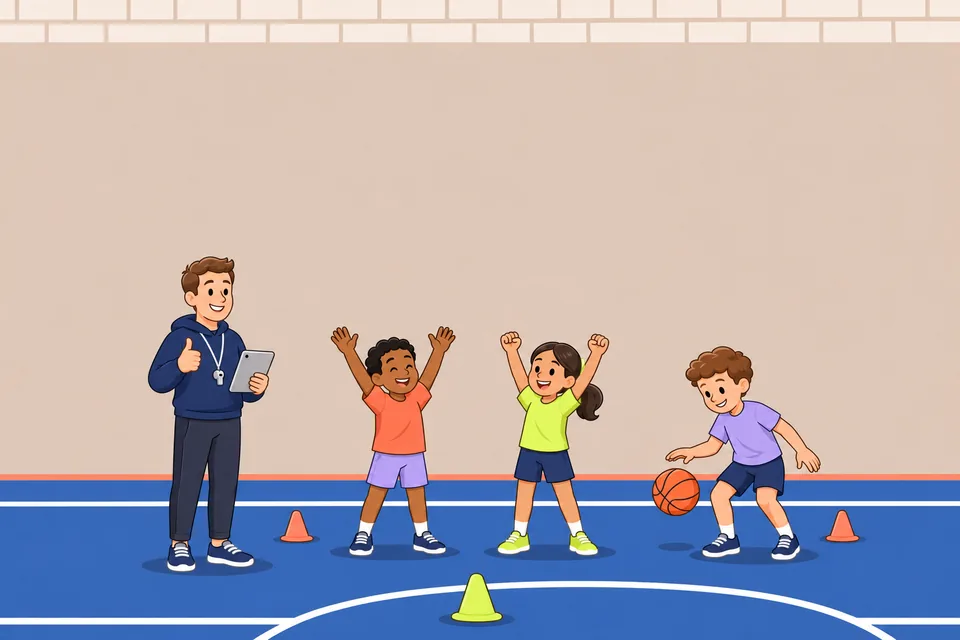
Ten attention getters for PE cover every grade band: four call-and-response signals for Grades K–5, three stop signals for Grades 6–12 and three nonverbal signals for any age. A signal works once students have practiced the exact response, so teach one, rehearse it at walking speed and reward a fast stop with more game time.
This list is for PE specialists, classroom teachers who run PE and first-year teachers who are hoarse by third period. Every entry gives grades, group size, time and a short how-to, followed by steps for teaching a signal, a plan for resetting your attention signals after winter break and a table of common mistakes.
Match the signal to the age first: signals 1–4 suit Grades K–5, signals 5–7 suit Grades 6–12, and signals 8–10 work at any age. Hard walls, bouncing balls and music swallow a raised voice, so every signal below gives students something to do with their hands, feet or eyes.
| # | Signal | Grades | Type | Needs |
|---|---|---|---|---|
| 1 | “Class, class” and “Yes, yes” | K–5 | Call and response | Voice |
| 2 | “Macaroni and cheese” and “Everybody freeze” | K–3 | Call and response | Voice, open floor |
| 3 | Clap pattern echo | K–5 | Call and response | Hands |
| 4 | Freeze poses | K–4 | Call and response | Voice, open floor |
| 5 | Ball down | 6–12 | Verbal cue | Any equipment |
| 6 | Countdown from five | 6–12 | Verbal cue | Voice |
| 7 | Team captain relay | 6–12 | Visual, team-based | Tally board |
| 8 | Raised hand and home base | K–12 | Nonverbal | Marked spot |
| 9 | Music stop | K–12 | Audio | Speaker you can pause |
| 10 | Timer whistle | K–12 | Audio | Countdown timer |
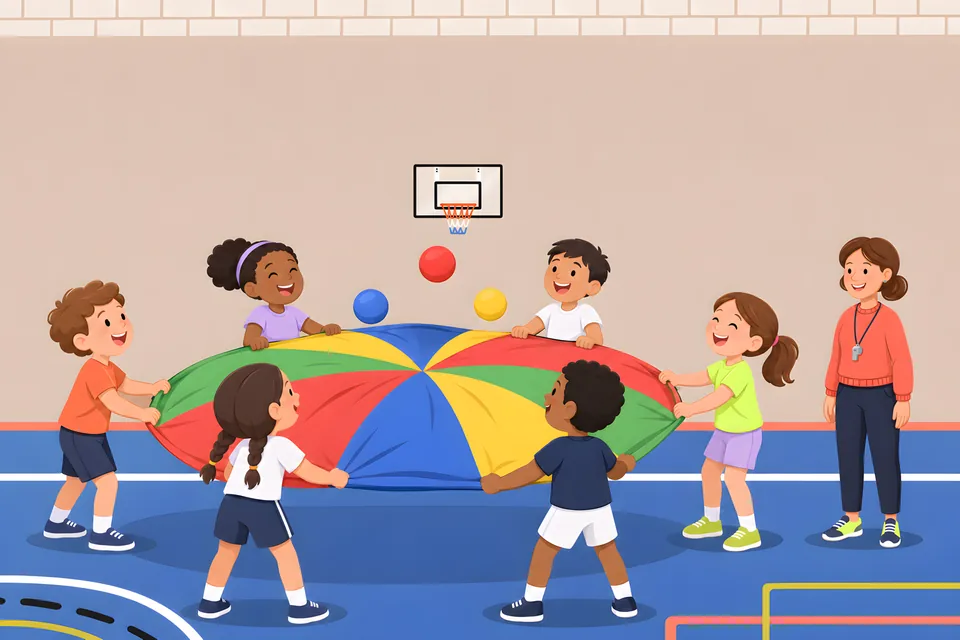
Four call-and-response signals fit Grades K–5 because the answer gives young students a job: freeze, clap or strike a pose.
Grades K–5 · whole class · about 3 seconds · no equipment
Say “Class, class” in a short rhythm or pitch. Students echo the same rhythm with “Yes, yes”, freeze and look at you. Change the voice (whisper, sing, growl) to keep it fresh, and start talking only when the last student is still.
Grades K–3 · tag and locomotor games · about 3 seconds · open floor
Call the phrase during a moving game. Students answer “Everybody freeze” and stop with feet planted and knees slightly bent. Freeze means stop within a step or two, so rehearse at a walk first and keep students about an arm’s length apart on a dry, clear floor.
Grades K–5 · whole class · about 5 seconds · no equipment
Clap a short pattern, such as clap-clap, clap-clap-clap. Students tuck balls under an arm or set them down, clap the pattern back and put both hands on their heads. Test the claps from the far end line to see whether they carry over your usual noise. Use longer patterns in Grades 3–5.
Grades K–4 · whole class · about 5 seconds · open floor
Call “Freeze like a flamingo” (one leg), “tree” (arms up) or “statue”. Students hold the pose silently for a count of three. Let a student name the pose each day, and skip one-leg poses on a slippery floor.
Students in Grades 6–12 answer short, calm cues that treat them like athletes, so skip chants and give a plain instruction with a clear response.
Grades 6–12 · whole class · about 5 seconds · balls, racquets or sticks
Say “Ball down” at normal volume. Students hold balls still under a foot, or lay racquets and sticks flat beside them and out of walking paths, then face you. Give the next instruction only when nothing is moving.
Grades 6–12 · whole class · 5 seconds · no equipment
Count “Five, four, three, two, one” at normal volume, one number per second. At zero, students are still, equipment is still and eyes are on you. If a group is still moving at zero, say nothing and count again. The lost game time is the only cost.
Grades 6–12 · teams of any size · about 10 seconds · whiteboard or scoreboard
Raise a hand. Captains raise theirs and pass it to their teammates. The first team that is silent and still earns a tally. Tallies only go up, so a slow team never loses points. When a team reaches an agreed number, say five, it picks the next warm-up. Reset the count each week. With two teams, you can show the tally on the Scoreboard & Game Counter.
Three nonverbal signals work at any age: a raised hand at a fixed spot, a music stop and a timer whistle.
Grades K–12 · whole class · about 10 seconds · a marked spot
Choose one spot, such as the center circle or a cone on the sideline, and give every set of instructions from there with your back to a wall so you can see the whole class. Raise one hand and wait without talking. Students who see it raise their own hand, pass it on and walk to the spot.
A common variant is “Give me five”: the teacher holds up five fingers, and students answer with eyes watching, ears listening, mouths quiet, hands still and feet still. It suits Grades K–5 and gives the raised hand a checklist students can remember.
Grades K–12 · movement drills and games · instant · speaker you can pause from where you stand
Play music while students move and cut it as the stop signal. Students freeze when the music stops and look at you. Keep the volume low enough to talk over, and cut the music before you give instructions.
Grades K–12 · stations and drills · 1, 3, 5, 10 or 15 minutes, or a time you set · phone or tablet
Start a countdown timer for the drill. At the whistle, students stop, hold equipment still and look at you, so you do not have to shout across the court. The Countdown Timer in the PhysEdPrep app ends with a whistle. Test from the far court whether the sound carries, and see timers with rotation alerts for station rotations.
Flicking the lights is another classic signal, but use it only where the gym stays lit by windows. Skip it in a windowless gym with balls in motion.
On a large outdoor field, during games like capture the flag in PE class, a raised hand may not carry. Pair it with one short whistle blast, and have students stop where they are before walking in.
Teach one signal at a time, and rehearse it at walking speed before you use it in a game.
Students tend to respond faster when a quick stop earns something: more game time, a choice of the next warm-up or a turn as caller. Do not make laps or push-ups the price of a slow stop. SHAPE America’s 2021 position statement calls using exercise as punishment, or withholding PE or recess as a consequence, inappropriate.
Every wait comes out of activity time. SHAPE America recommends moderate to vigorous activity for 50 percent of PE class time. In a 40-minute class, 50 percent is 20 minutes. Six stops that each take 60 seconds to settle cost 6 minutes, 30 percent of that target. At 10 seconds each, you lose 1 minute. The guide to more active time in PE class covers routines that cut wasted time.
Reset in the first class back by re-teaching one signal and rehearsing it at walking speed before any game.
For the rest of your routines, see the first week of PE routines and rules and classroom management in a loud gym.
Six habits make stop signals fail, and each has a quick fix.
| Mistake | Cause | Fix |
|---|---|---|
| Repeating the signal three times | Students learn the first call is optional | Give it once, wait for a count of five, then repeat once, quieter |
| Talking before the last student is still | Early talking teaches students to tune out | Wait for stillness, then thank the group |
| Using a new signal every day | No response becomes automatic | One primary signal, one backup |
| Laps or push-ups for a slow stop | Students link the signal to punishment | Reward a fast stop with game time |
| Freezing from a full sprint | Students collide or slip | Rehearse at a walk, stop within a step or two, keep an arm’s length apart |
| Repeated whistle blasts in a small gym | The sound echoes off hard walls and startles young students | One short blast, or switch to a raised hand or music stop |
Third graders, usually ages 8 and 9, like call-and-response signals with a movement or a twist: “Macaroni and cheese” and “Everybody freeze”, freeze poses and the clap pattern echo. Name a caller of the day who picks the pose or the rhythm, and rotate the job so every student gets a turn.
Give students a reason, a choice and quick success. Say why you are stopping the class, let them choose between two warm-ups or roles, and keep waits short so most of the class stays active. Praise specific behavior, and never use laps or push-ups as punishment.
Change one thing each week: a rule, a role, the music or the team size. Small teams give every student more touches, and jobs such as caller of the day or equipment manager give students a stake in the class. Keep your stop signal the same so the changes do not cost you control.
Yes, when they are short, calm and treat students like athletes. Ball down, countdown from five and the team captain relay fit Grades 6–12, and the raised hand, music stop and timer whistle work at any age. Funny signals land best when students pick them, so let a team suggest a one-word response and retire it when it gets old.
Combine a visual signal with a sound, and stand at a fixed home base so everyone can see you. Raise a hand, cut the music or start the timer whistle, and let captains or station leaders pass it on. Practice the response with the whole group before you use it in a game.
Yes, a whistle works on large outdoor fields and for safety stops, as long as you give one short blast and teach the response like any other signal. Indoors, hard walls make a whistle echo. Repeated blasts can also startle young students or students who are sensitive to noise. In a small gym, a raised hand, a music stop or a countdown usually works better.
Visual signals work best for these students. Use a raised hand at a fixed home base, a picture card or a hand sign the class agrees on, and pair it with a peer buddy who taps a shoulder. Check the student's IEP or 504 plan for agreed supports. Keep sound signals short and quiet for students who are sensitive to noise.
In a 30- or 40-minute period with 24 to 36 students, much of the lost movement time comes from routines like roll call, team picks and…
Capture the flag is a two-team tag game: each side guards a flag on its own half of the gym or field and tries to carry the other team's…
When students return from outdoor recess or a loud hallway transition with racing voices, jumping straight into a lesson rarely works.
Download the PhysEdPrep app for iOS & Android and try the 3 free units without an account before the first bell. Yearly and 12-month plans start with a 7-day free trial that includes all 6 gym tools, such as the Countdown Timer for your stop whistle; see current prices in the app.
App for iPhone, iPad and Android.