Standards
Building an Adaptive PE Curriculum
An adaptive physical education curriculum connects your school's general K–12 movement scope and sequence with the motor goals in each…
Lacrosse works in PE when the sticks and balls are soft and every student has room to move. Lacrosse PE lesson plans start with a fixed skill order, enough sticks and floor space, and no-contact rules set before the first scrimmage; mixed-ability options and a way to check stick skills during play come next. Soft-stick lacrosse fits K–12 classes in a gym or on a field.
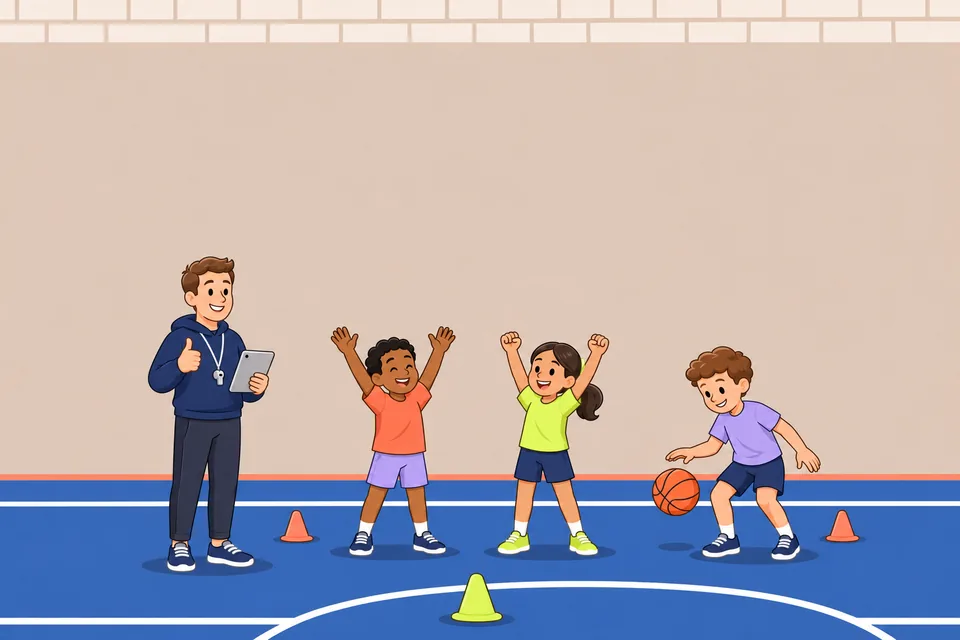
Teach soft-stick lacrosse in a fixed order: grip and cradle first, then scooping, then throwing and catching with a partner, then short small-sided games. Use one soft stick per student, soft balls, and no-contact rules from the first lesson. Keep passing in pairs instead of long lines so students stay active, and assess a few students per class with a simple checklist.
Plan one soft stick and about one soft ball per student, because cradling and scooping drills need a ball for each person. For a class of 24, that is 24 sticks and roughly 30 balls, with spares for the ones that roll under the bleachers. Hard rubber lacrosse balls carry a different injury risk and belong to programs that issue protective gear. For a beginner class, use soft, pliable balls and ask your administrator about district rules on eyewear and other gear before the unit starts.
The rest of the kit is probably in your equipment room already:
Let each student pick a top hand in the first lesson and switch to the other side once the cradle is steady. If your stick heads are symmetrical, students can change hands without changing sticks.
Start with grip and cradle. A student who cannot hold the ball in the pocket has nothing to do after a scoop or a catch, so stick control comes first. Scooping comes next because it ends in a cradle and makes loose balls playable. Throwing and catching with a partner follows once students trust the pocket. The USA Lacrosse PE curriculum, described on the SHAPE America blog, lists the same early order for grades K–2: stick introduction, cradling, scooping, then throwing.
| Skill block | Look-fors | Lead-up activity |
|---|---|---|
| Grip and cradle | Top hand near the head, bottom hand at the butt end, forearms rock the stick, head upright by the ear | Cradle on a personal spot, then walk a cone course |
| Scooping | Knees bent, stick head flat on the floor, scoop through the ball and rise into a cradle | Scoop a stationary ball, cradle three steps, drop it in a hoop |
| Throwing and catching | Step toward the target, top hand pushes, bottom hand pulls; catch on a target stick and give with the ball | Close-range partner passes, then wall passes |
| Moving with the ball | Cradle at a jog without losing the ball; pass and catch on the move | Pass-and-follow in pairs along lanes |
| Small-sided games | Pass to open teammates, shoot below shoulder height, defend without contact | 3-on-3 with cone gates (rules below) |
Older classes add tactics. The same curriculum lists dodging, on-ball defense and stick protection for grades 6–8, and the draw, team preparation and game analysis for grades 9–12. For another stick-and-ball unit, see our floor hockey guide. Our team handball guide covers a game with the same passing and open-space tactics, played without sticks.
Skip long passing lines. SHAPE America recommends 50 percent of class time at moderate-to-vigorous intensity (dodgeball position statement), and eight students waiting behind one thrower work against that. Use pairs in separate lanes.
| Activity | Group | Space (about) |
|---|---|---|
| Cradling and scooping | Whole class on personal spots | Spots 10 ft apart |
| Partner passing | Pairs | 10 ft between partners, lanes 10 ft apart |
| Wall passing | One student per spot | 6 ft of wall per student |
| 3-on-3 or 4-on-4 | 6 to 8 players | One half basketball court (42 × 50 ft on a high school court) |
On grass, walk the field before class and check for holes and wet spots. Indoors, collect loose balls between rounds, because a ball under a sneaker is a slip risk.
Partner Pass Streak turns the pairs setup into a game. Partners stand about 10 ft apart and throw to each other's stick during a one-minute round, counting consecutive catches. A drop, or a throw the partner cannot reach with one step, resets the count to zero; the player who dropped it picks the ball up by hand and the pair starts counting again at once. A pair's score is its best streak of the round. The round ends at the whistle; the Countdown Timer in PhysEdPrep has a 1-minute quick pick with a whistle at the end. Balls that roll out of a lane are collected at the whistle, and a pair that loses its ball takes a spare from the bin. Pairs with a streak of 8 or more can step back one pace for the next round; adjust that threshold to your class.
Read these rules aloud, ask students to repeat them back, and practice the stop signal once at walking speed. A soft stick or ball can still hurt a shin or a face at close range.
Gate Lacrosse is a first scrimmage built on these rules. Play 3-on-3 or 4-on-4 on a half court. Each team defends a gate of two cones about 6 ft apart on its end line, with no goalie, so no shot is aimed at a person. A team scores one point when it passes or shoots the ball through the other gate below shoulder height after at least two passes. A dropped ball or an out-of-bounds pass is a turnover: the player who lost it picks the ball up by hand and gives it to the nearest opponent, who restarts with a pass from that spot (or from the boundary line after an out-of-bounds pass) while defenders stay an arm's length back. A contact foul gives the ball to the fouled team at the same restart. Flip a coin for first possession: that team starts with a pass from behind its own gate, and after a goal the team scored on restarts the same way. Keep the area behind each gate clear of people, because missed shots roll or fly past the end line. A game ends at 5 goals or at the whistle, then teams rotate to a new opponent.
The USA Lacrosse curriculum, as the SHAPE America blog describes it, uses R.E.E.L. (Rules, Equipment, Environment, Learning Strategies) as a memory aid for modification options. Here is one way to apply each; change one at a time and let students pick their level.
Mix levels on every team. The Team Creator in PhysEdPrep builds teams at random, balanced by skill or split by gender from your saved class rosters. Our guide to fair ways to pick teams without captains covers more options. For individual accommodations, follow each student's IEP or 504 plan, and see our guide to building an adaptive PE curriculum.
Choose four to six students per lesson, tell the class what you are looking for, and mark what you see during rotations or scrimmages. Over a unit of about 6 to 8 lessons, that covers a class of 24 once or twice. Use three levels: not yet, developing, secure. A roster with one column per skill and one letter per mark is enough.
| Skill | Secure | Developing |
|---|---|---|
| Cradle | Ball stays in the pocket for about ten steps at a jog, stick upright | Ball falls out when the student speeds up or turns |
| Scoop | Gets low, scoops through the ball and rises into a cradle without stopping | Stops, slows down, or uses a hand |
| Throw | Steps toward the target; ball reaches the partner's stick between waist and shoulder | Arm-only throw, ball arrives off target |
| Catch | Offers a target stick and pulls it back on contact | Stick stays stiff, ball bounces out |
Tie each skill to a standard. In SHAPE America's 2024 National PE Standards, stick skills fall under S1 (motor skills), and keeping the no-contact agreement and sharing the ball show up under S3 (social skills). Our guide to PE lesson plans and the SHAPE standards covers how lessons connect to them.
Start with the USA Lacrosse physical education curriculum: the SHAPE America blog post links to its elementary and secondary "Lacrosse in Schools" lesson plans on SHAPE America's downloads page and describes skills by grade band (K–2, 3–5, 6–8, 9–12). Check that page for the current file format and access terms, since links on older posts can change. Compare any teacher-shared PDF with your equipment, space and no-contact rules before you use it.
Plan about 5 to 10 lessons, one or two for each skill block from grip and cradle to small-sided games. A class with no stick experience needs the upper end. Classes that already know stick-and-ball games such as floor hockey may need fewer lessons on cradling and scooping.
No. Use cone gates or hoops as targets so no shot is aimed at a person. Add a goalie only after your district approves the equipment and rules for it, and keep every shot below shoulder height until then.
Yes. Split the class in half: one half works with sticks in pairs while the other half feeds balls by underhand toss or observes with a checklist, then swap at the whistle. In scrimmages, run two 3-on-3 games with the 12 sticks while the other students keep score and watch for contact fouls, and swap after each game.
Usually not for the setup in this guide (soft balls, soft sticks, no contact), but your district's policy decides, so ask your administrator before the unit. Each lesson plan in the USA Lacrosse PE curriculum has an equipment box at the top, so check it for every lesson you borrow. A harder ball or contact play changes the safety plan and usually calls for protective gear.
An adaptive physical education curriculum connects your school's general K–12 movement scope and sequence with the motor goals in each…
Good SHAPE America national standards PE lesson plans start with a clear objective taken from the four standards (S1–S4) and the…
When captains pick teams one student at a time, it eats class time and often leaves the same kids standing there last.
Download the PhysEdPrep app for iOS & Android, try the 3 free units without an account, and use the Team Creator and timers on your next lacrosse day. Memberships are bought in the app, and the Yearly plan starts with a 7-day free trial; see current prices in the app.
App for iPhone, iPad and Android.