Unit plans
Elementary PE Lesson Plans, K–5
Good elementary PE lesson plans K-5 share the same few parts: one objective, a floor setup, a skill focus, a game that uses the skill, and…
Every score, jump distance and rep count in PE is already a number. Math PE lesson plans put those numbers to work in Grades K–5 games, so students count and measure while they move. That keeps activity time high and hands the classroom teacher real results to graph.
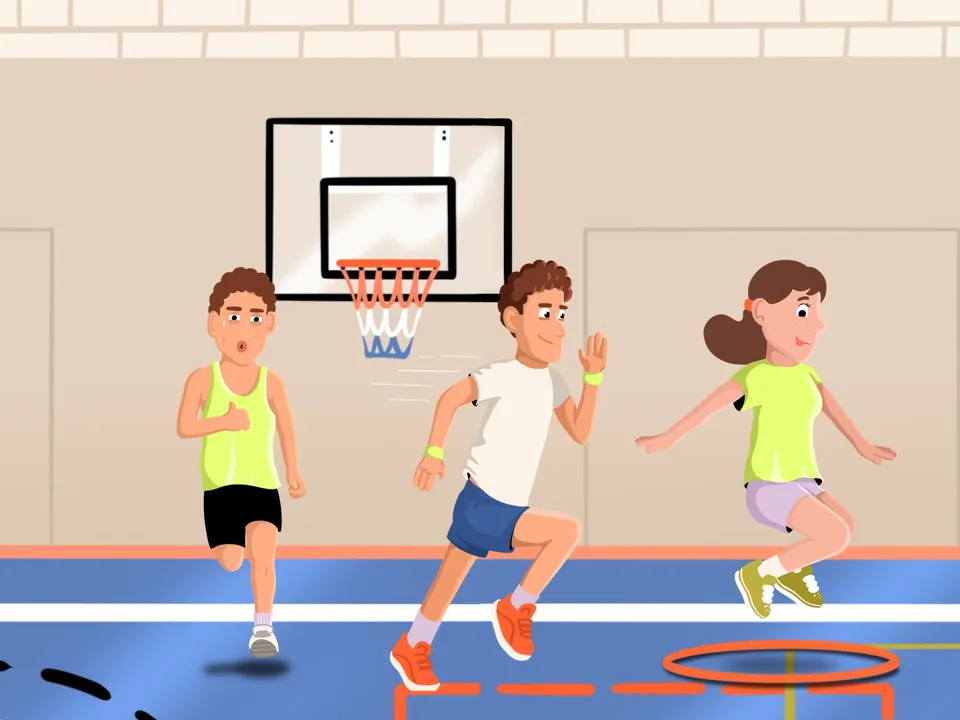
Math fits into PE when the math is the scoring, counting, measuring or timing that a game already needs, and students answer by moving. Pick one math skill per class, such as counting in Grades K–2 or distance and scores in Grades 3–5, and keep thinking pauses short. SHAPE America recommends moderate-to-vigorous activity for 50 percent of class time.
Let the game produce the numbers. Scores, rep counts, jump lengths and rotation times already exist in PE class, so math can be the way students keep score, check a result or choose a move while the movement stays the main event.
The PE objective still comes first. Pick a movement goal, such as underhand throwing or changing direction, and name the math skill second. SHAPE America's 2024 National PE Standards (S1–S4) cover motor skills, movement and fitness concepts, social skills and personal skills, so each math task serves a PE goal.
A math task belongs in the gym if it passes three checks:
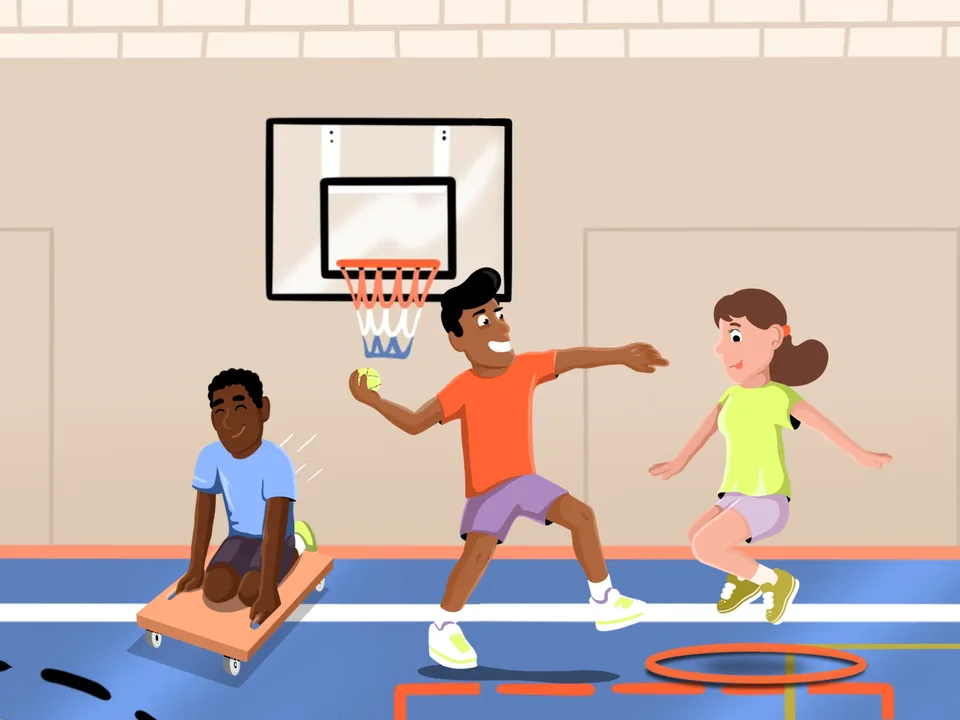
Counting, comparing, measuring and tallying fit the gym because the equipment gives students something to count or measure. Long written computation does not fit. The grades below are typical starting points. They follow the Common Core State Standards for Mathematics, which many states use or have adapted: Counting and Cardinality in Kindergarten (K.CC), finding the number that makes 10 (K.OA.A.4), multiplication within 100 in Grade 3 (3.OA) and line plots from measurement data from Grade 2 on (2.MD). Match them to the math sequence your school uses.
| Math skill | Gym task | Grades |
|---|---|---|
| Counting and skip counting | Count hops or bounces aloud; skip count by 2s, 5s or 10s while traveling along a line | K–2 |
| Number bonds to 10 | Fill a ten frame made of hoops with beanbags and name the empty spaces | K–2 |
| Addition and subtraction | Add the point values of bags that land in floor targets; find how many more reach a goal | 1–3 |
| Multiplication | Total equal groups: 3 bags in a 5-point target is 3 × 5 | 3–5 |
| Measurement | Estimate, then measure a standing long jump with a tape | 3–5 |
| Time and rate | Count reps in a timed round and compare rounds | 3–5 |
| Data and graphs | Tally class jump lengths or shot attempts and plot them | 3–5 |
| Fractions | Split a group of 12 into halves, thirds and quarters and name each part | 3–5 |
Young students count best when every number is a place to go or an object to move. Two games cover a lot of K–2 number work and need only number spots, hoops and beanbags.
Scatter number spots from 0 to 10, two of each, with a few steps of clear floor around every spot. Call a prompt and a locomotor skill: “Gallop to 2 more than 5” or “Hop to the number that makes 10 with 6.” Students travel to any correct spot while you count down from 5. Students on a wrong spot check with a neighbor and move. Nobody sits out and nothing is scored. Call the next prompt from wherever students stand, and stop after about 10 prompts or sooner if energy drops. Tape the spots down or use gripped ones, because loose spots slide on polished floors. Switch from hopping to walking if the floor is slick.
Lay 10 hoops in two rows of five for each team of four or five, and put 10 beanbags in a pile about 20 feet away. Call a number such as 7. One student at a time carries a single bag to the frame, places it in a hoop (no throwing), jogs back and tags the next student. When the frame shows 7, the team sits and says, “7 filled, 3 empty.” The first team to say it correctly scores a point. If the count is off, the team fixes the frame and says it again. The last student returns the bags to the pile before the next number. Play to 5 points, with team lanes about 6 feet apart. For the wider planning routine, see Elementary PE Lesson Plans, K–5.
By Grades 3–5, students produce numbers worth working with: how many points, how far, how close to a goal.
Groups of three share a throwing line and four floor targets (hoops or poly spots) at 6, 9, 12 and 15 feet, worth 1, 2, 3 and 5 points. One student throws five beanbags underhand, one at a time, while a partner calls the running total after each throw. A miss scores 0. The goal is a final total as close to 15 as possible, and the gap from 15 is the thrower's score. The third student collects the bags after the fifth throw, and roles rotate each round. After three rounds the smallest gap wins, and ties share the win. For multiplication, count the bags in each target first: 3 bags in the 5-point target is 3 × 5. Use soft beanbags only, throw toward the targets and never at people, and keep everyone behind the line until the fifth bag lands.
Partners take turns with a standing long jump. The jumper estimates the length in feet and inches and jumps. The partner measures from the takeoff line to where the closest heel lands, then records the estimate, the actual length and the difference. As an extension, convert the length to inches (× 12). Post the class lengths on a chart so the group can build a line plot. Use one jumper per lane with clear floor ahead, a dry flat surface or mats, and laced shoes.
Timed rounds make rate easy to feel. Set equal rounds of work and rest on any interval timer, such as the Structured Interval Timer in the PhysEdPrep Gym Tools. Partners alternate: one does step-ups or jumping jacks while the other counts, then they swap each round. After four rounds, students find the total reps and the difference between their best and lowest round.
Pulse counts add multiplication. Students find the pulse at the wrist, count beats for 15 seconds and multiply by 4 to get beats per minute. They compare a resting count with a count after a minute of jogging in place, then subtract. Keep the numbers private or report only the class range so nobody feels ranked. Students excused from vigorous activity can still count and calculate for a partner.
A weekly log extends the work beyond the gym. The Physical Activity Guidelines for Americans call for 60 minutes or more of moderate-to-vigorous activity daily for ages 6–17, which is 420 minutes a week (60 × 7). Students total their own minutes and find the gap. Treat the guideline as a weekly target and keep it out of the grade.
SHAPE America recommends moderate-to-vigorous activity for 50 percent of class time, a figure it cites in its dodgeball position statement. In a 40-minute class that is about 20 minutes of moving, and every math pause eats into that time. A workable limit is about 10 seconds per stop. If students need longer to solve a problem, the math belongs in the classroom first.
| Problem | Likely cause | Fix |
|---|---|---|
| Students line up to answer | One answer at a time | Everyone answers at once by traveling to a number spot or hoop |
| Class sits while you explain the math | New concept taught in the gym | Preview the skill and vocabulary in the classroom, then use the gym for practice |
| Fast finishers stand around | One difficulty level | Give finishers a second step, such as adding two numbers or a larger target total |
| Scoring takes longer than playing | Hand tallies on paper | Assign one scorekeeper per group |
| Students freeze on a wrong answer | Public right-or-wrong calls | Partner checks, a number line on the floor, no elimination |
For two-team games, the Scoreboard & Game Counter in the Gym Tools shows points and game time big enough to read across the gym (details in the scoreboard and game counter guide), and the Countdown Timer ends a round with a whistle.
The classroom teacher knows which math skill students are working on, and the PE teacher knows which games can carry it. A short exchange before the unit starts is enough:
Classroom teachers who run PE themselves can start with the guide to teaching elementary PE as a classroom teacher. Short movement breaks suit the classroom itself; see brain breaks and active classroom games. For students with IEP or 504 plans, the guide to building an adaptive PE curriculum is a starting point, and the student's plan and team decide which modifications apply.
Yes, when the numbers come from the sport itself. Students can calculate shooting percentages, compare lap pace or schedule a tournament. A round-robin with 6 teams needs 15 games (6 × 5 ÷ 2), and the Tournament Planner in PhysEdPrep generates round-robin schedules for 2 to 10 teams on up to 4 courts.
Grade the movement outcome and treat the math as a quick check for understanding. A student who throws accurately but misadds the total has still met the throwing goal, and you can fix the sum on the spot. What counts toward the PE grade is set by your district's grading policy.
Most games use what a school gym already owns: poly spots or taped numbers, hoops, beanbags, cones, a measuring tape and a clipboard. Foam dice add random numbers for addition and multiplication games. Use soft beanbags or foam objects for anything thrown, aim throws at floor targets, and never throw at people.
Pair them with a partner, mark a number line on the floor, and allow a neighbor check before anyone moves. Offer smaller numbers in the same game, for example targets worth 1, 2 and 3 instead of 1, 2, 3 and 5. Avoid elimination and public right-or-wrong calls, so a wrong answer costs a few seconds and not a turn.
Tape a grid of two rows with five squares each on the floor, or lay out 10 poly spots per team. With hoops, a class of 25 in teams of five needs 50 hoops, which few gyms own. Taped grids lie flat, so nobody trips on a hoop edge during the relay, and they also work for Number Spot Hop.
Good elementary PE lesson plans K-5 share the same few parts: one objective, a floor setup, a skill focus, a game that uses the skill, and…
Teaching elementary PE as a classroom teacher means running a full class in a gym, on a field or between desks without a PE degree behind…
A good brain break starts within a minute and ends on a signal everyone knows.
Try the 3 free units, no account needed, to see how a full PE unit is built, then use the Gym Tools for scoring and timing. Memberships are bought in the app, and yearly plans start with a 7-day free trial; see current prices in the app.
App for iPhone, iPad and Android.