Games & warm-ups
Rainy Day Indoor PE Games for Small Spaces
Rainy day indoor PE games in a classroom need a clear patch of floor and rules that are quick to explain.
When an assembly, a testing day or a second class takes half your gym, the students still show up. PE games for small spaces work when you cut waiting time and control how fast students move. A hallway lane, a stage or half a cafeteria can hold a full class when every group has its own zone and every game has clear rules.
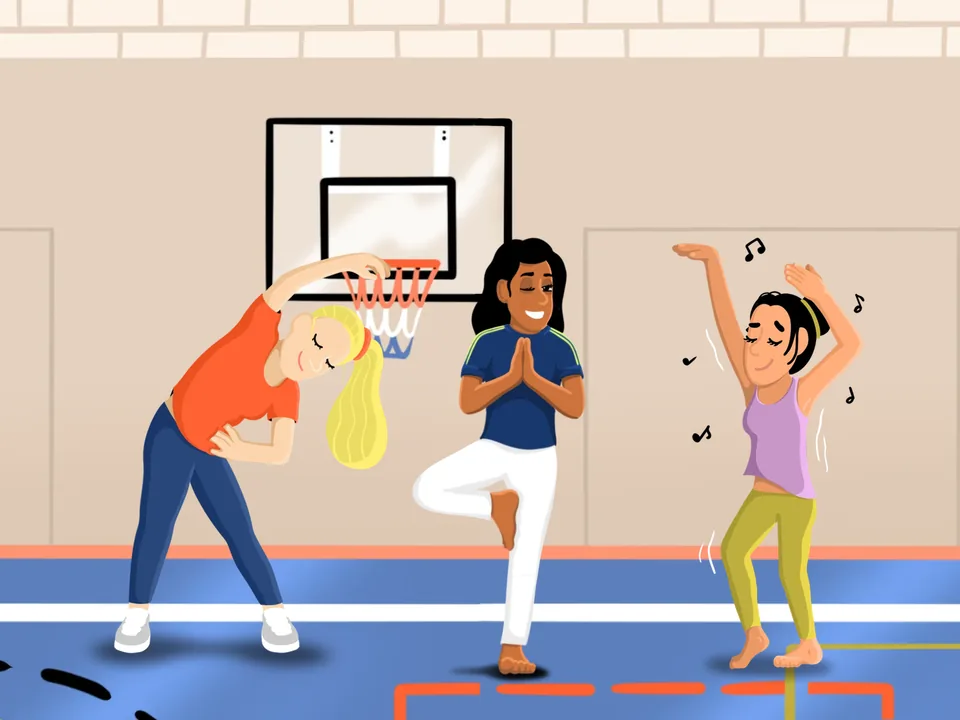
Pick games where students stay on a spot or in a marked zone, work at short range and move at walking speed. Balloon volleyball, partner pass streaks, hoop toss ladders and walking-only zone tag fit an area about the size of a pickleball court (20 × 44 ft) when you split the class into groups of about 4 to 6. Cut waiting time first, then slow the movement down.
The class size stays the same and the floor shrinks. That changes how far students can travel, how long they wait for a turn and how much room a stumble needs. Fix those three and most of your usual games survive in a smaller area.
Start with a measurement. Pace off a rectangle of 20 × 44 feet, the size of a pickleball court. That is 880 square feet, or about 37 square feet each for 24 students. Where your space is smaller than that, favor in-place and partner games. Where it is larger, walking lanes or light jogging may be possible. Watch the first minute of any game: if students keep swerving around each other, slow the rule down or add a boundary.
Waiting is the second problem. SHAPE America's recommendation, cited in its dodgeball position statement, is moderate-to-vigorous activity for 50 percent of PE class time. A line of eight students behind one hoop works against that. In a small space, shrink the group before you shrink the game: pairs and groups of about 4 to 6 keep everyone touching a ball or moving. If your roster is big as well as your space being small, see PE games for large classes for ways to group a full roster.
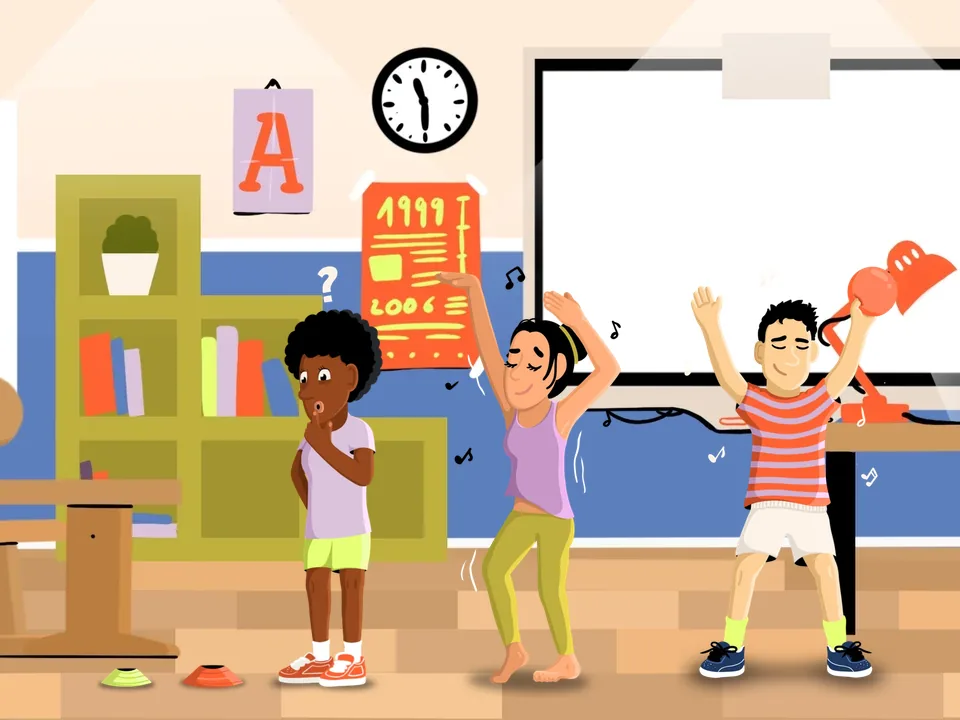
In-place games fit the tightest rooms: a stage, a cafeteria with the tables pushed back, a hallway lane. Each student keeps a spot, and the game comes to the student.
Two teams of 4 to 6 face each other across a tape line or low rope, standing or sitting on the floor. Each team may touch the balloon up to three times, and at least two different players must touch it before it crosses. A team gives the other side a point when the balloon lands on its side, leaves the marked area after its touch, a player hits it twice in a row, a team uses a fourth touch, or the balloon crosses after touches from only one player. The team that just scored taps the next balloon over from its own spot. Play to 7, then rotate one spot and start again. Use latex-free balloons if any student or staff member has a latex allergy, and pick up popped pieces right away.
Each group of 4 to 6 picks six in-place exercises, one per number on a die: squats, wall sits, slow mountain climbers on a mat, high knees on the spot. A student rolls, the group does 10 controlled repetitions (a 10-second hold for wall sits), and the next student rolls. The group aims for a target such as 12 rolls before the timer ends. If it falls short, it counts its rolls and tries to beat that number next class. Offer an easier version of each exercise. Never hand out the dice as a consequence for losing a game: SHAPE America calls exercise as punishment inappropriate.
Short-range challenges give students many repetitions in a few square feet, and every pair can work along one wall or in its own lane. The score is a number the pair tries to beat, so nobody waits for a winner.
Each pair lays three hoops flat in a line, about 3, 5 and 7 feet from a tape line for grades 3–5 (move them closer for younger students). Partners alternate underhand tosses until each has thrown five beanbags. The nearest hoop scores 1 point, the middle one 2 and the farthest 3. A bag that misses every hoop scores 0 and stays where it landed until both partners finish, so nobody walks into a toss. Partners add their points, record the total out of 30, and play again to beat it.
Partners stand on tape marks 8 to 10 feet apart (6 feet for younger students), with all pairs in parallel lanes running the same way. They chest-pass or bounce-pass a foam ball and count consecutive clean catches. A drop, or a pass that makes the partner leave their mark, resets the count to zero, and the player who made the error starts the next streak. Each pair records its best streak when the timer sounds. To raise the level, add a pivot before the pass or a one-bounce rule. Keep passes below head height and never across another lane.
Divide the room by group instead of treating it as one big floor. Zones keep each game small, make turns short and let you see every group from one spot. Mark them with cones, tape or flat spots, and give each zone a clear edge.
The sketch shows a half gym split into four zones of 4 to 6 students: Zone 1 for zone tag, Zone 2 for the hoop toss ladder, Zone 3 for pass streak lanes and Zone 4 for fitness dice. A buffer to the divider separates you from the other class. From the teacher spot you can see every zone.
| Space | Layout | Games that fit | Extra rule |
|---|---|---|---|
| Half gym | 2–4 zones of 4–6 students, cones at the corners | Zone tag, hoop toss ladder, pass streak | Keep a clear buffer from the other class or divider |
| Hallway | Pairs in parallel lanes along one wall, all set up the same way | Pass streak (rolling for K–2), fitness dice | Soft equipment; no through traffic; exits, doors and stairwells stay clear |
| Stage | Spots along the back | Fitness dice, seated balloon volleyball | In-place only; nothing near the edge |
| Cafeteria | Tables folded or pushed to the walls and locked | Balloon volleyball, fitness dice | Walking only; floor dry and clean |
| Blacktop corner | Cone boxes away from traffic | Pass streak, hoop toss ladder | Check the surface and the heat first |
Three of the Gym Tools in the PhysEdPrep app for iOS & Android help with zones. The Countdown Timer has quick picks for 1, 3, 5, 10 or 15 minutes with a whistle at the end, the Structured Interval Timer runs equal rounds of work and rest, and the Team Creator builds groups at random, by skill or by gender. For more blacktop options, see Outdoor PE Games When the Gym Is Closed.
You control five things: speed, direction, equipment, boundaries and the floor. State the rules before the first round and teach one stop signal everyone knows, such as a raised hand.
Split the class into zones of 4 to 6 students. In each zone, one student wears a pinnie as the tagger. Everyone walks, and the tagger tags with a light two-finger tap on the shoulder or upper back. A tagged student takes the pinnie and becomes the tagger, who counts to five silently before moving so nobody is tagged straight back. A student who runs or steps outside the zone freezes for a count of three. The goal is to not hold the pinnie when the whistle sounds, and nobody keeps score. The round ends at the whistle. Pick new taggers, rotate zones clockwise and restart.
Most space losses are on the school calendar: assemblies, testing days, shared-gym days. Ask the office for those dates each term and prepare a small-space version of the lesson before the day arrives.
Classroom Brain Breaks, a classroom sample pack with 13 movement breaks, is one of the 3 free units and needs no account.
Yes, for in-place and partner activities. Push desks to the walls or use the open center, tuck chairs in and check that the floor is dry and shoes are tied. Seated balloon volleyball, fitness dice with low-impact exercises and movement breaks fit. Running and hard-ball throwing do not. On slick tile floors, keep to stand-in-place work, and supervise the whole room.
Most do with changes. Lengthen the pass distance only as far as the lanes stay clear, add a pivot or one-bounce rule to the pass streak, and let students choose the exercises for fitness dice. Use smaller hoops in the hoop toss ladder. Tag stays walking-only at every age. Older students also handle partner-led stations well.
Choose quiet equipment first: beanbags, foam balls and balloons instead of hard or bouncing balls. Use games where students stay on a spot, and set a raised-hand signal for stop and start instead of a whistle. Agree on a volume level with the neighboring teacher before class, since hallway and cafeteria noise carries.
Use short-range tasks that produce a number. Pass streaks give each pair a best streak, and the hoop toss ladder gives a pair total out of 30. Record those once or twice, and watch one cue per zone, such as eyes on the target. These checks fit the motor skills standard (S1) in SHAPE America's 2024 National PE Standards.
Rolling partner passes, seated balloon volleyball and a hoop toss with the hoops about 2 to 4 feet from the line fit K–2 best. Give one-step instructions, show each game once and keep groups to about 4. Use large beanbags and foam balls. Balloon pieces are a choking hazard for young children, so pick up popped pieces right away and watch every zone.
Rainy day indoor PE games in a classroom need a clear patch of floor and rules that are quick to explain.

Outdoor PE games when the gym is closed need different planning than gym games: no walls, no painted lines and a surface you did not pick.
A sick call at 6 a.m. leaves a substitute with a gym, a roster and a bin of equipment.
Get the PhysEdPrep app for iOS & Android to split your class into zone groups with the Team Creator and time each zone rotation with the Countdown Timer. The 3 free units need no account.
App for iPhone, iPad and Android.