Games & warm-ups
PE Games for Small Spaces and Half Gyms
When an assembly, a testing day or a second class takes half your gym, the students still show up. PE games for small spaces work when you…
Teaching 35 to 60+ students in a single gym or combined class period turns standard single-ball games into long waiting lines and off-task behavior on the sidelines. PE games for large classes fix that with continuous play, quick reentry tasks instead of sitting out, and several courts running at once. Below are two whole-group games, floor layouts for small-sided play, and a multi-court tournament for Grades 4–12.
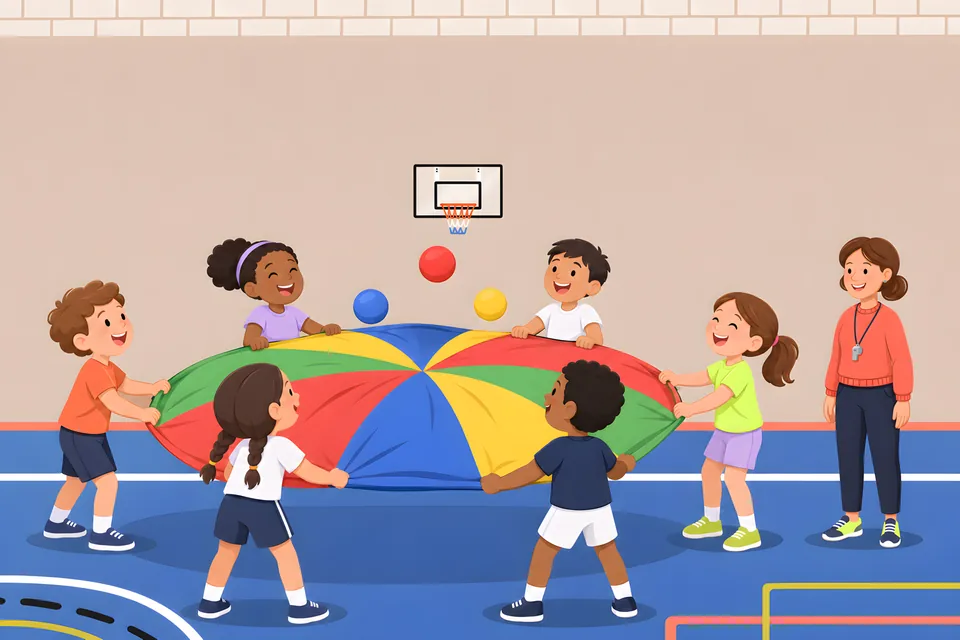
Good PE games for large classes replace player elimination and single relay lines with continuous-play zones, 10-second reentry tasks, or four parallel mini-courts. SHAPE America's benchmark is at least 50 percent of class time in moderate-to-vigorous activity. As a rule of thumb, keep relay or station groups around 4 to 6 students and aim for one foam ball or beanbag per 3 to 4 players.
When a single PE class grows to roughly 35 to 60 students because of combined homerooms or double-booked gym time, traditional two-team games with one ball leave most of the roster standing still. According to the SHAPE America position statement on dodgeball and MVPA, K–12 physical education classes should engage students in moderate- to vigorous-intensity physical activity for at least 50 percent of class time, while traditional elimination dodgeball (hitting players out with a ball) is considered inappropriate for K–12 PE.
The Physical Activity Guidelines for Americans (2nd edition) from the U.S. Department of Health and Human Services state that children and adolescents ages 6 through 17 should do 60 minutes or more of moderate-to-vigorous physical activity daily, with muscle- and bone-strengthening activity on at least three days a week.
In a 45-minute period with 45 students, waiting in a 15-person line for one turn at a cone can push active time well below that 50 percent target. High-headcount classes work best when you put roughly one piece of equipment in play for every 3 to 4 students, swap sitting out for instant reentry tasks on the perimeter, and split the basketball floor into four cross-court zones.
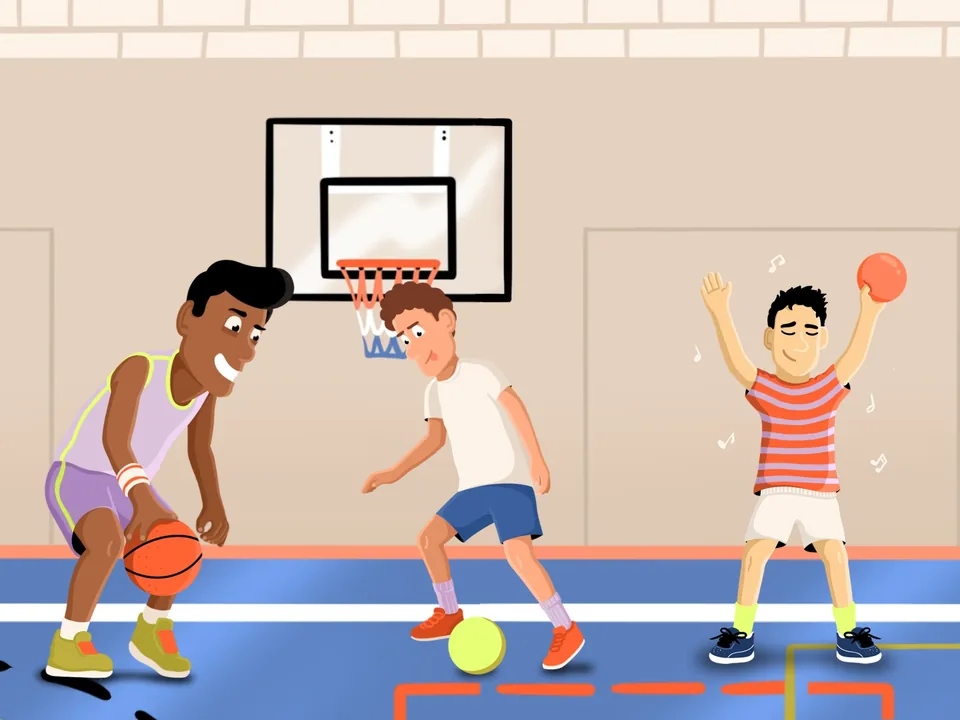
Whole-group games keep roughly 30 to 60 students active when nobody sits on the bleachers. Mark a 6-foot safety buffer from walls on a clean, non-slip floor and supervise from the perimeter with the whole floor in view.
Two teams of about 15 to 25 players stay on opposite halves of the gym with 10 foam pins per baseline and 12 soft foam balls. The goal is to knock down opposing pins with knee-high floor rolls while keeping your own pins standing. Each pin still down when the round ends scores 1 point for the other team, and defenders can stand one fallen pin back up each time they complete 5 squats behind their baseline. Balls thrown in the air or rolling out of bounds do not count; a player retrieves the ball from the sideline and restarts from their half. A player who crosses the center line hands any ball they hold to the other team and touches their own baseline before rejoining. A round ends after about 4 minutes or when all 10 pins on one side are down at once, then teams reset all pins at the baseline.
Four teams start at corner hoops set 8 feet from the walls and try to collect the most beanbags from a center pile of 50 bags. Every player jogs (no sprinting or diving) to carry one beanbag at a time into their home hoop for 1 point, taking bags from the center pile or from opposing hoops, never from a player's hands. Throwing a bag, carrying two at once, or guarding within 6 feet of a hoop is a fault: the player returns any bag to the center pile and restarts from their home hoop. The round ends after about 3 minutes on the whistle, scores are counted, and all bags return to the center.
For a whole-field game that holds 40 or more players outdoors, see Capture the Flag in PE class. For more whole-group ideas, browse these classic gym games worth bringing back.
Splitting a basketball court widthwise into four cross-court zones gives 36 to 48 students four games at once, with teams of 4 to 6 and substitutes rotating in on each whistle. Small-sided setups fit the SHAPE America National Physical Education Standards (2024 edition), released in March 2024 for K–12 PE in the US. The four standards, S1 to S4, are motor skills, movement and fitness concepts, social skills, and personal skills; they replace the 2013 edition with five. If your gym is smaller or shared, see these PE games for small spaces and half gyms. On days you are stuck in a classroom, try these rainy-day indoor PE games.
| Floor Layout | Class Size | Group Setup | Safety Buffer |
|---|---|---|---|
| 4 Cross-Court Mini-Courts | 36 to 48 students | 8 teams of 4 to 6 players | 5 ft between courts, 6 ft to walls |
| 8 Perimeter Skill Stations | 32 to 48 students | 8 groups of 4 to 6 players | Clockwise rotation along outer cones |
| Inner Track + Center Game | 40 to 60 students | Half in center 4v4s, half on outer fitness loop | Coned lane separating runners and courts |
Keep a 5-foot neutral lane marked with flat poly spots between adjacent courts so players chasing a loose ball do not collide across court lines. The plan below shows Court 1 to Court 4 side by side, with a neutral lane between each pair. The teacher stands on the sideline with all four courts in view, and the equipment cart sits in a corner.
A round-robin for 8 teams on four courts takes 7 rounds. With games of about 4 minutes and a 45-second transition whistle, that is roughly 33 minutes, so it fits a 45-minute period only when teams start in position and the courts are set up before the bell. With 40 to 48 students in Grades 4–12, form 8 teams of 5 or 6 and mark four cross-court areas with cones and pop-up nets or floor goals. With 9 or 10 teams, only 8 can play at a time: the extra teams officiate and keep score each round, and you play as many rounds as time allows instead of the full schedule.
Instead of drawing paper schedules between periods, you can use the 6 gym tools in the PhysEdPrep app for iOS & Android. The Tournament Planner creates round-robin schedules for 2 to 10 teams on up to 4 courts, generated in one tap, and the Scoreboard & Game Counter displays points and game time for two teams, big enough to read across the gym. For a full schedule built around a 45-minute period, see our guide on running a round-robin tournament in a 45-minute PE class.
Set one central horn or whistle for all four courts so every game starts and ends together. Ties stand at the buzzer, and teams read the next court assignment off a whiteboard or tablet posted at the equipment cart.
Supervising 40 to 60 students safely in a tight gym depends on keeping your back to the perimeter wall or corner so the entire floor stays in your field of vision at all times. Noise levels climb quickly with large groups, so establish an audio freeze signal (such as two short whistle blasts or pausing gym music) where every student sets equipment on the floor within three seconds.
When fair weather allows you to move a combined class onto turf or blacktop for extra breathing room, check these outdoor PE games when the gym is closed for wide-boundary field setups.
Counting off by fours across a 50-student class eats into movement time and invites students to trade numbers on the way to their cones. Instead, assign permanent home-base squad spots on day one (for example, six lines of 8 to 10 students facing the center circle) and pre-stack colored pinnies on the matching perimeter cones before the bell rings.
When you need fresh matchups, use a random team generator for PE class so teams are ready as students walk through the gym doors. Inside the PhysEdPrep app for iOS & Android, the Team Creator builds fair teams in one tap: random, balanced by skill or split by gender, from your saved class rosters. Once games begin, the Differentiated Phase Timer lets you name every phase and give it its own time, repeating the sequence for as many rounds as you need so station switches happen on cue.
To see complete units where each lesson lists the learning objective, the equipment you need and every phase step by step, try 3 free units on PhysEdPrep without an account, including Basketball for Grades 5–7, Parachute Games from grade 1, and Classroom Brain Breaks.
You need roughly 15 to 25 balls, beanbags, or targets in active play for a class of 50 students, which is about one piece of equipment for every 2 to 3 players (one for every 3 to 4 players is a workable minimum). In station or relay formats, set up 8 to 10 parallel cones so each line holds about 5 or 6 students.
Assign extra players as rotating floaters or 60-second sub-ins at the center cone so every team keeps equal numbers on the court. In a 4v4 game with 9 players per court, the extra player swaps in each time a team scores or after finishing a quick baseline agility task.
Start with eight-station perimeter circuits (about 5 or 6 students per station) using simple, low-rule activities like beanbag target tosses, cone agility runs, and hula-hoop challenges where rules take under 30 seconds to demonstrate. In the PhysEdPrep app for iOS & Android, every game and station is explained step by step with setup diagrams and safety notes, and every plan includes all grades K–12.
Individual memberships for PE teachers, classroom teachers, and student teachers are bought as in-app purchases in the PhysEdPrep app for iOS & Android (see current prices in the app), and yearly and 12-month plans include a 7-day free trial. For PE departments, principals, and districts, the School & District License offers a custom quote via support@physedprep.com with purchase orders accepted and tax forms on request.
When an assembly, a testing day or a second class takes half your gym, the students still show up. PE games for small spaces work when you…
Knowing how to run a round-robin tournament in a 45-minute PE class comes down to arithmetic: how many teams, how many courts, and how…

Outdoor PE games when the gym is closed need different planning than gym games: no walls, no painted lines and a surface you did not pick.
Start with 3 free units on physedprep.com/free/, no account needed. Or download the free PhysEdPrep app for iOS & Android at physedprep.com/get-the-app/ and test all 6 gym tools and K–12 lessons with a 7-day free trial on yearly and 12-month plans (see current prices in the app).
App for iPhone, iPad and Android.