Games & warm-ups
Fun Games for Every Grade, K–12
Games in PE class usually fall apart for two reasons: students spend too much time waiting, and the rules or the space don't fit the group.
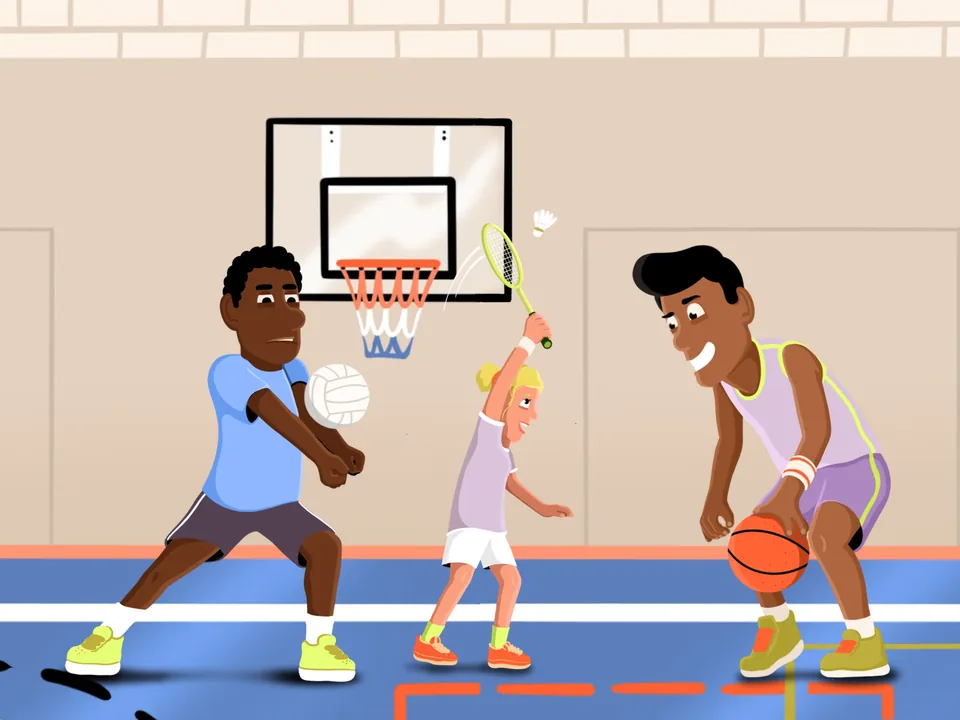
Ten junior high PE activities suit Grades 6–8, and nine of them take 8 to 20 minutes of class time. Three build on student choice, two are fitness formats, three are small-sided games and two are team formats with fair teams and rotating roles. The Rotating-Roles Mini-Season is the exception: it runs as a short unit.
Junior high and middle school PE (Grades 6–8) means full classes, mixed ability and students who care what their peers think. Every activity below lists group size and gear, and its rules run from scoring to restarts. A table of common mistakes and a section on unit planning follow the list.
A full class in a small gym fits Builders and Bulldozers or Choice Stations, and a skill focus fits one of the small-sided games. Capture the Flag needs the most space.
| Activity | Group | Time | Gear |
|---|---|---|---|
| Choice Stations | groups of 4–5 | about 15 minutes | cones, task cards, balls or ropes |
| Student-Designed Circuit | groups of 4 | about 20 minutes | cones, jump ropes, mats, timer |
| Invent-a-Game Challenge | groups of 4–6 | about 20 minutes | two pieces of equipment per group |
| Builders and Bulldozers | 2 teams, 12–30 students | about 8 minutes | at least 20 cones |
| Pick-Your-Pace Intervals | pairs | about 10 minutes | interval timer, move cards |
| 4v4 Ultimate | teams of 4 | about 12 minutes | soft discs, cones, pinnies |
| Catch-and-Toss Volleyball | teams of 3 | about 12 minutes | low net or rope, beach ball |
| Cone Gate Soccer | teams of 4 | about 10 minutes | soccer or foam balls, 12 cones |
| Capture the Flag | 2 teams, 16–30 students | about 20 minutes | flags or beanbags, hula hoops, pinnies |
| Rotating-Roles Mini-Season | teams of 6 | a short unit | pinnies, balls, posted schedule |
The main difference from elementary PE is social: students in Grades 6–8 notice who is watching. They tend to work harder when they pick the task, understand the scoring and see fair teams, and they tend to check out when they stand in a line or get hit out of a game.
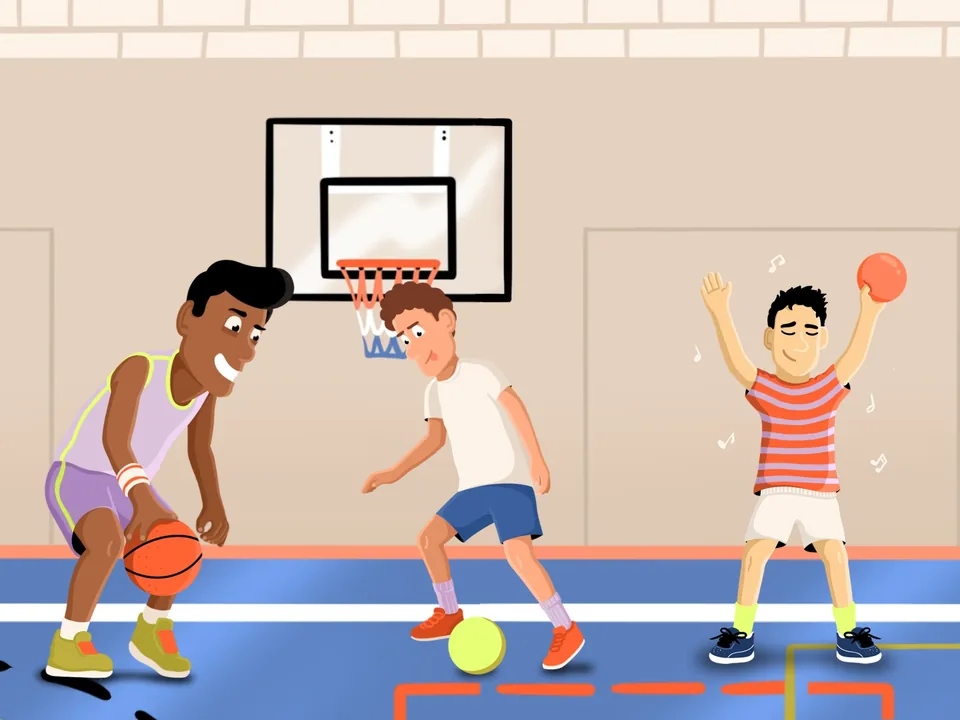
Choice Stations, a Student-Designed Circuit and an Invent-a-Game Challenge let students shape the task and its difficulty. Each has a target and a rule set, so choice does not turn into wandering.
Groups of 4–5 · about 15 minutes · cones, task cards, balls or ropes
Set up five stations that each train one skill at three levels, for example passing to a target from three distances. Groups mark their level with a cone color, count hits on a tally card and move up a color once they reach their own target. On the whistle, groups rotate to the next station. It ends when every group has visited every station.
Groups of 4 · about 20 minutes · cones, jump ropes, mats, timer
Each group builds a four-station circuit with one upper-body, one lower-body, one core and one cardio move, plus an easier and a harder version of each. Groups swap circuits, run the other design in timed rounds of equal work and rest, and leave one written suggestion. Check every design first: floor work needs mats, and nobody jumps off equipment.
Groups of 4–6 · about 20 minutes · two pieces of equipment per group
Give each group two pieces of equipment and three requirements: everyone touches the ball before a point counts, there is a clear way to score, and the rules say what happens after a miss. Groups write the rules on an index card and show it to you before play: no throwing at people and no body contact. They then play and fix one rule that felt unfair. It ends when two groups teach their game to each other. The student-invented games unit covers a longer version.
Fitness feels like a game when students choose the move, see the scoring and never receive it as a consequence. SHAPE America's position statement on physical activity as punishment calls using exercise as punishment, or withholding PE as a consequence, inappropriate. Keep these two formats separate from behavior management.
2 teams, 12–30 students · about 8 minutes · at least 20 cones
Spread the cones over the floor, half upright and half on their sides. Builders stand tipped cones up, and Bulldozers tip upright cones over. Hands only, walking or jogging, no throwing cones, no blocking, and keep an arm's length from anyone already bending over a cone. After one minute you call stop and count: more upright cones means Builders win the round, more tipped means Bulldozers win, and equal counts are a tie. Swap jobs and play four rounds; the team that wins more rounds takes the game, and two wins each is a draw. Keep the floor dry and clear of other equipment.
Pairs · about 10 minutes · interval timer, move cards
Partners pick three moves from a card of eight, such as step-ups, squats, line hops and mountain climbers, and choose a pace: steady enough to talk, or hard enough that talking takes effort. They work through their moves in timed rounds of equal work and rest, count reps and try to beat their own count next round. It ends when the timer has run all rounds, and nobody is ranked against anyone else. The Structured Interval Timer sets equal rounds of work and rest with prep time and a progress ring.
Games of 3v3 and 4v4 keep everyone involved because each student handles the ball or disc many times instead of waiting for a turn. In its position statement on dodgeball, SHAPE America cites a recommendation of moderate-to-vigorous activity for 50 percent of PE class time and calls traditional elimination dodgeball, where players are hit out, inappropriate for K–12 PE.
Teams of 4 · about 12 minutes · soft discs, cones, pinnies
Mark a half court with cone end zones, away from the walls. A team scores by catching the disc in the end zone, and nobody runs with the disc. A drop, interception, out-of-bounds throw or hold longer than 5 seconds turns the disc over where it stopped. Play starts with a throw from one team's own end zone (flip a coin). After a score the other team restarts from its own end zone. First to 5 points wins, or the leader when you call time. Defenders stay an arm's length away, so the game stays non-contact.
Teams of 3 · about 12 minutes · low net or rope, beach ball
Flip a coin for the first serve, then serve underhand from behind the end line. The first contact may be a catch followed by a toss to a teammate; after that the ball is volleyed or bumped, with three contacts at most per side. A ball that hits the floor, goes out or needs a fourth contact gives the other team the point and the serve. Play to 11 or until you call time, and rotate one spot clockwise each time your team wins the serve back.
Teams of 4 · about 10 minutes · soccer or foam balls, 12 cones
Two teams share a half court with six gates, each made of two cones a few steps apart. A team scores by passing the ball through a gate to a teammate on the other side, but a team cannot use the same gate twice in a row. After a point or an out-of-bounds ball, the other team restarts with a pass from the sideline. First to 6 points wins, or the leader when you call time. Indoors, use foam or soft balls and keep passes on the floor.
Fair teams come from a random or skill-balanced draw instead of captains, and roles that rotate every game keep each student involved whether or not they play. The guide to picking teams without captains lists quick methods.
2 teams, 16–30 students · about 20 minutes · flags or beanbags, hula hoops, pinnies
Each team holds one half and guards four flags on its back line, with a hula-hoop jail in its back corner. Players try to grab a flag from the other half and carry it across the center line without being tagged. Players can be tagged only on the opposing half, and a tag is a two-hand touch to the shoulder. A tagged carrier drops the flag where tagged, a defender returns it to the back line, and the tagged player walks to the opposing jail. A teammate's tag frees a jailed player, and both walk back to their own half. A team wins with three captured flags, or with the most flags when you call time. Play on a dry floor or field with boundaries away from walls, and no tackling. The guide to Capture the Flag in PE class covers the game in more depth.
Teams of 6 · a short unit · pinnies, balls, posted schedule
Teams of six stay together for the whole unit. In each game, four teammates play 4v4 by the rules of Ultimate or Cone Gate Soccer while one referees and one keeps score, and everyone switches jobs for the next game. Teams play a round-robin so each meets every other team once. A win scores 2 points, a tie 1, and the opposing referee can add 1 fair-play point. The Tournament Planner generates “Round-robin schedules for 2 to 10 teams on up to 4 courts”. The season ends when every team has played every other team.
Waiting in line, hit-out games, fitness as a consequence, captain picks, too many rules and unstructured choice are the usual culprits.
| Mistake | Cause | Fix |
|---|---|---|
| Students wait in line | One ball for a big team, or long relay lines | Play 3v3 or 4v4, or run stations |
| Half the class sits out | Hit-out games | Add a way back in, like the jail in Capture the Flag, or count team points |
| Fitness used as a consequence | Laps or push-ups after a broken rule | Use a quick reset and schedule fitness as its own activity |
| Teams picked by captains | Public picking order | Draw random or skill-balanced teams |
| Rules overload | A full rule set on the first day | Start with two rules and add one per round |
| Choice without a target | “Do what you want” instructions | Offer 2–3 defined options, each with a target |
For mixed-ability classes, change one thing per activity: lower the net, widen the gates, or score against each student's own previous count. For students with disabilities, the guide to adaptive PE activities for K–12 lists further modifications.
Attach each activity to one skill focus in a multi-week unit, so the format changes while the skill stays the same. A passing unit, for example, can start with Choice Stations, move to Cone Gate Soccer and 4v4 Ultimate, and finish with the Rotating-Roles Mini-Season.
Catch-and-Toss Volleyball leads into the pickleball unit or the badminton unit. For the bigger picture, see the middle school PE unit plans, the yearly scope and sequence and the winter indoor units.
Plan 8 to 20 minutes for a single activity. A short format like Builders and Bulldozers (about 8 minutes) works as an opener, and a longer one like Capture the Flag (about 20 minutes) can carry the main part of class. Stop while students still want another round, and change one rule if interest drops before then.
Use 3 to 4 players per side, as in 3v3 volleyball and 4v4 Ultimate or soccer. Smaller teams mean more touches per student and fewer bystanders. If you have more students than space, run two games side by side instead of adding players to one.
Offer a choice between two tasks with the same target, such as the easier or harder side of a station, or give the student a role: referee, scorekeeper or equipment manager. Talk with the student privately after class, not in front of peers. A role keeps them in the activity while you find out what is behind the refusal, such as fear of being watched or a skill gap.
Yes, with changes. Ultimate, Capture the Flag and Builders and Bulldozers work on a dry, even field with cones as boundaries. In a small gym, shrink the small-sided games to a half court, keep boundary lines away from the walls, use soft balls or foam discs and save Capture the Flag for a larger space.
Aim for at least half of class time in moderate-to-vigorous activity, the recommendation SHAPE America cites in its dodgeball position statement. In a 45-minute class that is about 23 minutes of moving. The HHS Physical Activity Guidelines call for 60 minutes daily for ages 6–17, so PE covers only part of it. Short explanations and small-sided games help you reach that share.
Games in PE class usually fall apart for two reasons: students spend too much time waiting, and the rules or the space don't fit the group.
Capture the flag is a two-team tag game: each side guards a flag on its own half of the gym or field and tries to carry the other team's…
Download the app for iOS & Android and open the 3 free units without an account. When you run the team formats, the Team Creator draws random or skill-balanced teams from your class roster, and the Tournament Planner builds the round-robin for your mini-season.
App for iPhone, iPad and Android.