Games & warm-ups
No-Equipment PE Warm-Up Games
PE warm-up games without equipment need floor space and a signal everyone knows, nothing else.
Adults bring up Steal the Bacon and Sharks and Minnows as soon as they learn you teach gym, and most of those old PE games still work. A few need new rules, because they bench kids for most of a class. Teaching a game your students have never seen takes a one-sentence goal, a stop signal, and a short practice round.

Teach the classics that have simple rules, little equipment, and room for a whole class to move: Steal the Bacon, Red Light, Green Light, freeze tag, and Sharks and Minnows. Rewrite the games that bench players for long stretches or rely on hard throws and collisions. A good update keeps every student playing and fits the rules into a few sentences.
Ask a room of adults what they played in gym and the same names come back: Steal the Bacon, Sharks and Minnows, Red Light, Green Light, Duck Duck Goose, freeze tag, kickball, dodgeball, Capture the Flag, and parachute games. Red Rover and musical chairs come up too, usually with a story about getting hurt or sitting out first.
These games lasted because the rules fit into a few sentences, they need a ball, a beanbag, or nothing at all, and they stretch from a small group to a full class. They also left three habits that today's teachers work around: eliminating players early so they watch from the wall, long waits for a turn, and contact that goes past a light tag.
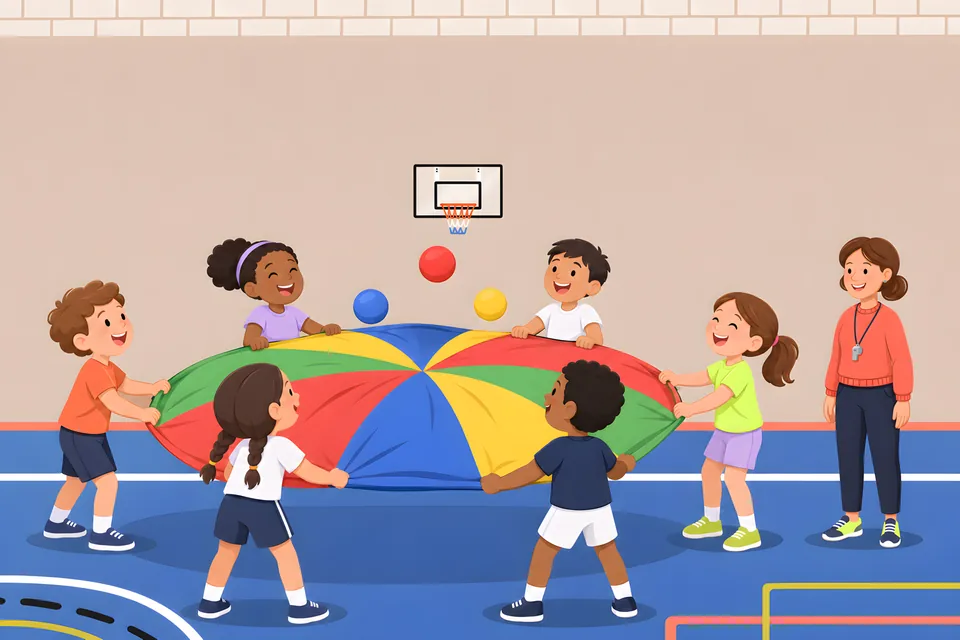
Parachute games are on that list too, and Parachute Games is one of the 3 free units that need no account.
Before a classic goes into a lesson, decide what it needs. The fix column names the one change that matters most in a typical class of 25 to 30 students.
| Game | Problem in the classic version | Fix | Verdict |
|---|---|---|---|
| Steal the Bacon | Only two players run per call | Call two or three numbers at once, one beanbag per pair | Update |
| Sharks and Minnows | Tagged players drop out | Tagged players become seaweed and keep tagging | Update |
| Red Light, Green Light | One long line, one caller | Two or three lanes, each with a student caller | Keep |
| Freeze tag | Frozen players can wait a long time | A teammate unfreezes them with a high five | Keep |
| Duck Duck Goose | Most of the circle sits | Several small circles | Update |
| Kickball | Long kicking lines, few touches in the field | Smaller teams on two fields | Update |
| Dodgeball | Elimination, hard throws at close range | Soft balls, points instead of outs, policy check | Update or skip |
| Capture the Flag | Long waits in jail | A teammate's tag frees jailed players | Update |
| Parachute games | Crowding when grips and spacing are unclear | Set grip and spacing rules, supervise closely | Keep |
| Red Rover | Runners crash into linked arms | No safe fix; use a tag game with a start signal | Retire |
| Musical chairs | Elimination and scrambles for chairs | One floor spot per student, nobody removed | Update |
A classic holds up when students understand it after one demonstration and the equipment fits in one hand. Steal the Bacon qualifies, though only two players run at a time.
Split the class into two teams on opposite sidelines, facing each other, with clear floor between them. Give each player a number so every number appears once on each team; if the teams are uneven, one student takes two numbers. Put a beanbag on the floor at the center and call a number. Those two players run to the center, and each tries to grab the beanbag and carry it back across their own sideline without being tagged by the other. A clean return scores 1 point for the grabber's team. A light tag on the shoulder or back before the line scores 1 point for the tagger's team. A push or grab gives the point to the other team. Reset the beanbag at the center and call the next number. Once every number has been called twice, the team with more points wins.
To keep more students moving, call two or three numbers at once, with a beanbag at the center for each pair and the pairs running in separate lanes. Play on a dry floor, leave room to stop beyond each sideline, and tell runners to slow down and reach for the beanbag instead of diving.
Dodgeball draws the most debate of the old games. The classic format has two built-in problems: hard balls thrown at close range, and elimination that leaves the weakest throwers and dodgers watching from the wall after the first few throws. SHAPE America's 2017 position statement calls traditional elimination dodgeball inappropriate for K–12 PE, and some schools and districts restrict dodgeball-style games, so check your policy before you plan one.
If your policy allows it, change the equipment and the ending. Use soft foam or fleece balls sized for the age group, keep the floor clear of benches and gear, and leave open space behind each team. Hand the balls out evenly before play starts so nobody scrambles for them at the center line.
Here is a version where nobody sits out. Two teams stand on either side of a center line, with a few balls per team (about one ball for every three players is a starting point). A team scores 1 point when a thrown ball hits an opponent below the waist without bouncing first. The hit player jogs to their own back line, touches it, and rejoins. A caught ball scores nothing, and the thrower makes the back-line trip instead. Stepping over the center line gives the other team 1 point, and that player makes the back-line trip too. A ball that leaves the court goes to the team that did not throw it. Play to a time limit or a target score you set before the round. Then collect the balls, hand them out evenly again, and start the next round. The team with more points wins.
Most elimination games can swap “you're out” for “you have a job.” A tagged player does a short task and rejoins, frees a teammate, or stays in play in a new role. Sharks and Minnows shows how.
Mark two end lines across the gym, with room to stop beyond each one and sidelines along both edges. Pick one or two sharks to stand in the middle. Every other student is a minnow and starts behind one end line. On your signal the minnows run to the opposite end line while the sharks tag them with a light one-hand touch on the shoulder or back. A tagged minnow becomes seaweed: feet stay planted, arms can reach, and a light touch tags any minnow who runs past. A minnow who leaves the sidelines becomes seaweed too, and a tag that involves grabbing or pushing does not count. Free minnows keep crossing back and forth. The round ends when one free minnow is left or when you call time. That minnow wins and becomes a shark next round, and if you called time, the free minnows share the win. Everyone returns to the starting line to begin again.
Duck Duck Goose has a different problem: most of the circle sits and waits. Run several small circles so fewer students wait. A few games are better retired than updated. Red Rover sends a runner into a line of linked arms, and no rule change removes that collision. A tag game with a start signal, like Sharks and Minnows, gives students the same chase.
A class of 30 on one court often means most students wait, yet SHAPE America recommends moderate-to-vigorous activity for 50 percent of PE class time (cited in its dodgeball position statement). Mark two or three playing areas with cones or the lines already on the floor and run the same game in each. Cones and a few beanbags are enough for Steal the Bacon and Red Light, Green Light.
Red Light, Green Light scales well. Students line up on a start line, and a caller stands at a finish line across the gym with their back turned. On “green light” students move toward the caller, walking or jogging as you decide. On “red light” the caller turns around and students freeze. Anyone the caller sees moving goes back to the start line. The first student to touch the finish line wins and becomes the caller for the next round, and everyone returns to the start line. Run as many rounds as time allows. In a big class, set up two or three lanes, each with its own caller, and leave open floor past the finish line and between lanes so players can slow down. For more formats, see PE games for large classes, and for a half gym, games for small spaces.
Use this order for any game your students have not seen:
Agree on one tagging rule for the whole class, because arguments about who got tagged stall a lot of tag games. Names and rules for games like freeze tag differ from region to region, so tell students which version you are using.
Once students know a game, let them change one rule, such as the size of the playing area, and play one round to test it. That step leads into a student-invented games unit.
Steal the Bacon and Sharks and Minnows both work with middle and high school classes when you keep the rules short, add a visible score or a team goal, and drop any babyish framing. Let students run the caller role, and invite them to propose one rule change after the first round. Check that the floor and space suit the faster running of older students.
Yes, if you slow the movement down. Switch running to walking or hopping, keep groups small enough that everyone can turn without touching a neighbor, and clear desks, chairs, and gear before you start. Red Light, Green Light works as a walking game in a classroom with a clear path. Stop play if students begin to crowd the same spot.
Agree on the rule before play: a light touch on the shoulder or back counts, and the tagger says “tag” out loud. If two students disagree, they settle it with one round of rock-paper-scissors and play on, so nobody waits for you to rule. If the same disputes keep coming up, add an observer or switch to a game with a scoreboard.
Write down four things: the goal, the boundaries, what happens when someone is tagged or loses the ball, and how a round ends. If one of them is missing, decide it yourself before class and tell students you are using your version. A colleague who has taught at your school for years may remember the local rules.
No, there is no national ban on dodgeball in US schools. SHAPE America's 2017 position statement calls traditional elimination dodgeball inappropriate for K–12 PE, and some districts and schools restrict it in their own policies. If yours allows throwing games, use soft balls, score points instead of eliminating players, and aim only below the waist.
PE warm-up games without equipment need floor space and a signal everyone knows, nothing else.
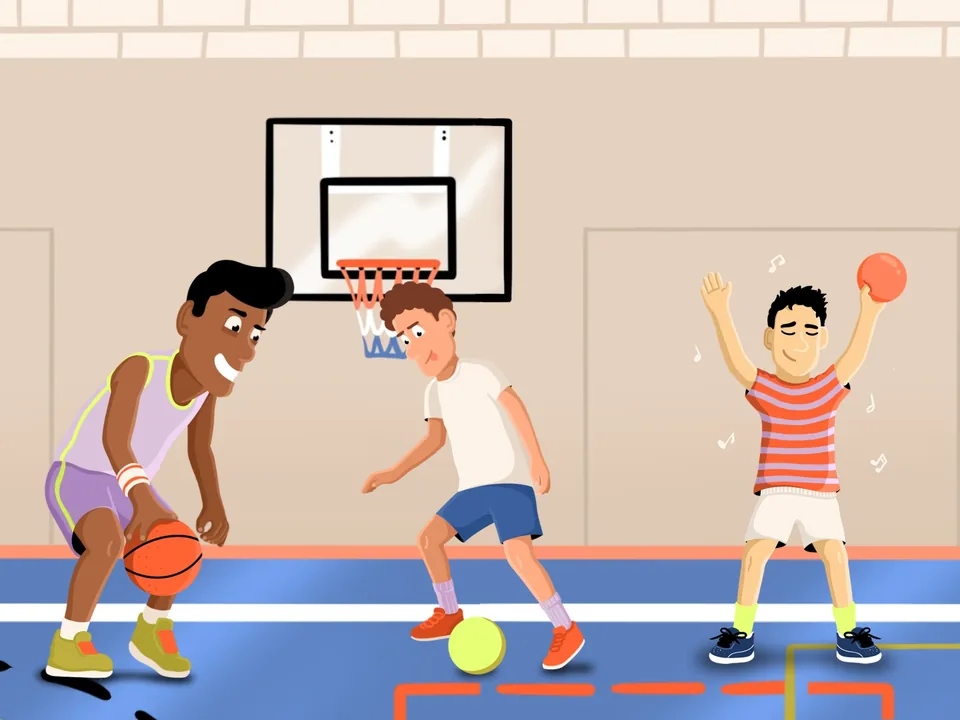
When captains pick teams one student at a time, it eats class time and often leaves the same kids standing there last.
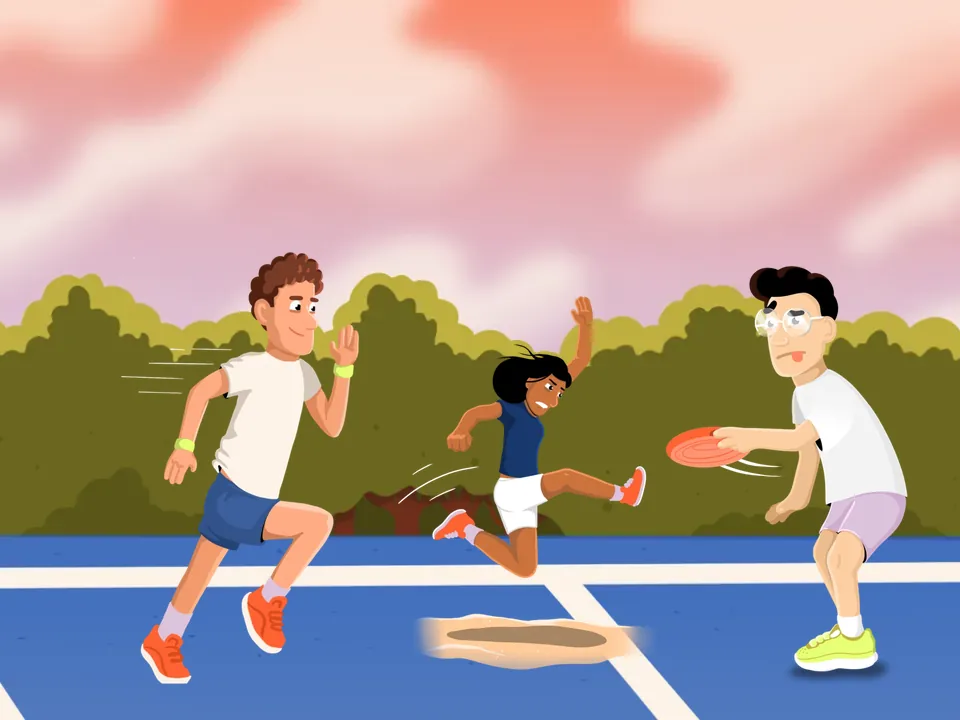
Parachute games for elementary PE in K–2 work best when they stay simple: waves, a dome, a ball bounce, and a walk around the circle.
Parachute Games is one of the 3 free units, along with Basketball for Grades 5–7 and Classroom Brain Breaks, and all three open in the PhysEdPrep app for iOS & Android without an account. Yearly and 12-month plans start with a 7-day free trial; see current prices in the app.
App for iPhone, iPad and Android.