Games & warm-ups
Station Setups for PE Class
PE stations split a class into small groups that rotate through different tasks, so more students handle equipment and fewer stand in line.
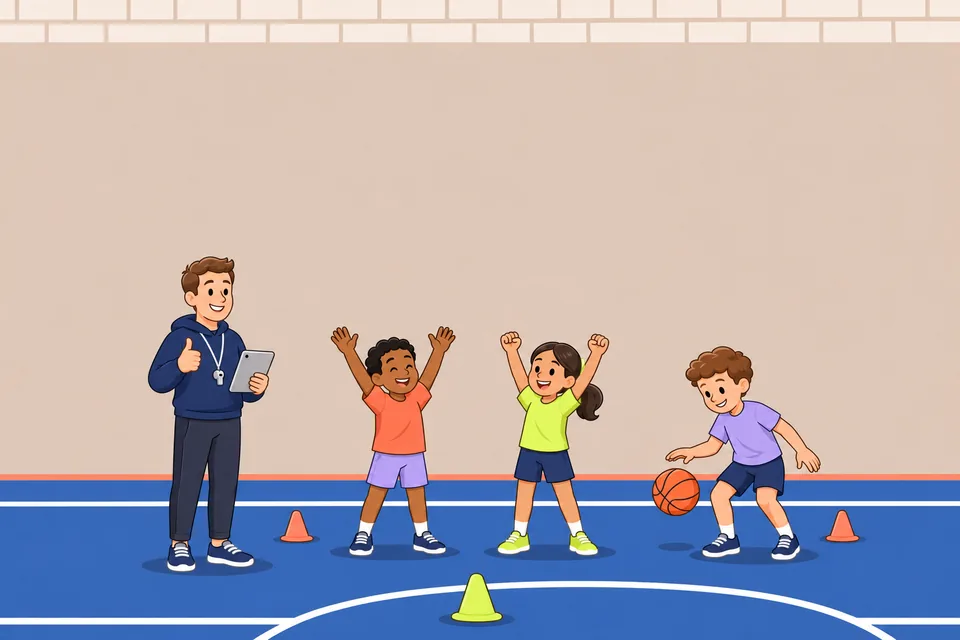
Set up a PE escape room with four movement stations, one digit clue per station and a 15-minute countdown, using gear most gyms already own. Teams of 4–5 earn each digit card by meeting the station’s pass mark and rotate on a whistle every 3 minutes. Then they sort the four digits and tell the code to the teacher at the lock.
For the last week before winter break, or any class that needs a team puzzle without a props budget, you can build an escape room from jump ropes, bean bags, poly spots, foam balls and cones. Below: a copy-and-fill planning sheet, a finished four-station example, three code types, a first-run mistakes table and a setup checklist with a floor plan.
Teams earn one clue card per station by passing a movement challenge, then use the clues to open a final lock before the clock runs out. Nobody sits at a desk, because every clue is earned with movement.
Counting aloud and agreeing on one code also practice the social-skills standard in SHAPE America’s 2024 National PE Standards (S3, “Develops social skills through movement”).
The planning sheet needs a header that sets the story and the rules, plus one row per station. Copy both parts into a document and fill in the blanks.
Header fields:
Station rows (four rows suit a class of 16–20 split into four teams):
| Station | Challenge and pass mark | Clue card | Space and safety | Easier / harder |
|---|---|---|---|---|
| ______ | ______ | ______ | ______ | ______ |
| ______ | ______ | ______ | ______ | ______ |
| ______ | ______ | ______ | ______ | ______ |
| ______ | ______ | ______ | ______ | ______ |
Write every pass mark as a number students can count aloud. Bean bags and hoops are good for station challenges; for more, see bean bag games for PE and hula hoop games for PE.
A finished sheet pairs a one-sentence story with four station rows, each with a countable pass mark and a clue. Here the theme is “The Locked Equipment Closet”: someone changed the closet code, and each station holds one digit of the new one. Teams have 4–5 students, the escape clock is 15 minutes, the whistle rotates teams every 3 minutes, and the lock is a four-digit combination lock on a gear bag.
| Station | Challenge and pass mark | Clue card | Space and safety | Easier / harder |
|---|---|---|---|---|
| Red rope | Each student does 10 jumps on their own rope while a teammate counts aloud. Pass mark: all members reach 10. | 4 | Jumpers one rope length apart, sneakers, dry gym floor or mat | Easier: 10 hops over a rope lying flat. Harder: 10 jumps alternating feet. |
| Blue balance | Each student walks a bean bag on the back of one hand along 6 poly spots and back. A drop sends that student to the first spot. Pass mark: all finish. | 9 | Spots can slide on polished floors: tape them down, walk, no running | Easier: bean bag on the palm. Harder: bean bag on the head. |
| Green toss | In volleys, each student tosses one foam ball underhand at a floor hoop on the Checker’s “go” and collects on “collect.” Pass mark: 8 makes in total. | 2 | Foam balls only, nobody retrieves during a volley | Easier: cone line closer. Harder: cone line farther back. |
| Yellow agility | Students weave through 5 cones one at a time and tag the next teammate, in two lanes. Pass mark: every student finishes 2 weaves. A knocked cone voids that trip. | 7 | Lanes a few steps apart, walk back along the outside | Easier: walk the weave. Harder: side-shuffle the weave. |
In this sheet’s answer key the cards read 4, 9, 2 and 7, so the code is 2479. Treat the numbers as starting points: after one run, raise or lower each pass mark so a typical team finishes with a little time to spare. For more ways to scale a station, see 10 ways to differentiate in PE.
Cones, cards and poly spots can carry three kinds of code: digits, letters or colors. Each clue sits under an upside-down cone and becomes visible only after the pass mark is met.
To stop teams from copying each other, put one envelope per team color under every cone and give each team a different digit set on the Gatekeeper’s key. All teams follow the same sorting rule but end at different codes, so the Gatekeeper checks each code against the key and says “open” instead of using one fixed combination lock.
To match the season, change the story and the card container: paper snowflakes before winter break, plastic eggs in spring. On the 100th day of school, a number theme fits the digit code well; more ideas are in 100th day of school PE activities.
Run two clocks: a 15-minute escape countdown that every team can see and a whistle every 3 minutes that moves teams to the next station. Four rounds of 3 minutes plus a 3-minute last-chance round fill the 15 minutes.
On a phone or tablet, the Countdown Timer in the PhysEdPrep app offers quick picks for 1, 3, 5, 10 or 15 minutes with a whistle at the end. The Differentiated Phase Timer lets you name every phase, give it its own time and repeat the sequence for as many rounds as you need, which suits five rounds of 3 minutes.
Standing around cuts the activity level. SHAPE America recommends moderate to vigorous activity for 50 percent of PE class time, and three habits protect that share: rotate on the whistle instead of on finish, let early finishers repeat the harder version until the whistle, and sort the digits while walking to the lock. The MVPA guide covers more ways.
Form teams before class. The Team Creator makes random, skill-balanced or gender-split teams from saved class rosters, and fair ways to pick teams explains more options. For a cooperative version, make the goal “every team’s lock opens before the clock ends” and let teams that have escaped serve as extra Checkers. More ideas are in cooperative games for PE.
Five problems can derail a first run: bunching at one station, copied codes, argued counts, too much standing and penalty exercise. The last one matters most: SHAPE America’s position statement on physical activity as punishment (released 2021) calls exercise as a consequence inappropriate, so a wrong code leads to a hint, never push-ups or laps.
| Mistake | Cause | Fix |
|---|---|---|
| Teams bunch up at one station | Teams move on as soon as they finish | Rotate on the whistle, not on finish. Early finishers repeat the harder version. |
| Teams copy a neighbor’s code | Every team sees the same cards | One envelope per team color under each cone, a different digit set per team. |
| Pass marks get argued | Nobody confirms the count | Name a Checker each round who counts aloud. The teacher spot-checks. |
| Puzzle time turns into standing time | Too many clues or a long riddle | Keep to four digits and one sorting rule. Sort while walking to the lock. |
| Wrong codes earn penalty exercise | The teacher wants to slow down guessing | Say “still locked” and give a hint after two wrong tries. Never assign exercise. |
Setup needs four station zones, one lock zone and a visible clock, and most items come from a standard gym closet. Place Red rope top left, Green toss top right, Yellow agility bottom right, Blue balance bottom left and Lock and clock in the center; teams rotate clockwise. For other layouts, see station setups for PE.
Plan about 15 minutes of play for four stations: four 3-minute rounds plus a 3-minute last-chance round. Each extra station adds one more 3-minute round, so five stations need an 18-minute clock. Younger students or higher pass marks need more time per round, so run the game once and adjust.
Yes, if you replace digits with colors and lower the pass marks. Use the poly-spot floor lock, which needs no reading, and set pass marks such as 5 jumps instead of 10. Keep an adult in sight of every station, because young students need supervision around ropes and throwing.
Use an answer card instead. The Gatekeeper holds a clipboard with each team’s code, says “open” for a match and “still locked” otherwise. The reward can be a cheer, a sticker or the team’s pick for the next warm-up game. A lock on a gear bag is optional.
Keep the pass mark and swap in a movement the student can do at similar effort, such as arm swings instead of jumps, seated tossing or rolling a bean bag along the line. Agree on the swap before the game so it counts toward the team’s pass mark. Follow any IEP or 504 plan on file.
Build a second copy of all four stations with its own lock zone and answer key, then split the class into six teams of five, three teams per set. Each set rotates the same way, with one station empty each round. One teacher can run both sets only if they are within sight of each other; otherwise ask an aide or a student teacher to be the second Gatekeeper.
Yes, grades 6–12 can play the same format if the stations and the puzzle get harder. Raise the pass marks and swap in sport skills, such as 10 forearm passes in a row per pair. You can also add a short math step to the code, for example adding up the four digits. Keep the 15-minute clock and the 3-minute rotation so everyone keeps moving.
PE stations split a class into small groups that rotate through different tasks, so more students handle equipment and fewer stand in line.
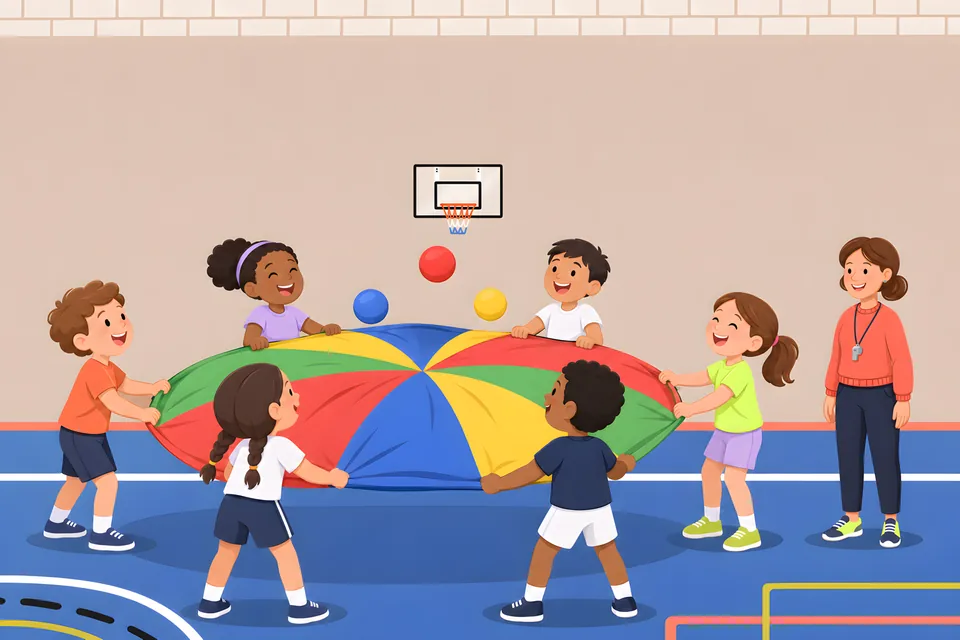
For PE specialists and classroom teachers with a mixed-ability class and little planning time.

Some students in your class have played a sport for years, and others are touching it for the first time.
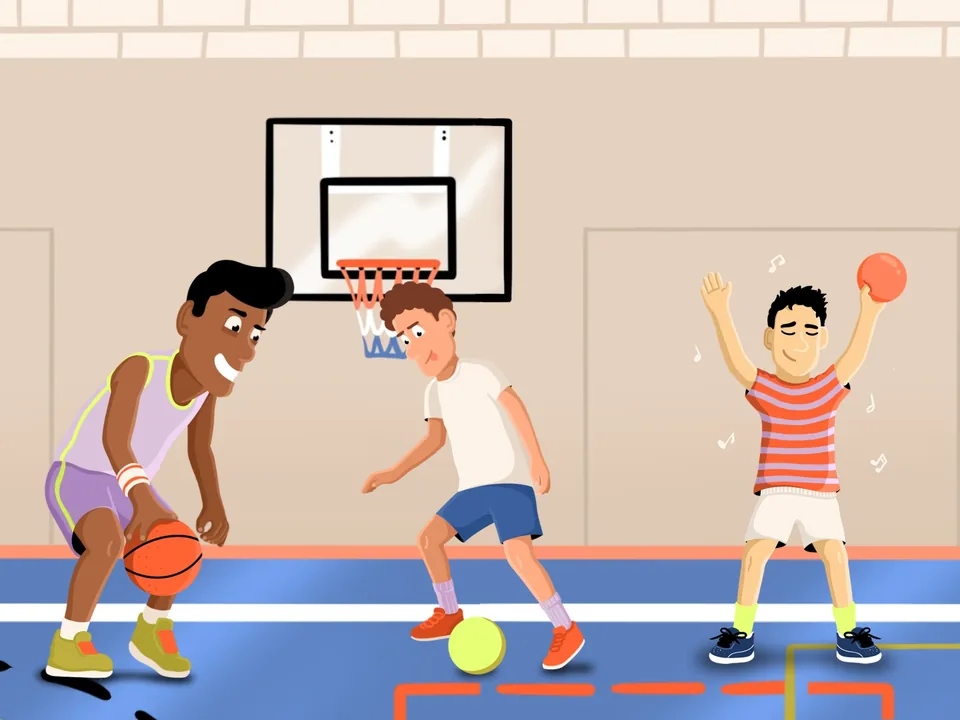
In a 30- or 40-minute period with 24 to 36 students, much of the lost movement time comes from routines like roll call, team picks and…
Download the PhysEdPrep app for iOS & Android; the download is free, and the 3 free units open without an account. The 7-day free trial on the Yearly plan opens all 6 gym tools. See current prices in the app.
App for iPhone, iPad and Android.