Games & warm-ups
Bean Bag Games for PE
This list is for PE specialists and classroom teachers who run bean bag toss games for kids in Grades K–5, with a few options for Grades…
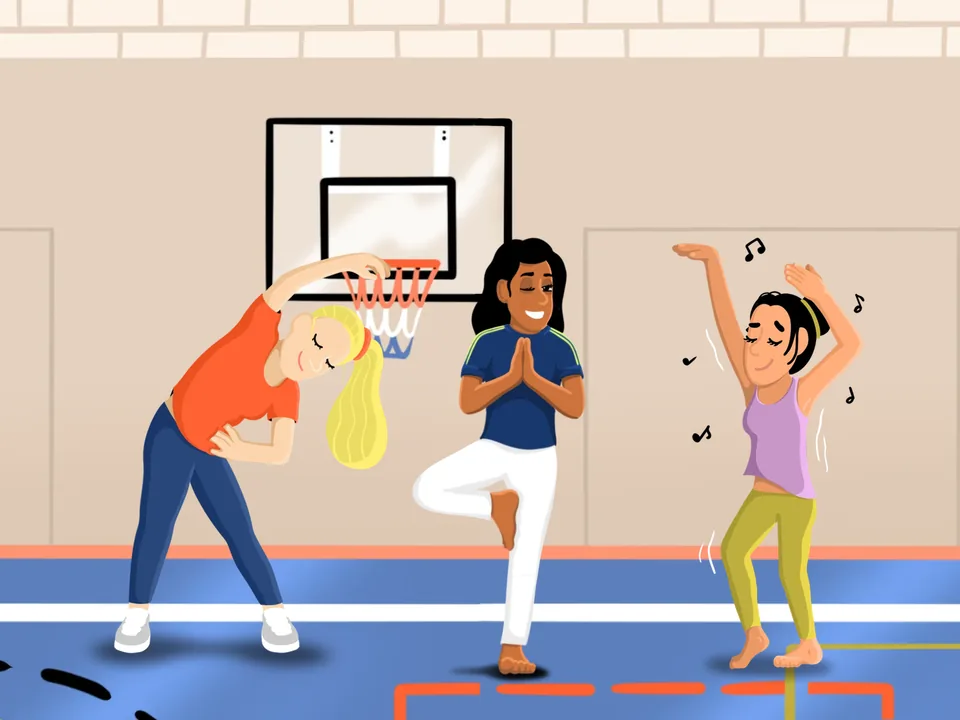
Here are 10 PE fitness activities: 4 cardio games, 4 strength exercises and 2 flexibility routines, each about 3 to 8 minutes. Most need only cones, jump ropes or bean bags and suit Grades K–12 with adjustments. Aim for moderate-to-vigorous movement during about half of class time, and never use exercise as punishment.
This list is for PE specialists, secondary teachers and classroom teachers who run mixed-ability classes with little planning time. It adds the five health-related components in kid language, a way to run the activities as stations or intervals, and the safety limits that keep fitness positive.
Four of the 10 activities work from kindergarten up: Freeze Tag Rescue, Animal Walk Relay, Bean Bag Squat Passes and Mirror Stretch Partners. The other six start between Grades 2 and 4. None needs more than cones, pinnies, jump ropes, bean bags, a wall, an open floor or optional mats. Grades are starting points: for younger or less fit students, shorten the work time and offer an easier version. For more Grades K–5 material, see the Elementary (K–5) page.
| Activity | Grades | Group | About how long | Equipment |
|---|---|---|---|---|
| Freeze Tag Rescue | K–5 | 12–30 students | 5 min | pinnies, cones |
| Cone Shuttle Relay | 3–8 | teams of 4–5 | 6 min | cones |
| Jump Rope Intervals | 2–12 | individual | 5 min | jump ropes |
| Talk-Test Jog Loop | 4–12 | whole class | 8 min | cones or field lines |
| Animal Walk Relay | K–3 | teams of 5–6 | 5 min | cones |
| Plank Tap Partners | 4–12 | pairs | 4 min | mats optional |
| Bean Bag Squat Passes | K–5 | pairs | 4 min | 1 bean bag per pair |
| Wall Sit Countdown | 3–12 | individual | 3 min | clear wall |
| Mobility Line | 3–12 | whole class | 4 min | open floor |
| Mirror Stretch Partners | K–8 | pairs | 3 min | open floor |
The five health-related components of fitness are cardiorespiratory endurance, muscular strength, muscular endurance, flexibility and body composition. Each has a plain version for students:
Body composition changes slowly and depends on much more than class, so skip weighing and measuring in front of students. The ten activities below train the other four. In SHAPE America's 2024 National PE Standards, knowing these components belongs to Standard 2, movement and fitness concepts. To adjust any activity, change one FITT variable at a time: frequency (how often), intensity (how hard), time (how long) or type (which activity).
On volume, the HHS Physical Activity Guidelines ask ages 6–17 for 60 minutes or more of moderate-to-vigorous activity daily, with muscle- and bone-strengthening activity on at least three days a week. PE cannot supply all of that. SHAPE America recommends moderate-to-vigorous intensity for 50 percent of class time. Short fitness blocks of about 3 to 8 minutes in most lessons add active minutes across the week.
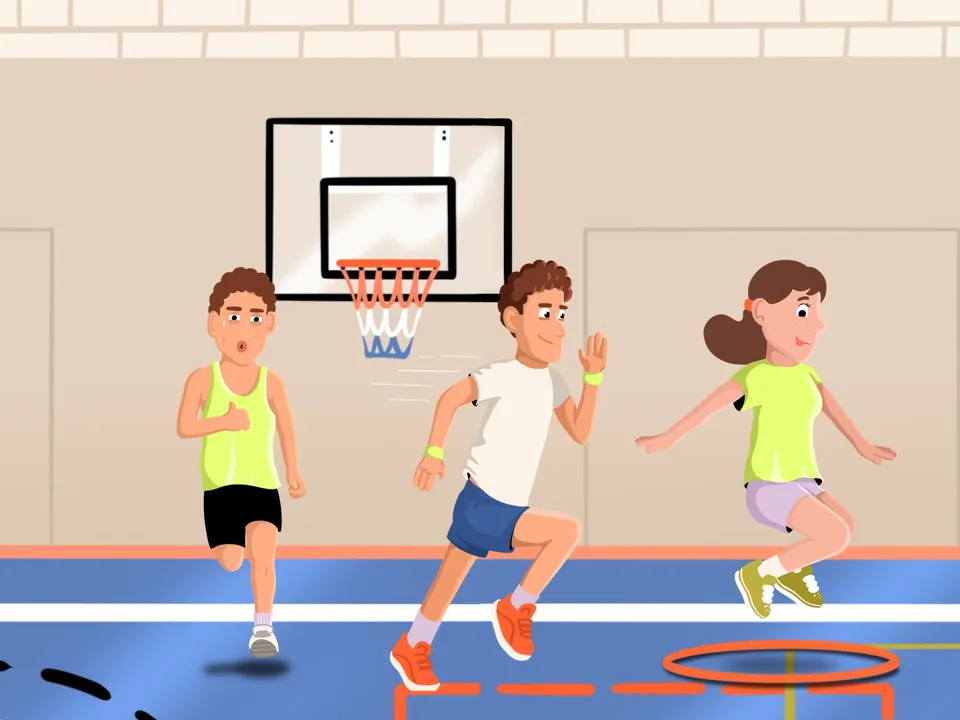
Freeze Tag Rescue, Cone Shuttle Relay, Jump Rope Intervals and the Talk-Test Jog Loop keep students moving nonstop toward a time goal instead of a distance goal. A dance unit for PE builds cardio across several lessons.
Two or three taggers in pinnies use a soft two-finger touch. Tagged players freeze with legs wide until a free player crawls through to release them. Nobody sits out. Whistle every 60 to 90 seconds, pick new taggers and restart with everyone free; four rounds end the game. Mark a boundary with cones, well clear of walls.
Each team lines up behind a start cone, with a far cone about 30 feet away. The first runner touches the far cone, returns and tags the next; skipping the cone means going again. The first team with everyone back scores a point, and the round ends when the last team finishes. Play four rounds with lanes a few steps apart and every far cone well clear of walls.
Students spread out so no rope reaches another student. Work 30 seconds, rest 15, and repeat for five rounds. Offer a basic bounce, an alternate-foot step or, for beginners, swinging the rope beside the body. Students count their own jumps and try to top their last count; a missed jump restarts the count. Use a gym floor, not concrete.
Mark a loop with cones or field lines. Students jog at a pace that still lets them say a sentence to a partner, and walk when they can't. Set one clock for the class and let each student track their own jogging minutes instead of laps. In high heat, shorten the block, move indoors or avoid the hottest midday hours outside. Students with asthma follow their care plan.
Four strength exercises need only cones, a bean bag, a wall and optional mats: Animal Walk Relay, Plank Tap Partners, Bean Bag Squat Passes and Wall Sit Countdown. Reps stay slow and controlled, with no max lifts.
Teams line up behind a cone with a turnaround cone about 20 feet away. Round one is bear walk, then crab walk, then frog jumps. Each player travels out in the animal walk, runs back upright and tags the next; a player who stands up early continues from where they rose. A round ends when the last team finishes, and three rounds end the game. Use a clean, dry floor.
Partners face each other in a forearm or straight-arm plank and tap each other's hand, alternating sides. Hold 20 seconds, rest 10 and repeat six times. Students whose hips sag drop to their knees and keep tapping; hands on a wall or bench make an easier incline. Mats help on hard floors.
Partners stand about 6 feet apart with one bean bag. The holder squats until the bag touches the floor, stands and tosses it underhand to the partner, who repeats. Count clean catches in 30 seconds; a dropped bag is picked up with no penalty. Three rounds end the game. More ideas: bean bag games for PE.
Students lean their backs on a wall, feet a step out, knees bent no lower than thighs parallel to the floor. Count down from a time you choose, such as 20 seconds; students stand up whenever they need to, so nobody is out. Each student compares the hold with their own earlier one. Anyone who feels sharp pain or dizziness stops.
Flexibility work fits as a short mobility routine before activity and a slow stretch afterward.
Students stand in lines at one end of the floor and travel across it one movement at a time: walking lunge with a twist, leg swings beside a wall or partner, arm circles, slow high knees. Keep movements smooth, not bouncy. Each line crosses twice, then the main activity starts. More starters: warm-ups with little or no equipment.
One partner leads a slow stretch, such as a high reach, a seated reach toward the toes or a butterfly sit, and holds it about 15 seconds while the other mirrors. Then they swap, and two or three stretches each end the activity. Stretch to mild tension, never pain. For more, see cool-down activities for PE.
Aim for groups of three or four students per station and one signal that starts and stops every rotation. That keeps lines short and the whole class moving through your fitness lessons.
A timer that calls each rotation lets you coach form instead of watching a clock. Among the 6 gym tools in the PhysEdPrep app, the Structured Interval Timer runs "Equal rounds of work and rest, with prep time and a progress ring", and the Differentiated Phase Timer lets you "Name every phase and give it its own time." The Team Creator builds "Fair teams in one tap: random, balanced by skill or split by gender". Related guides: interval timers for fitness stations and how to set up PE stations.
| Mistake | Cause | Fix |
|---|---|---|
| Students wait in line | Groups too large, one set of equipment | Three or four per station, duplicate equipment |
| Form falls apart late in the round | Work time too long for the age | Shorten work, keep rest at half the work time |
| Early finishers stand around | Work counted in reps | Count time, add a bonus move |
Fitness stays positive when exercise is never assigned as a consequence and every task has an easier and a harder version. The SHAPE America position statement calls using exercise as punishment, or withholding PE or recess as a consequence, inappropriate.
PE stands for physical education, the school subject that teaches movement skills, fitness and healthy habits. This guide covers the school subject: fitness activities for Grades K–12 that need little equipment.
No. For ages 6–17, the HHS Physical Activity Guidelines ask for muscle-strengthening on at least three days a week, so two days without a structured workout can fit. The same guidelines still call for 60 minutes or more of moderate-to-vigorous activity daily, so a rest day from workouts should still include active play.
Walking, jogging, biking, swimming, dancing, jumping rope, playing tag, climbing, playing soccer and doing push-ups are 10 examples. The HHS guidelines sort such activities into aerobic, muscle-strengthening and bone-strengthening, and some, like jumping rope, count in more than one group.
Include fitness in most lessons as short blocks of about 3 to 8 minutes rather than one long fitness day. SHAPE America recommends moderate-to-vigorous intensity for 50 percent of class time, and short blocks across the week add up toward the 60 minutes of daily activity HHS recommends for ages 6–17, which PE alone cannot supply.
Give every activity an easier and a harder version and let students choose: wall plank or floor plank, rope or no rope, jog or walk. Count time instead of repetitions, and compare each student with their own earlier result rather than with classmates, so no one is ranked in front of the class.
Wall Sit Countdown, Plank Tap Partners and Mirror Stretch Partners work in a classroom with the desks pushed back, because each student needs only about an arm's reach of space. Replace jump rope with jumping in place without a rope, and keep the cone relays for the gym. Short classroom movement breaks add active minutes on days without PE.
Grade effort, form and personal progress instead of raw scores. Have each student record a baseline, such as wall-sit seconds or jogging minutes, set their own goal and retest after about four to six weeks. Check what students know about the fitness components with a quick exit question. Keep results private and never post scores or body measurements.
This list is for PE specialists and classroom teachers who run bean bag toss games for kids in Grades K–5, with a few options for Grades…

This list is for PE teachers who have a few minutes left and a gym full of sweaty, loud students.

PE stations split a class into small groups that rotate through different tasks, so more students handle equipment and fewer stand in line.
K–12 PE teachers and classroom teachers can hand this sheet out before the holidays.
Get the app for iOS & Android and time your fitness stations with the Structured Interval Timer or the Differentiated Phase Timer. The 3 free units open without an account, and the 7-day free trial on a yearly or 12-month plan adds the full library and all 6 gym tools. See current prices in the app.
App for iPhone, iPad and Android.