Unit plans
Elementary PE Lesson Plans, K–5
Good elementary PE lesson plans K-5 share the same few parts: one objective, a floor setup, a skill focus, a game that uses the skill, and…
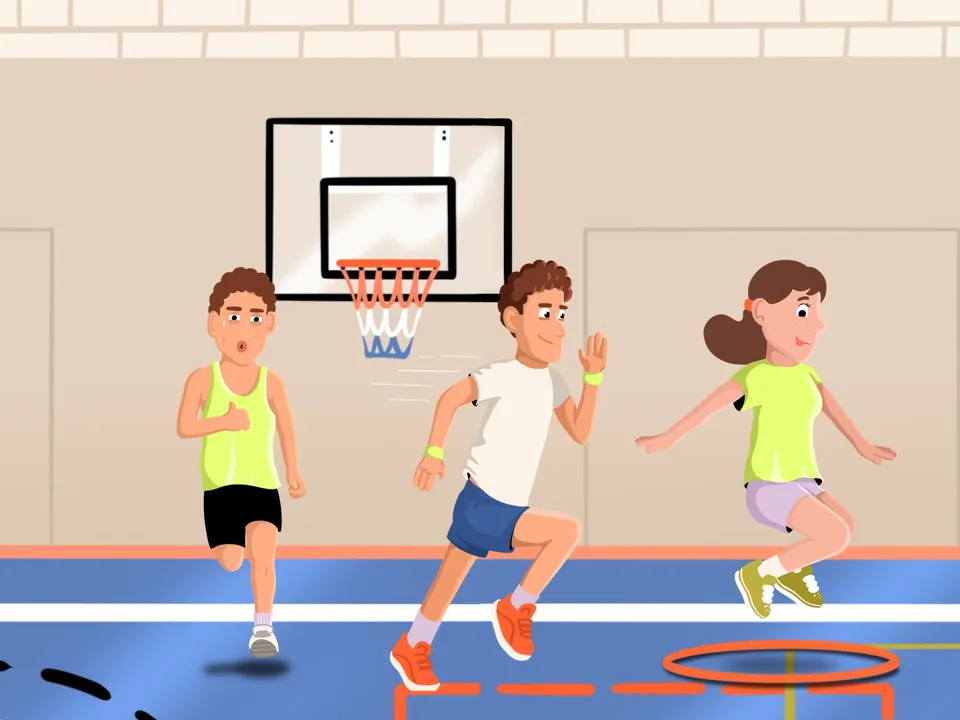
A PE dance unit runs about 3 to 4 weeks at three or four classes a week and moves through four stages. Start with beat and counting, teach line dances in formation, add a partner or square dance, then let small groups create a routine and share it. Grade accuracy on the beat, movement concepts, teamwork and effort, not talent.
Many PE teachers put off dance because they don't see themselves as dancers. You don't need to be one: recorded callers and songs that name each step carry much of the teaching. The plan is written for Grades K–5 and 6–12 and ranges from picking styles to grading a class that includes students who would rather sit out.
A dance unit needs a floor, a speaker and almost no equipment, so it fits most gyms, even when the field is frozen or two classes share the space.
It also covers the national standards. SHAPE America's 2024 National PE Standards (S1–S4) name dance forms under Standard 1 (motor skills) at every grade span from PreK–2 to 9–12, and Standard 2 asks students from PreK through Grade 8 to apply movement concepts to dance and rhythms.
Dancing counts as activity only when students are moving. SHAPE America recommends moderate-to-vigorous activity for 50 percent of class time (2017 position statement), and the Physical Activity Guidelines for Americans call for 60 minutes or more of moderate-to-vigorous activity a day for ages 6–17. Keep explanations short and let the whole group repeat each step with the music. More cold-weather options: winter indoor PE units for middle school.

Start with line dancing, add one partner or square dance, and keep cultural and creative dance for later in the unit.
| Style | Best for | Teaching note |
|---|---|---|
| Line dance (Cupid Shuffle, Cha-Cha Slide, Electric Slide) | First dances, any class size | Everyone faces the same way and needs no partner. The Cupid Shuffle and Electric Slide are four-wall dances: after each pass the group turns a quarter turn to face a new wall. |
| Square dance (four couples, a caller) | Upper elementary and middle school | Use a recorded caller and teach each call (circle left, do-si-do, promenade) alone before linking calls. |
| Cultural and folk dance (Virginia Reel, Tinikling) | Most grades, linked to social studies | Name the country or community and play recordings from it. |
| Creative dance | Groups of four, any grade | Limit the task: a set number of eight-counts, with levels, pathways or speed as prompts. |
In a square dance set, four couples form a square facing the center, and the caller names one move at a time. When a set tangles, stop the music, send everyone back to the starting square and restart the call. Assign partners by pinny color or number, not by gender.
Middle and high school classes often respond to hip hop combinations: teach a short one, then let groups change two counts. For Tinikling, practice the footwork over poles lying still first, then use light poles, a slow tempo, a non-slip floor and close supervision, with partners kneeling at the pole ends and fingers clear of the closing gap.
A dance unit builds in four stages: beat and counting, steps in formation, creation and showcase.
| Stage | Goal | What students do |
|---|---|---|
| Beat and counting | Move on the beat | Clap and walk to the music, count in eights ('5, 6, 7, 8') and copy a leader. |
| Steps in formation | Learn three complete dances | Two line dances in rows, then one partner or square dance; add quarter turns. |
| Creation | Apply movement concepts | Groups of four build a routine from a set number of eight-counts with one change of level and one change of formation. |
| Showcase | Share and reflect | Half the class dances while the other half watches with a task, then swap; short written reflection. |
To teach one dance, show the whole dance once, then teach the first eight counts with your back to the group so your left is their left. Add the next eight counts, link the two parts, and add the music last at a slow tempo.
If your classes meet once or twice a week, run the same four stages over more weeks and shorten each dance instead of dropping a stage. Younger students do well with shorter dances and more circles; elementary PE lesson plans for K–5 cover that grade band. In the classroom, dance brain breaks without video can build the beat before students reach the gym.
Remove the audience first, because refusal usually comes from fear of being watched or of getting a step wrong.
| Problem | Likely cause | Fix |
|---|---|---|
| Students drift to the back row | Fear of being watched | Use four-wall dances so each quarter turn changes who is in front; assign rows by pinny color. |
| A student sits out | Unsure of the steps or the music | Ask privately, then offer a role (counter, formation checker) and a smaller version of the steps. |
| Partner refusal | Discomfort with touch | Dance in lines or circles without contact, or let partners hold opposite ends of a pinny, kept loose. |
| Laughing at others | Peers act as an audience | Set the rule: dance with the group, never at someone. No solos in the unit. |
| Steps fall apart | Tempo too fast | Go back to half speed or to counting without music; add the music last. |
Offer choices that keep everyone inside the lesson goals: pick the song from three clean options, choose the tempo, or take a role such as counter. Give every step a seated or low-impact version, so students who use wheelchairs or have joint limits follow the same counts with arms and upper body. Check each student's IEP or 504 plan for accommodations; building an adaptive PE curriculum goes further.
Give each dancer about one arm span of space in every direction, and keep the music loud enough to find the beat but quiet enough that your cues still carry.
In the sketch, the teacher stands in front of Row 1, back to the dancers, with the speaker raised at the front wall. Row 1, Row 2 and Row 3 are the dancer lines, and four boundary cones mark the dance area. Check that every dancer can take a quarter turn without reaching a wall, a bleacher or a neighbor.
Score four criteria on a three-level scale during ordinary class time, so no grade rests on one performance.
| Criterion | What you watch | 2024 standard |
|---|---|---|
| Accuracy on the beat | Steps land on the beat in the dances taught | S1 |
| Movement concepts | Levels, pathways or speed used on purpose in the group routine | S2 |
| Teamwork | Shares ideas, rehearses, supports partners | S3 |
| Effort and reflection | Tries every dance and names one thing to improve | S4 |
Use levels such as beginning, developing and secure. Carry a clipboard and rotate through the roster so you observe each student more than once before the unit ends. Grade a modified step against the same criteria. A two-question exit slip (Which step was hardest? What will you change?) supplies the reflection evidence. For rubrics in other units, see assessing PE class.
End with a showcase in which half the class dances while the other half watches, then swap, so no one performs alone for the whole room.
Skip dance-offs and eliminations: they bring back the audience pressure you removed. If you invite another class or families, keep it short, let students choose a role such as dancer, counter or stage manager, and check your district's policy before recording students or posting video.
Yes. Pick songs and recorded callers that give the directions, such as the Cupid Shuffle, whose lyrics name the direction of each step, and practice each dance yourself before class. Teach in short parts, and let students who already know a dance co-lead one section. You need to know the steps and the count. A polished performance is optional.
Square dancing is usually taught from about Grade 4 on, because students must follow a caller and change partners. Younger students do better with circle and line dances built on one simple pattern, such as walking in a circle or stepping left and right. Start with a single call, such as circle left, and add a second once the first lands on the beat.
Plan about three dances plus one student-created routine in a unit of about 3 to 4 weeks: two line dances and one partner or square dance. Three dances learned well give students something to perform, while a longer list tends to stay half-learned. If classes meet less often, keep three dances and stretch the weeks, not the list.
Split the class into two groups: one dances while the other follows a checklist, such as counting steps or spotting turns, then swap after each dance. Line dances take less space than partner dances because the rows stay in one place. Mark the dance area with cones and keep about one arm span between dancers.
Contact the family before the unit, explain the learning goals and ask what the student can take part in. Many students can join non-partnered rhythmic movement or take a role such as counter or routine planner while still working toward the same goals. Your district's policy on accommodations decides what you can offer, so check it and involve your administrator if the question stays open.
Good elementary PE lesson plans K-5 share the same few parts: one objective, a floor setup, a skill focus, a game that uses the skill, and…
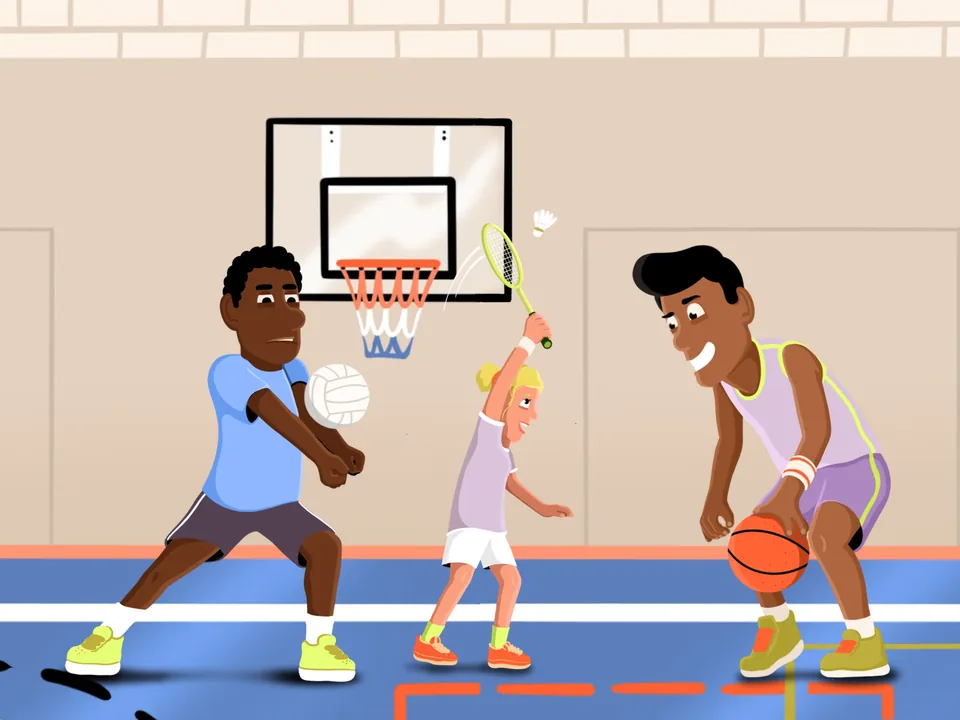
In winter the field is gone, the gym is shared with other teams, and wet shoes end up on the floor.
Get the app for iOS & Android and open the 3 free units without an account; the 7-day free trial applies to the Yearly plan and the 12-month plan, and you can see current prices in the app.
App for iPhone, iPad and Android.