Literacy Activities for PE Class
This list is for PE specialists, classroom teachers who run PE and secondary teachers who are asked how their class supports reading and…
Nine Black History Month PE activities cover Grades K–12, and each takes 10 to 30 minutes with common gym gear. Pair every game with one real person or tradition, such as Wilma Rudolph's relay or Double Dutch, and tell that story in about 2 minutes before students move.
These activities are for PE teachers planning February, from kindergarten freeze dance to high school tournaments. Every game spells out its scoring, what happens after a mistake and how a round restarts. Safety conditions are noted wherever students jump, sprint, kick or use ropes.
Nine activities cover Grades K–12, from a 10-minute freeze dance to a 30-minute round-robin cup. Group sizes assume a class of 24 to 30 students.
| Activity | Grades | Group | Time | Gear |
|---|---|---|---|---|
| Jazz Freeze Dance | K–2 | Whole class | 10 min | Speaker, floor spots |
| Read-Aloud, Move-Along | K–3 | Whole class | 15 min | Picture book |
| Double Dutch Jump-In | 2–8 | Teams of 4 to 6 | 20 min | 2 long ropes per team |
| Negro Leagues Kickball | 3–6 | 2 teams of 8 to 15 | 30 min | Soft kickball, 4 bases |
| Rudolph's Relay | 3–8 | Teams of 4 | 15 min | Foam batons, cones, tape |
| Athlete Spotlight Stations | 5–12 | Groups of 4 to 5 | 30 min | Cards, cones, landing mat |
| Trivia Sprint | 5–12 | Teams of 4 to 6 | 15 min | Question cards, cones |
| Soul Train Line | 5–12 | Whole class | 15 min | Speaker, open lane |
| Pioneer Cup | 6–12 | 6 teams | 30 min | Pinnies, game equipment |
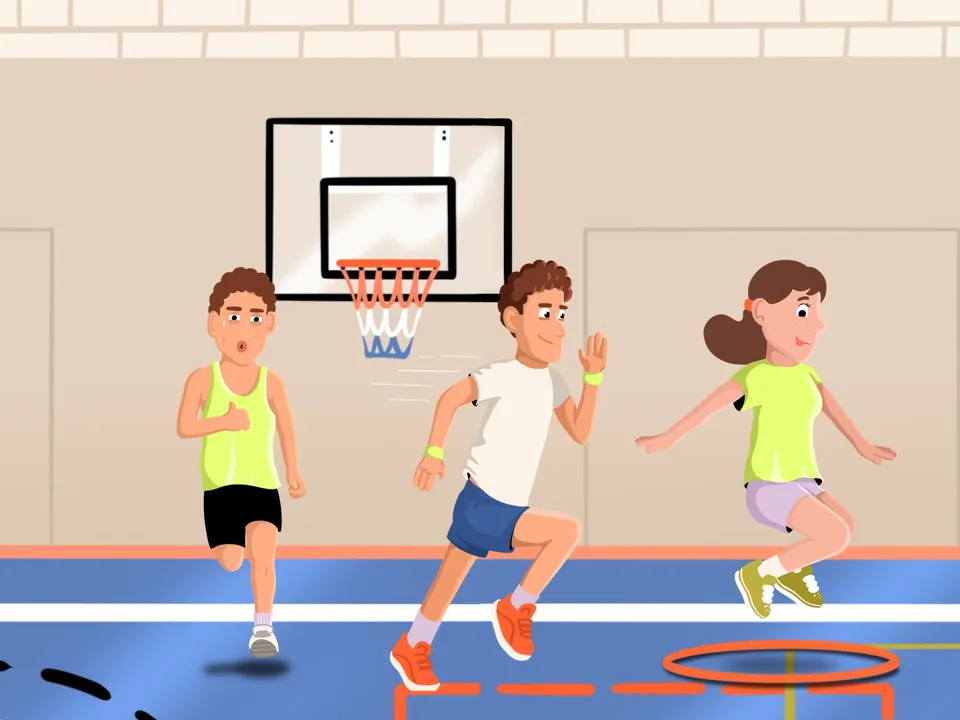
Jazz Freeze Dance and Read-Aloud, Move-Along suit Grades K–3 because the history fits into a few sentences and the movement is locomotor (see locomotor activities for K–5).
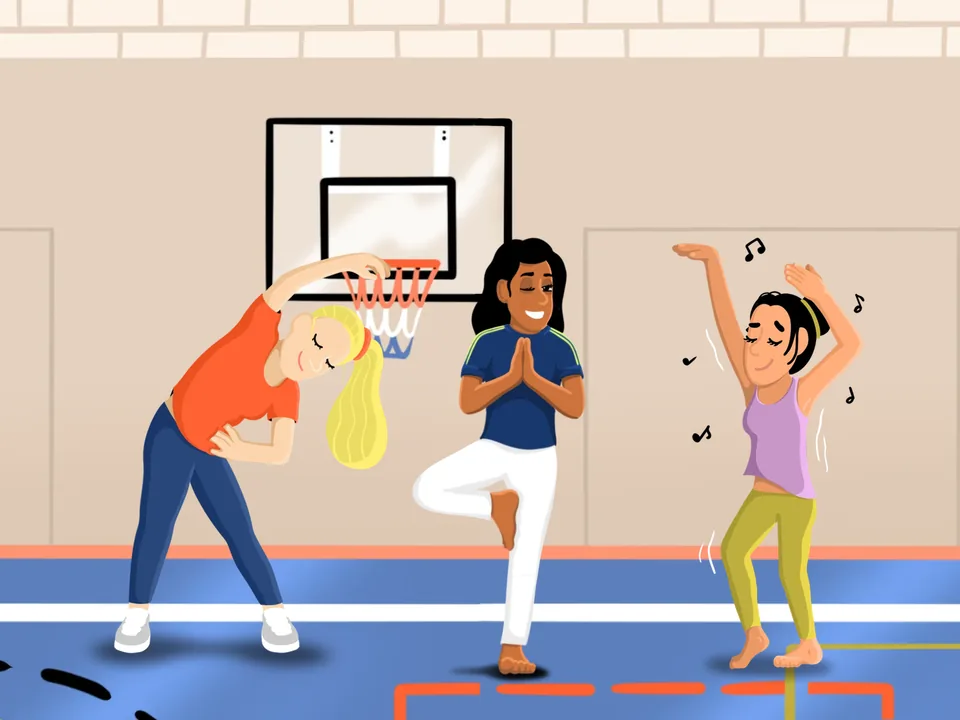
Grades K–2, whole class, about 10 minutes, a speaker and one floor spot per child. Play a track by a Black jazz musician such as Louis Armstrong or Ella Fitzgerald and call a locomotor skill each round: skip, gallop or slide. To vary it, add a pathway such as zigzag or curved (more in movement concept activities for PE). When the music stops, children freeze in a balance pose on their spot. Nobody is out: a child who moves early simply tries again next round, and the game ends after eight rounds. Keep an arm's length between children on a dry floor.
Grades K–3, whole class, about 15 minutes, one picture book. Read a short passage from a picture biography such as Wilma Unlimited by Kathleen Krull. Each time you read a movement word like run, leap or balance, the class acts it out for 10 seconds. After four passages, students name one fact they remember and walk a cool-down lap. The literacy in PE guide has more book-based ideas.
Double Dutch Jump-In and Negro Leagues Kickball suit Grades 2–8 and give teams a clear score to chase.
Grades 2–8, teams of 4 to 6, about 20 minutes, two long ropes per team. Black girls in New York City made Double Dutch popular, playing on sidewalks and stoops, and in the 1970s two city police officers, Ulysses Williams and David A. Walker, organized it as a team sport and brought it into schools (Michigan Public). Each team has two turners, one jumper and one counter. Start with one long rope until a jumper reaches 10 jumps in a row, then add the second. A miss resets the count to zero and roles rotate. The best streak is the team's score, and the round ends after everyone has jumped twice. Space teams a full rope length apart on a non-slip floor. The jump rope skills ladder covers progressions.
Grades 3–6, two teams of 8 to 15, about 30 minutes, a soft kickball and four bases. The Negro National League formed in 1920 as a professional league for Black players, and Jackie Robinson broke major league baseball's color line with the Brooklyn Dodgers in 1947. Play standard kickball with a rolled pitch: three outs end an inning, a ball caught in the air is an out, and a base player holding the ball on the base before the runner arrives is an out. Fielders never throw at runners. Each run is one point. A foul is a re-kick, and a third foul in one at-bat counts as an out. The game ends after three innings. Roll pitches at a moderate speed and keep waiting kickers behind a cone line well back from home plate.
Rudolph's Relay and Athlete Spotlight Stations put Black Olympians and other athletes at the center of a skill practice.
Grades 3–8, teams of 4, about 15 minutes, a foam baton per team, cones and tape. Wilma Rudolph won the 100 m, 200 m and 4 × 100 m relay at the 1960 Rome Olympics, the first American woman to win three track and field golds at one Games (World Athletics). Each runner sprints a short leg between cones and passes the baton inside a taped exchange box. Only clean passes score, one point each. A dropped baton is picked up by the runner who dropped it, and the pass restarts in the box. Each team runs three rounds, and the team with the most clean passes wins. Leave a run-out past the last cone, keep lanes apart and use dry grass or a non-slip floor. The track and field unit guide adds more events.
Grades 5–12, groups of 4 to 5, about 30 minutes, six stations with a bio card at each, plus cones, foam balls and a landing mat. Pair each athlete with one skill: Wilma Rudolph and a sprint start, Jesse Owens (four golds at the 1936 Berlin Olympics) and a standing long jump, Alice Coachman (1948 London Olympic high jump gold) and a low jump over a pool-noodle bar onto a mat, Jackie Robinson and a base-running turn, Althea Gibson and foam-ball rallies, Simone Biles and balance holds on a taped line. Groups rotate on a whistle, read the card aloud and earn a stamp for answering its one question. The round ends after all six stations. Supervise the jump station directly and keep the bar low. Station setups shows layouts.
Trivia Sprint and Soul Train Line suit Grades 5–12, and Pioneer Cup suits Grades 6–12, because students at these ages can research, choose and compete.
Grades 5–12, teams of 4 to 6, about 15 minutes, a question deck at the far end and cones. Teams line up behind a start cone. The first runner sprints to the deck, draws a card about an athlete or event from that week's lessons, jogs back and the team answers together. A correct answer earns 2 points and a wrong one earns 0, with no exercise penalty. The next runner draws a new card, and the round ends when every runner has gone twice. The team with the most points wins. Set the deck several steps short of the wall and keep team lanes apart. For a clue-based version with locks and codes, adapt the PE escape room template with Black history questions.
Grades 5–12, whole class, about 15 minutes, a speaker and an open floor lane. Soul Train was a long-running music and dance TV show, and its signature line had dancers take turns moving down the middle of two facing lines. Pairs dance down the lane for eight counts with moves they choose, such as a step-touch or grapevine, while the lines clap the beat, then peel off to the end. Anyone may walk the lane. The activity ends after everyone has gone twice.
Grades 6–12, six teams of 4 to 5, about 30 minutes, pinnies and the gear for a game your class already knows. Before class, each team picks a Black athlete, coach or team as its name and writes a one-sentence introduction. Build the round-robin in the Tournament Planner in the PhysEdPrep app: six teams on three courts play five rounds of 5-minute games. A win earns 2 points and a tie 1. That sport's usual rules decide fouls, turnovers and restarts. The cup goes to the team with the most points after round five, and ties share it.
Tell one person's story accurately in about 2 minutes, then let students move. In the US, Congress passed Public Law 99-244 in 1986, designating February 1986 as “National Black (Afro-American) History Month”, and the 2026 theme, “A Century of Black History Commemorations,” marks 100 years since Negro History Week began in 1926 (GovInfo).
To keep the history from turning into a lecture, attach one fact to one movement and give students a choice, such as which athlete names their team or which move they add to the Soul Train lane. Check every card against a museum, library or federation page before you print it. Keeping the talk to about 2 minutes also protects active time, and the guide to reaching 50% MVPA in PE class shows how to plan for it.
| Mistake | Cause | Fix |
|---|---|---|
| Cards list medals only | Facts without context | Add one obstacle the person faced and one question |
| Slavery or segregation becomes a game premise | Wanting the story to feel real | Discuss hard history, play only achievements and traditions |
| Only athletes appear | Sport-class habit | Add musicians, dancers and traditions such as Double Dutch |
| Wrong dates or names | Unchecked sources | Verify each card before printing |
The 2026 theme is “A Century of Black History Commemorations,” set by the Association for the Study of African American Life and History (ASALH). It marks 100 years since Carter G. Woodson created Negro History Week in 1926.
The United States and Canada observe it in February, and the United Kingdom observes it in October. US schools teach it in February, and Congress designated February 1986 as National Black History Month (Public Law 99-244). Choose the month that matches your school calendar and country.
Five widely taught events are the Emancipation Proclamation (January 1, 1863), the Brown v. Board of Education decision (1954), the Montgomery Bus Boycott (1955–1956), the March on Washington (August 28, 1963) and the Voting Rights Act (1965). Add Jackie Robinson's 1947 major league debut to connect with sports, and pick events by grade level.
Yes, most of these activities adapt well when you offer a choice of role or pace. Run Jazz Freeze Dance seated or with arm movements, let relay runners walk or roll their leg, keep Trivia Sprint at a brisk walk, and let anyone walk the Soul Train lane. Ask the student what works for them and adjust distances before the activity starts.
Yes, the nine activities use gear many gyms already have, such as cones, pinnies, long jump ropes, a soft kickball and a speaker, plus printed cards and one picture book from your library. For free planning material, three free units open without an account: Basketball: Shooting, Passing & Dribbling (Grades 5–7), Parachute Games and Classroom Brain Breaks. They are general PE units, not Black History Month units.
This list is for PE specialists, classroom teachers who run PE and secondary teachers who are asked how their class supports reading and…
Elementary PE specialists, classroom teachers covering gym periods, and student teachers can use any game below as a quick warm-up or…
PE stations split a class into small groups that rotate through different tasks, so more students handle equipment and fewer stand in line.

For the last week before winter break, or any class that needs a team puzzle without a props budget, you can build an escape room from…
Download the app free for iOS & Android and try the 3 free units without an account. Yearly and 12-month plans start with a 7-day free trial; see current prices in the app.
App for iPhone, iPad and Android.