Goalball, Boccia & Sitting Volleyball
Each comes with rules for scoring, fouls, and restarts, and you also get a goalball court diagram, low-cost equipment swaps, and jobs for…
Four square uses four players in squares numbered 1 to 4, who hit a rubber playground ball underhand after it bounces once in their square. Square 4 starts each rally with a drop-and-hit serve. A player who misses, allows two bounces, sends the ball onto an inside line or out of bounds, or catches it goes to the waiting line, and lower players move up.
Elementary and middle school teachers need four square rules that students can apply on their own, at recess and at a PE station. Below are a court plan and a call table that settles liners and cherry bombs before the first serve, plus rotation setups and K–2 changes.
A common school four square court for Grades 3–12 measures about 16 × 16 ft in total, divided into four equal 8 × 8 ft squares numbered 1 through 4, and uses a rubber playground ball around 8.5 inches in diameter. For Grades K–2, shrink the grid to about 12 × 12 ft (four 6 × 6 ft squares) and use a soft, light ball around 10 inches wide. The smaller grid also fits tight indoor spaces.
Arrange the grid so Square 4 sits next to Square 3 and Square 1, with Square 2 diagonally opposite, and mark a corner Service Line inside Square 4. Use a dry, level blacktop or swept gym floor free of gravel and loose equipment, with about 4 ft or more of clear space between the outer lines and any wall, pole, or neighboring court. Put the waiting line about 4 ft behind Square 1, require closed-toe athletic shoes, and have an adult supervise, as you would for other outdoor recess games for PE and playground play.
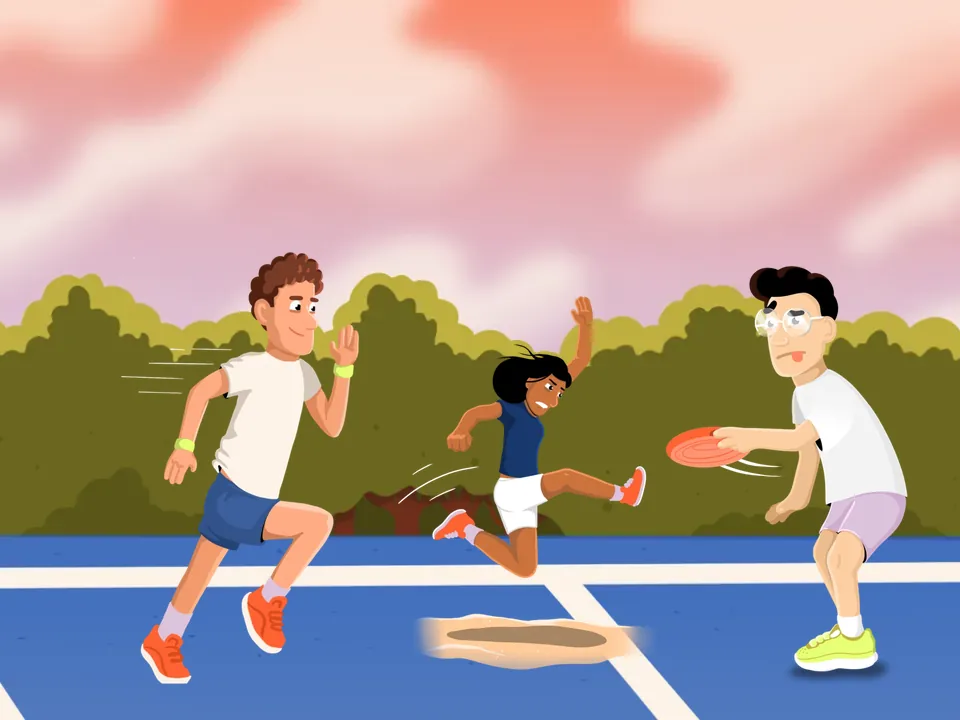
Four players try to move up from Square 1 to Square 4 and then stay there for as many rallies as they can. Your square is your rank, so standard play needs no team score. For a number in PE class, the player in Square 4 can count 1 point for each rally survived.
In common school play, a hit onto an inside line puts the hitter out, a ball on an outer line is in, and a cherry bomb is an out. Some playgrounds count every line as out, so announce your version before the first serve. A cherry bomb usually means a hard slam that sends the ball bouncing high over another player's head. It can hit a classmate in the face, so keep it banned and have an adult watch the courts.
| Play or Mistake | Common School Call | Quick PE Cue |
|---|---|---|
| Inside line hit ("liner") | Hitter is out; inside lines divide squares. | Remind players: "Inside out, outside in." |
| Outer boundary line hit | Ball is good; receiver must return it. | Redraw faded lines before play. |
| Air hit before bounce | Receiver who touched it early is out. | Have beginners say "bounce, hit" aloud. |
| Double bounce or miss | Player whose square got the first bounce is out. | Wait near the back line in ready stance. |
| Hold, catch, or scoop | Player who cradles or carries the ball is out. | Strike cleanly with flat, open palms. |
| Cherry bomb or fist hit | Hitter is out; only open-palm underhand hits count. | Palms up, swing from low to high. |
If two players disagree about whether a fast shot clipped an inside line, replay the rally from Square 4 or settle it with one round of Rock-Paper-Scissors. Skip the waiting-line vote, because the next student in line gains from an out. Handling calls this way gives students practice in solving problems with others, part of Standard 3 (social skills) in SHAPE America's 2024 National Physical Education Standards (S1–S4).
Cap each four square group at around 6 to 8 students per court (four active players plus two to four waiting) so players who are out get back into Square 1 sooner. With 20 students on one grid, 16 of them stand and wait. Open more courts, since SHAPE America recommends moderate-to-vigorous physical activity for 50 percent of PE class time.
At recess, shorter lines mean more turns, which helps toward the 60 minutes or more of daily moderate-to-vigorous activity that the federal Physical Activity Guidelines for Americans set for ages 6 through 17.
Cooperative, doubles, and seated play change the goal, team size, or position for mixed skill levels. Unless noted, underhand open-palm hits, inside-line outs, upward rotation, and Square 4 serves still apply, and play ends at your whistle.
All four players chase the longest rally, adding 1 group point per legal hit. A fault resets the count to zero: Square 4 goes to the back of the line, the others move up one square, and a waiting student enters Square 1. With only four players, Square 4 moves to Square 1. The new Square 4 serves, and the best count is the court record.
Eight players form pairs, one pair per square, on a court of about 20 × 20 ft with about 4 ft or more of clear space around it. Partners alternate hits, one after each bounce, and the other partner steps clear. The pair in Square 4 serves and earns 1 point per rally survived. A fault, or two hits in a row by one partner, sends both to the line; lower pairs move up and a waiting pair enters Square 1. With exactly eight players, the pair that faulted restarts in Square 1. Most points at the whistle wins.
Everyone plays seated, so wheelchair users and classmates share a similar height. Use a court of about 12 × 12 ft, a soft ball around 10 inches wide, and up to two bounces per square. Classmates sit on sturdy chairs without wheels while an adult watches for tipping; wheelchair users may roll within their square. Rotate as usual and serve once everyone is seated. It fits a unit with adapted PE games like goalball, boccia, and sitting volleyball.
In Grades K–2, shrink the court to about 12 × 12 ft (four 6 × 6 ft squares), use a soft, light ball around 10 inches wide, and skip outs while students learn to bounce and push the ball. Young players are still building bounce timing, so full rules can end many rallies right at the serve. While outs are paused, rotate on your signal.
Yes, one or two hands both work in this school version, as long as the hit is underhand with an open palm. A fist, an overhand swing, a catch, or a carry counts as an out. Some playgrounds set their own hand rule, so agree on it before the first serve.
Yes, players may step outside the outer boundary lines to return a wide shot after the ball bounces once inside their own square. Stepping across an inside line into another player's square in a way that blocks their path or swing counts as interference and causes an out.
No, bus stop, double tap, and black magic are playground house rules, and their meaning can change from school to school. Letting Square 4 add new rules before every serve slows rotations and starts arguments. Post one fixed set of underhand rules that applies to every round.
A missed or out-of-bounds serve is a fault in the standard setup for Grades 3–12, so Square 4 goes to the back of the line. While K–2 students or other beginners are still learning the drop-and-hit serve, let them try again without calling an out.
Each comes with rules for scoring, fouls, and restarts, and you also get a goalball court diagram, low-cost equipment swaps, and jobs for…
Each entry gives group size, gear and round length, plus the rules for what happens when the balloon hits the floor.
This list is for PE specialists and classroom teachers who run bean bag toss games for kids in Grades K–5, with a few options for Grades…

Recess supervisors and classroom teachers in Grades K–5 need games that start fast and run without a referee.
The PhysEdPrep app for iOS and Android is a free download with 3 free units you can try without an account: Basketball (Grades 5–7), Parachute Games, and Classroom Brain Breaks. Yearly and 12-month plans start with a 7-day free trial that opens 40+ unit plans, 240+ lessons, and all 6 gym tools for Grades K–12 (see current prices in the app).
App for iPhone, iPad and Android.