Games & warm-ups
10 Hula Hoop Games for PE
Each game comes with grades, group size, hoop count and a full rule set, followed by safety rules, fixes for common problems and ways to…
Ten balloon games for PE class run from solo keep-ups to balloon volleyball, in rounds of 2–5 minutes. Most need one balloon per student, pair or group and a clear floor the size of a classroom with the desks pushed back. Before you start, check for latex allergies and supervise closely with students under 8, because broken balloon pieces are a choking hazard.
This list is for PE teachers, classroom teachers and substitutes who need a low-prep game on a cold or rainy day. Each entry gives group size, gear and round length, plus the rules for what happens when the balloon hits the floor. Latex allergies and students under 8 can rule latex balloons out; the safety section covers what to do instead.
Body-Part Keep-Up, Combo Chain, Partner Rally and Circle Keep-Up fit a classroom with the desks pushed to the walls. The other six games need more open floor, such as a gym. The table lists group size, extra gear and round length for all 10 games.
| Game | Group | Extra gear | Round |
|---|---|---|---|
| Body-Part Keep-Up | Solo | Hula hoop or spot per student | 2 min |
| Slalom Tap | Solo, lines of 4–5 | 6 cones per course | 2 min |
| Combo Chain | Solo | None | 3 min |
| Partner Rally | Pairs | Hoop or spot per player | 2 min |
| Circle Keep-Up | Groups of 5–6 | None | 3 min |
| Noodle Balloon Relay | Teams of 4–5 | 1 pool noodle per team, 2 cones | 3 min |
| Balloon Volleyball | 4–6 per side | Rope or net, 2 stands | 10 points or 5 min |
| Balloon Four Square | 4 per court | Tape or chalk | 4 min |
| Protect Your Balloon | Whole class | 3 pinnies | 3 min |
| Balloon Clear-Out | Two teams | Cones or tape for a center line | 2 min |
Balloons fall slowly, which gives beginners time to track the object and strike it. Scarves slow the object the same way, as in the scarf activities guide. Balloon tapping is often light activity, and SHAPE America recommends moderate-to-vigorous activity for 50 percent of PE class time, so pair a balloon game with a faster station. More low-prep options are in PE games for small spaces and rainy day indoor PE games.
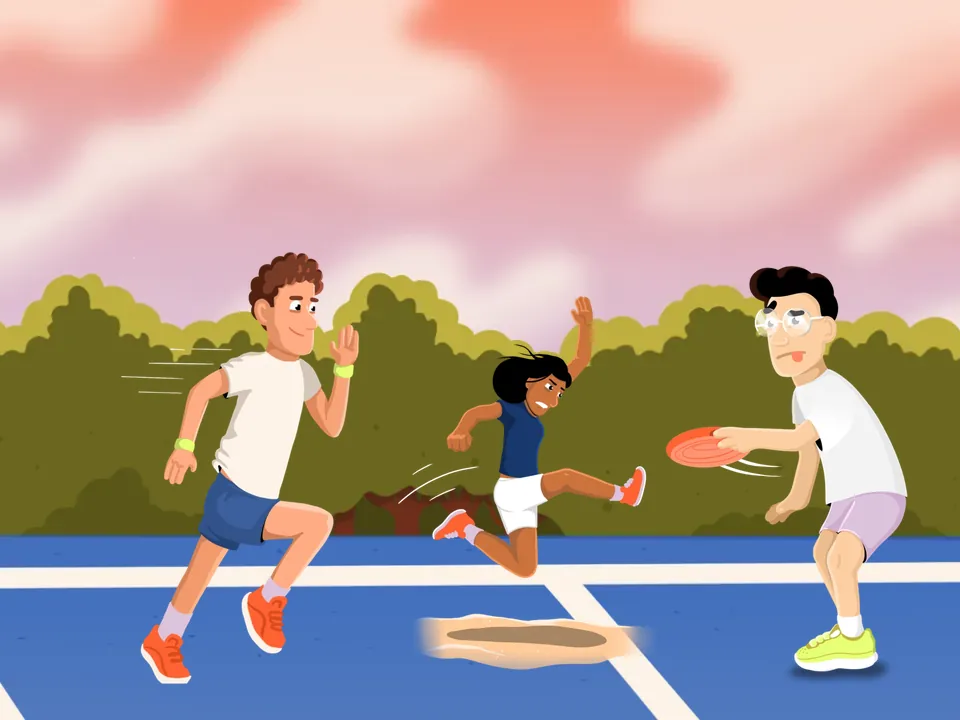
Before the first balloon comes out, check for latex allergies, think about student age and decide what you will do when one breaks.
Body-Part Keep-Up, Slalom Tap and Combo Chain give every student a balloon and a personal number to beat. A hula hoop or poly spot gives each student a space; the hula hoop games guide has more ways to use hoops.
Solo · 1 balloon and 1 hoop each · 2-minute rounds
Each student stands in a hoop and taps the balloon up without letting it touch the floor. Call a body part (right hand, left elbow, knee, head) and students use only that part until you call the next one. If the balloon lands, the student picks it up, steps back into the hoop and restarts the count at zero; students remember their best streak.
Solo, lines of 4–5 · 6 cones per course · 2-minute rounds
Set 6 cones in a zigzag about three big steps apart, one course per line. Students walk the course tapping the balloon upward with open hands, circle each cone and rejoin the back of the line; the next student starts when the one ahead reaches the third cone. If the balloon lands, the student restarts from the cone where it fell, and the round ends after 2 minutes.
Solo · no extra gear · 3-minute rounds
Students tap the balloon up and complete a chain of actions in order before the next tap. The chain starts with one action (a clap); after two clean chains in a row, add a second action (clap, then turn 360 degrees), then a third (touch the floor). A landed balloon sends the student back to one action. The round ends after 3 minutes, and students share their longest chain.
Pairs and groups of 4–6 can play Partner Rally, Circle Keep-Up and Noodle Balloon Relay, and each one has a shared count or a finish line to beat.
Pairs · 1 balloon per pair · 2-minute rounds
Partners stand about 6 ft apart, each in a hoop or on a spot, and tap one balloon back and forth, alternating touches. Every touch adds one to the shared count. If the balloon lands or one partner touches it twice in a row, the count resets to zero, and the pair keeps its best number. Give each partner a foam paddle or a paper plate for a striking version.
Groups of 5–6 · 1 balloon per group · 3-minute rounds
Players stand in a circle and tap one balloon in any order, but nobody touches it twice in a row. The group counts taps out loud, and a landed balloon resets the count to zero. The group's best run within 3 minutes is its score; once a group passes 20 taps, add a second balloon.
Teams of 4–5 · 1 pool noodle per team, 2 cones · 3-minute rounds
Each team lines up behind a start cone with a second cone about 15 ft away. The first student taps the balloon forward with the noodle around the far cone and back, then passes noodle and balloon to the next student. If the balloon gets away, the student fetches it and restarts from the spot where it got away. The first team with every student through wins; the round also ends after 3 minutes. Keep noodles below the waist and walk. More ideas are in pool noodle games.
Balloon volleyball for kids works with a rope or net at about the head height of the shortest player, 4–6 players per side and up to 3 touches per side.
4–6 per side · rope or net on 2 stands · rounds to 10 points or 5 minutes
For a seated version, everyone sits on the floor and you lower the rope so seated players can reach over it. Students who cannot run or jump then play on the same terms.
4 per court, the rest in line · tape or chalk squares · 4-minute rounds
Mark four touching squares in a 2 × 2 block, each about 5 ft per side, with one player per square and the rest in line. A player taps the balloon once with an open hand into any other square, and the player in that square must tap it on before it lands. Whoever lets it land in their square or taps it out of bounds steps to the end of the line, and the next student takes the square and starts the next rally with a tap. The round ends after 4 minutes.
Protect Your Balloon and Balloon Clear-Out are the two whole-class games on this list, and both need open gym floor and a clear stop signal such as a whistle or one of these attention getters.
Whole class · 1 balloon per student, 3 pinnies · 3-minute rounds
Each student keeps a balloon in the air while walking around the space. Three students in pinnies (for a class of about 24) have no balloon and are the wind: a wind player may tap another student's balloon with an open hand to send it away, but never touches the student and never taps the same balloon twice in a row. When a balloon lands, that student swaps with the nearest wind player: the student takes the pinnie and the wind player takes the balloon. Nobody sits out, and the round ends after 3 minutes.
Two teams · about 1 balloon per student · cones or tape for a center line · 2-minute rounds
Mark a center line and spread the balloons evenly on both sides. Teams tap balloons to the other side with open hands only, at a walk, and nobody crosses the line, throws, kicks or holds a balloon. At the stop signal everyone freezes and you count the balloons on each side: the team with fewer balloons on its side scores a point, equal counts score nothing, and balloons on the line count for neither. Redistribute evenly and play three rounds; the team with more points wins, and a tie plays one more round.
Inflate balloons before class with a hand pump or a handheld electric pump, and never ask students to inflate by mouth.
| Problem | Likely cause | Fix |
|---|---|---|
| Balloons drift off course | Ceiling fans, vents, open doors | Switch fans off and close doors before the first round |
| Students swat balloons at each other | Hard hits, no spacing | Open-hand taps only, hoops or spots for spacing |
| One strong player takes every volleyball touch | No touch rule | Add: no player touches twice in a row on a side |
| Balloon count at cleanup is one short | A balloon broke unnoticed | Pause and search the floor before the next game |
All 10 balloon games on this list run indoors, in a gym or a cleared classroom, and Body-Part Keep-Up, Combo Chain, Partner Rally and Circle Keep-Up need the least space. The guide to PE games for small spaces lists more indoor options for half gyms, hallways and cafeterias.
The name can mean a keep-it-off-the-floor game or the ankle-balloon stomp, where each player guards a balloon tied to an ankle. Protect Your Balloon above keeps the idea without popping: students keep their own balloon airborne while wind players try to knock it away. Skip ankle stomp with students under 8, since popped latex is a choking hazard and the bangs are loud.
Balloon volleyball, Circle Keep-Up and Balloon Clear-Out work for staff meetings, family nights and adult classes because the rules take about a minute to explain. Add a second balloon to Circle Keep-Up once the group passes 20 taps, and play volleyball seated if abilities are mixed. Ask about latex allergies first, as you would with students.
Usually not on their own, because balloons move slowly and most students tap at a light effort. SHAPE America recommends moderate-to-vigorous activity for 50 percent of PE class time, so pair a balloon game with a faster station or relay. Balloon Clear-Out and Noodle Balloon Relay tend to raise the pace most, and seated volleyball is the lightest.
Yes, for Body-Part Keep-Up, Combo Chain, Partner Rally and Circle Keep-Up, once the desks are pushed to the walls and the floor is clear of chairs and bags. Save the other six games for a gym, cafeteria or multipurpose room, because they need lanes, courts or room for the whole class to move. Ceiling fans and open vents push balloons off course, so switch them off.
Each game comes with grades, group size, hoop count and a full rule set, followed by safety rules, fixes for common problems and ways to…
This list is for PE specialists and classroom teachers who want pool noodle activities for kids that cost little.
When an assembly, a testing day or a second class takes half your gym, the students still show up. PE games for small spaces work when you…
With clear floor boundaries and modified rules, you can run indoor PE activities that keep students moving safely without knocking over…
Get the app for iOS & Android and try the Team Creator and Countdown Timer on your next indoor day. The Yearly plan starts with a 7-day free trial; see current prices in the app.
App for iPhone, iPad and Android.