Standards
Assessing PE Class Without Losing Time
PE assessment is the evidence you collect about what students can do, know and choose to do in class.
Grading in PE gets challenged fast when a grade rests on talent or uniforms, because students come into class with very different starting points. A defensible grade needs written criteria, a few kinds of evidence, and a routine that fits inside a normal class period. The same structure carries from Grades K–5 to Grades 6–12; only the weights and the wording of the criteria change.
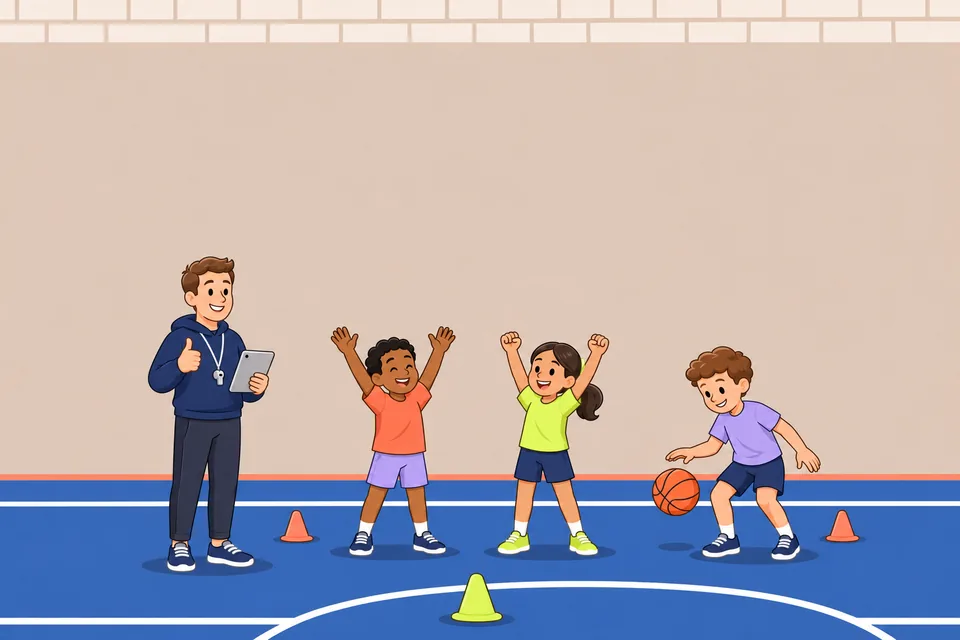
A PE grade should reflect what you taught: motor skills, knowledge of rules and tactics, and observable social behavior, each tied to written criteria students saw on day one. Leave out fitness test scores, natural talent, and uniform points. Collect evidence by watching a few students per class in roster order, so every student is observed several times per marking period.
Weights follow what you taught. A forearm-passing unit puts more weight on skills than a fitness-planning unit does. Set the split before the unit starts, hand it out on day one, and check your district policy first, because some districts fix the categories or require standards-based marks.
| Category | Evidence from normal class | Sample weight |
|---|---|---|
| Skills | Checklist of 2–4 taught cues, small-sided game observation, one skill task at unit end | 40–50% |
| Knowledge | Exit question, rules or tactics check, peer-coaching card, written fitness plan | 15–20% |
| Behavior | Observable actions: starts on the signal, includes teammates, follows safety rules | 30–40% |
Treat these weights as a starting range and shift them by grade band and unit. For example, 45% skills, 20% knowledge and 35% behavior adds up to 100.
Score the taught cues, not the outcome. For a forearm pass, the cues might be a flat platform, bent knees, and contact on the forearms. How high the ball goes depends partly on height and strength, so it stays out of the mark. The PE assessment guide covers collecting this evidence without losing activity time, and the Head, Heart, Hands guide sorts it into three domains.
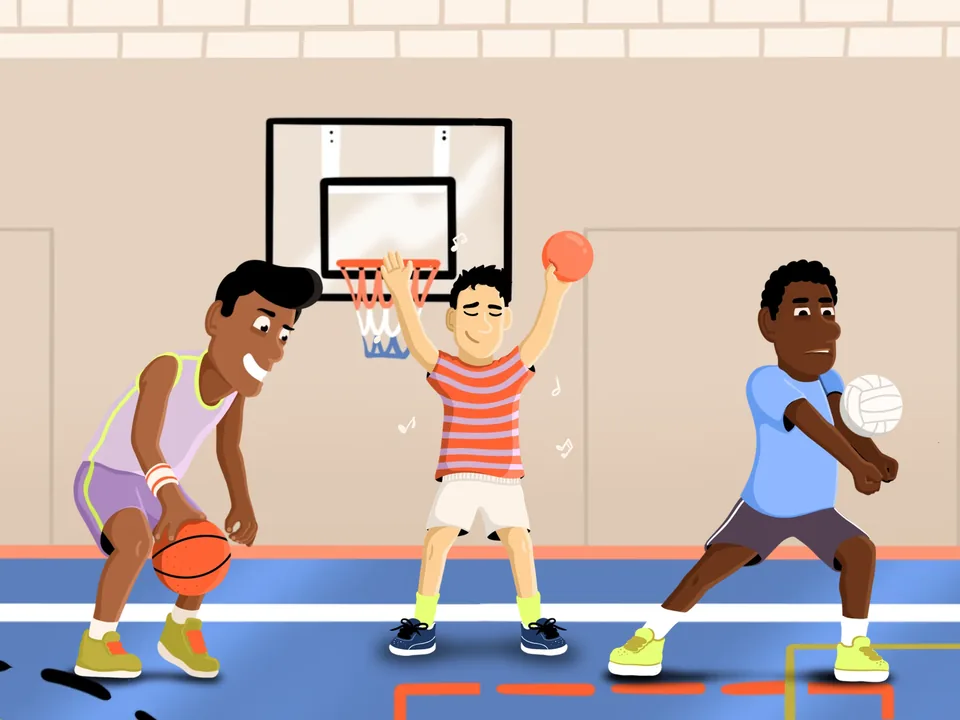
Participation and effort can count when you define them as actions you can see: starts on the signal, rotates with the group, follows safety rules, includes teammates. “Tries hard” cannot be seen from across the gym, so it drifts toward the students you already like.
Dress-out points are the weak spot because they reward owning the right shirt on the right day. Safe footwear and no loose jewelry are safety rules for the whole class, and you can enforce them without attaching points. SHAPE America also calls exercise as punishment, or withholding PE or recess as a consequence, inappropriate (SHAPE America position statement).
| Practice | Problem | Instead |
|---|---|---|
| Points for a specific uniform | Measures cost and laundry; can clash with family or religious dress | Require safe footwear and clothing the student can move in; grade “starts on the signal” under behavior |
| Grading fitness test scores | Genetics, growth timing, and starting point shape scores; SHAPE America's 2017 statement on appropriate and inappropriate uses of fitness testing (see the SHAPE America position statements) advises against grading on them | Grade a personal goal plan and knowledge of fitness concepts |
| Laps or push-ups for off-task behavior | SHAPE America calls exercise as punishment inappropriate | Restart the activity, have a private word, and record the behavior in the behavior category |
| Zero for a student who sits out | Erases evidence of knowledge and social skills | Assign a supervised role such as scorekeeper, official, or peer coach, and grade that task |
Standards-based grading in PE reports a level of mastery against a learning target instead of adding up daily points. SHAPE America's 2024 National PE Standards have four standards, S1 to S4: motor skills, movement and fitness concepts, social skills, and personal skills. They replaced the 2013 edition with five (S1–S5), so check which codes your district's report card prints and grade against those.
Pick one scale and write a descriptor for each level in student language before the unit starts. A four-level example for the forearm pass:
If your gradebook needs percentages, fix the conversion in advance. One example: level 4 = 100, level 3 = 85, level 2 = 70, level 1 = 55. Those numbers are a sample; your district's scale rules. Count later evidence more than early attempts, so a student who starts at level 1 and reaches level 3 earns a 3.
For unit-level mapping, see the guide on aligning PE lessons with the SHAPE America standards.
PE grading stays manageable when each class has one small job: watch one group against two to four cues. Here is a routine for a class of 28.
Seven students per class covers 28 students every 4 meetings. Over a 9-week marking period with two class meetings a week (18 meetings), each student collects at least 4 observation marks, plus the end-of-unit task.
Timers keep your eyes free. In the PhysEdPrep app for iOS & Android, the Differentiated Phase Timer lets you name every phase and give it its own time, and the Countdown Timer ends with a whistle. Class lists in the app hold private notes per student. All six Gym Tools are in the same app.
This is general information, not advice on a specific student. An IEP or 504 plan is a written document, so the accommodations it lists apply when you grade PE. Ask the case manager or the special education teacher which ones apply in your class, and follow them.
Keep the criterion and change the task. If the cue is “watches the target and steps toward it,” a student can show it with a seated throw at a larger target or with a lighter ball. The mark still reflects the same cue. Run modified tasks with enough space and supervision, and check equipment and surface for the student's needs. The guides on inclusive PE modifications and building an adaptive PE curriculum go deeper.
For a medical excuse, follow the written note and your district policy, and ask the school nurse what activity is allowed. A student who cannot be active can still earn evidence by officiating, scorekeeping, drawing a tactic, or writing a fitness plan. If a skill was missed because of a temporary injury, record “not assessed” instead of zero and reassess once the student is cleared. Asthma and heat conditions come with their own plans; follow those and your district's guidance.
Parents and principals usually ask the same three things: what is graded, how the grade was decided, and what the student can do to improve. A one-page grading sheet covers all three. Put the categories with weights, the cues for the current unit, and the level descriptions on it, and send it home at the start of the term.
Comments work best when they name a skill and a next step. Two samples:
For administrators, keep an evidence file: your grading categories with weights, the standards each unit targets, and your observation notes with dates. Keep the notes as long as your district's records policy says. If a grade is challenged, you can show the criteria, the evidence, and when it was collected.
Sometimes: whether PE counts toward GPA is set by district or state policy, and some schools include it while others exclude it or grade it pass/fail. Ask your counselor or registrar for the rule at your school. Either way, the grade is a school record. Written criteria and dated observation notes help you show how the grade was reached if it is ever questioned.
Give a high behavior mark and a skill mark that matches where the student is on the taught cues. Effort belongs in the behavior category, where it is scored by observable actions. Show the student the next level's descriptor and reassess later in the unit, because later evidence counts more than the first attempt.
Around 4 observation marks per student plus one end-of-unit task per unit is a workable minimum. That figure comes from watching 7 students per class in a class of 28 over about 18 meetings. Some districts set a minimum number of grades, so check yours first.
Cut the scope: two cues per unit, three levels (approaching, meeting, exceeding), and one end-of-unit task. Rotate the observation group by roster order so every student is watched on a schedule. Full rubrics on every student every day do not fit when you see around 500 students a week.
Pass/fail works when your district allows it and you mainly want to track participation and safety, but it hides skill growth. Letter or standards-based marks show progress on taught cues. If the report card requires letters, keep levels in your gradebook and convert them with a scale you publish in advance.
PE assessment is the evidence you collect about what students can do, know and choose to do in class.
A head heart hands pe assessment splits your gradebook into cognitive knowledge, social behavior, and physical execution so every K–12…
To align PE lessons with SHAPE America standards without adding paperwork, pick one standard per lesson, write an objective you can…
Open the 3 free units in the PhysEdPrep app, no account needed, and see how a unit builds lesson by lesson before you write your own criteria. Yearly plans start with a 7-day free trial; see current prices in the app.
App for iPhone, iPad and Android.