PhysEdPrep App Review for PE Teachers
Written for PE specialists, classroom teachers, student teachers and departments that are weighing a planning app before the next unit…
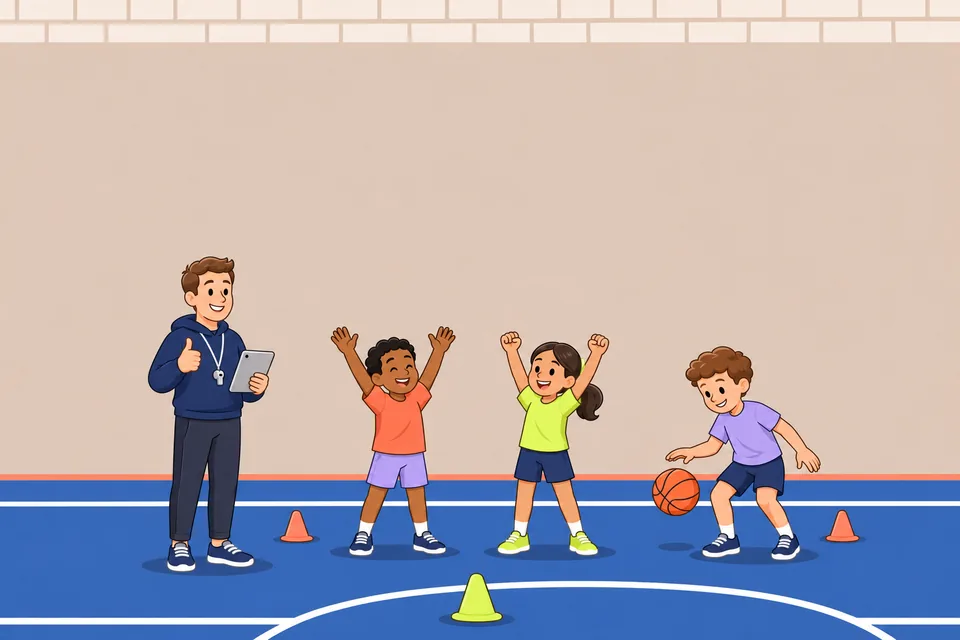
Protect your voice in a loud gym by speaking only when students are still and using a stop signal instead of shouting over the noise. Keep water at your sideline spot and sip between activities. See a doctor if hoarseness lasts more than three weeks, or sooner with warning signs such as pain when speaking or trouble breathing.
PE teachers, classroom teachers who run PE and student teachers often reach the last period with a scratchy voice after hours of talking over noise. The fixes here are signals, timers, standing spots and tone of voice, plus the warning signs that call for a doctor.
A gym wears out your voice because you talk over noise, across distance, for hours. Hard floors and walls bounce sound back, balls and sneakers add noise, and a class spread over a court or field means you call directions instead of saying them. The National Institute on Deafness and Other Communication Disorders lists speaking loudly in noisy situations and talking too long without rest among the causes of hoarseness from overuse. Teachers report voice problems more often than other adults: in a 2004 survey of teachers and nonteachers in Iowa and Utah, 11.0 percent of teachers reported a current voice problem, compared with 6.2 percent of nonteachers.
Two common drains in PE are shouting for attention and repeating a direction because half the class missed it. Both respond to routines. Early signs of strain:
Treat any of these as a cue to cut your talking that day. Hoarseness that lingers needs a doctor, covered in the last section.
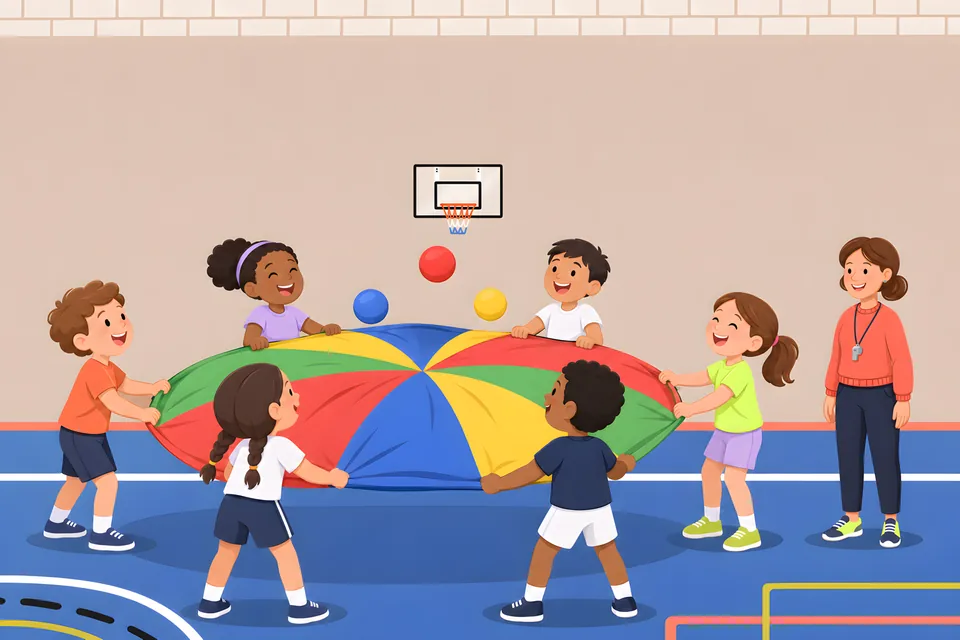
One stop signal that students have practiced replaces most of the shouting. Pick one per class, teach it in the first week and use it every time, because extra signals add noise. Practice with equipment in hand, so that “stop” means feet still, balls held or controlled on the floor, and eyes on you, even in a live game.
| Signal | How it works | Watch out for |
|---|---|---|
| Raised hand | You raise a hand and hold it; students copy, go quiet and face you. | Needs eyes on you. Add a second cue outdoors. |
| Whistle | One short blast means stop, nothing else. | Loud at close range indoors, so blow it from a few steps away from students. Overuse dulls it. |
| Music on and off | Music plays during activity; when it stops, students stop. | Needs a speaker you can pause fast, kept at a level you do not have to talk over. |
| Colored cone or flag | Green up means play, red up means freeze. | Needs a clear line of sight from the whole space. |
| Clap pattern | You clap a rhythm, students clap it back, then freeze. | Common in Grades K–5; Grades 6–12 may find it too young. |
Some students find whistles and sudden loud sounds hard to handle. Plan a visual stop cue and check with the student's IEP team or your school's adapted PE teacher (see what an adapted PE teacher does). For routines beyond stop signals, read classroom management in a loud gym.
A visible timer and scoreboard answer the questions you would otherwise call out: how much time is left, and what is the score. A wall clock, a stopwatch and a whiteboard already do this job. A timer on your phone or tablet adds an alarm, so you stop announcing the end of a round yourself.
The PhysEdPrep app for iOS & Android has four gym tools for this:
For a rotation, set the Differentiated Phase Timer once and use the quiet stretch to circulate and give feedback. The guides on station timers with rotation alerts and a digital scoreboard for multi-court classes cover setups in more detail.
Stand on the sideline with your back to the wall, so you can see every student, and stop talking once the activity starts. Give directions once, before play, at a normal speaking voice, with the class gathered close at a meeting spot. Ask one student to repeat the key rule, then send everyone out. That check heads off the second and third repeat.
During play, walk the edge of the activity instead of calling across it. Go to a student for a correction, and use thumbs, nods and hand signals for the rest. Stay out of ball paths and out of the middle of running games, and keep scanning the whole group.
The plan shows one setup: a teacher spot on the sideline, a meeting spot at center court, the scoreboard on the far wall and stations A to D around the space. The route visits each station in turn.
Less talking also leaves more room for movement. SHAPE America recommends moderate to vigorous activity for 50 percent of PE class time, and long explanations eat into that.
Change tone and pace for contrast, and let distance do the work that volume would do. Four tones, each with a line you could use:
Keep praise specific and say it from a few steps away: “Nice spacing on that pass.” If you catch yourself raising your voice to start a sentence, give the stop signal first and speak once the room is quiet.
Four habits protect your voice over a full day: water at transitions, an easy warm-up, quiet stretches in class and less talking on scratchy days.
A portable amplifier is another option. In a 2013 randomized trial, 40 female primary school teachers with mild voice problems took a voice-care course, and 20 of them also used an amplifier for 3 months. On the Voice Handicap Index, the amplifier group improved significantly (p = 0.003) and the course-only group did not (p = 0.4). The sample was small and all women, so the result may not carry over to a loud gym.
See a doctor if your voice has been hoarse for more than three weeks, especially without a recent cold or the flu. That is the NIDCD guidance. Go sooner if hoarseness comes with coughing up blood, difficulty swallowing, a lump in your neck, pain when speaking or swallowing, trouble breathing, or losing your voice completely for more than a few days.
Start with your primary care doctor or an ear, nose and throat doctor (otolaryngologist), who can look at your vocal folds and find the cause. Hoarseness has many causes, among them laryngitis, reflux and growths on the vocal folds, and only an exam sorts them out. A speech-language pathologist can then teach voice therapy: exercises and habits suited to your voice and your job. A voice coach helps with technique but does not diagnose.
This is general information, not a diagnosis for your case.
For your voice, the hardest class is the one where you repeat directions most in the largest space, whatever the age. Younger classes, such as Grades K–2, often need directions repeated more, while Grades 6–12 can need more behavior management. A stop signal, a meeting spot and visual timers cut the talking at either end.
A vocal teacher is usually called a voice teacher, voice coach or vocal coach. These coaches train technique for singing or speaking. A speech-language pathologist is the specialist for voice problems and runs voice therapy, typically after a doctor has looked at your vocal folds. If your voice hurts or stays hoarse, start with a doctor.
A whistle spares your voice, but it has limits. Use one short blast for stop only, from a few steps away from students, because a whistle is loud at close range indoors. Overuse dulls it. Students with sensory sensitivities may need a visual stop cue such as a raised flag, so check with your adapted PE teacher or the student's IEP team.
With mild hoarseness from a cold, you can usually keep teaching if you lighten your talking load: use signals and timers, run stations that manage themselves, and keep water at your sideline spot. If it hurts to talk or your voice is gone, take the day and use a sub plan. See a doctor if hoarseness lasts more than three weeks.
Written for PE specialists, classroom teachers, student teachers and departments that are weighing a planning app before the next unit…
You may share students with a specialist, or you may be weighing a move into adapted PE yourself.
Get the app and run your next station rotation with the Differentiated Phase Timer and the Scoreboard & Game Counter. The 7-day free trial comes with the Yearly plan and the 12-month plan; see current prices in the app.
App for iPhone, iPad and Android.