Games & warm-ups
10 Winter Games for PE Class
January and February bring cold days and no holiday theme to lean on. These games are built for classes of 12 to 32 students in a standard…
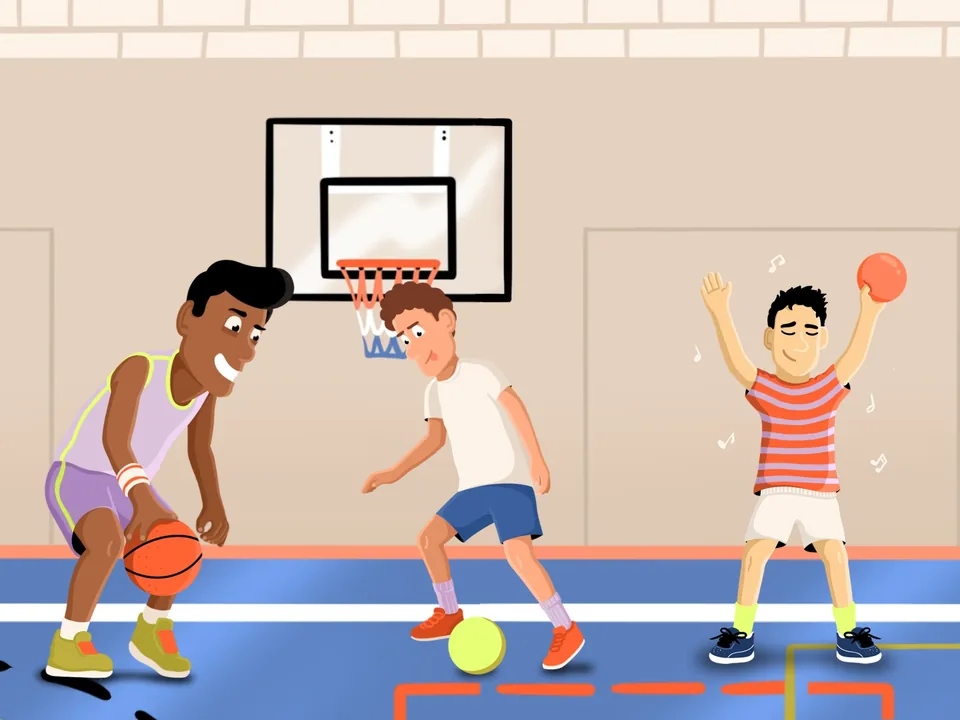
These 10 basketball games for PE keep Grades K–12 moving when you cap shooting groups at 3–6 players per hoop. Start Grades K–5 with whole-class dribbling games, then move upper elementary and secondary classes into partner shooting and 3v3 half-court play across 3–6 minute rounds with instant re-entry.
Teaching PE with 28 students and two to four hoops makes full-court 5v5 impractical because 18 kids stand waiting along the wall. The 10 games below fit elementary through high school gyms and outdoor blacktop, with player counts, scoring, turnover restarts, and a four-hoop floor layout.
A basketball game works in PE class when shooting groups stay at 3–6 players per hoop and mistakes trigger an instant reset instead of elimination. SHAPE America recommends moderate- to vigorous-intensity activity for 50 percent of PE class time, a figure cited in its dodgeball position statement. That time counts toward the 60 minutes or more of daily moderate-to-vigorous activity that ages 6–17 should get under the HHS Physical Activity Guidelines for Americans (2nd edition).
| Game | Grades | Group Size | Round Time | Primary Skill |
|---|---|---|---|---|
| Dribble Sharks and Minnows | K–5 | 12–30 players | About 4 minutes | Dribbling in traffic |
| Poly Spot Dribble Collectors | K–5 | 10–28 players | About 4 minutes | Heads-up control |
| Builders and Bulldozers Dribble | K–5 | 10–30 players | About 3 minutes | Low dribble |
| Poly Spot Hot Shots | 2–8 | 3–5 per hoop | About 5 minutes | Set shooting |
| End-Zone Basketball | 3–10 | 8–12 per court | About 5 minutes | Passing (no hoop) |
| Two-Ball Partner Hot Shot | 3–8 | 4–6 per hoop | About 4 minutes | Catch-and-shoot |
| 3v3 Half-Court Three-Pass | 6–12 | 6–9 per hoop | About 6 minutes | Spacing & passing |
| Sideline Basketball | 6–12 | 12–20 per court | About 6 minutes | Court vision |
| Continuous Knockout | 4–12 | 4–6 per hoop | About 5 minutes | Free throws |
| Team Around the World | 4–12 | 3–5 per hoop | About 5 minutes | Arc shooting |
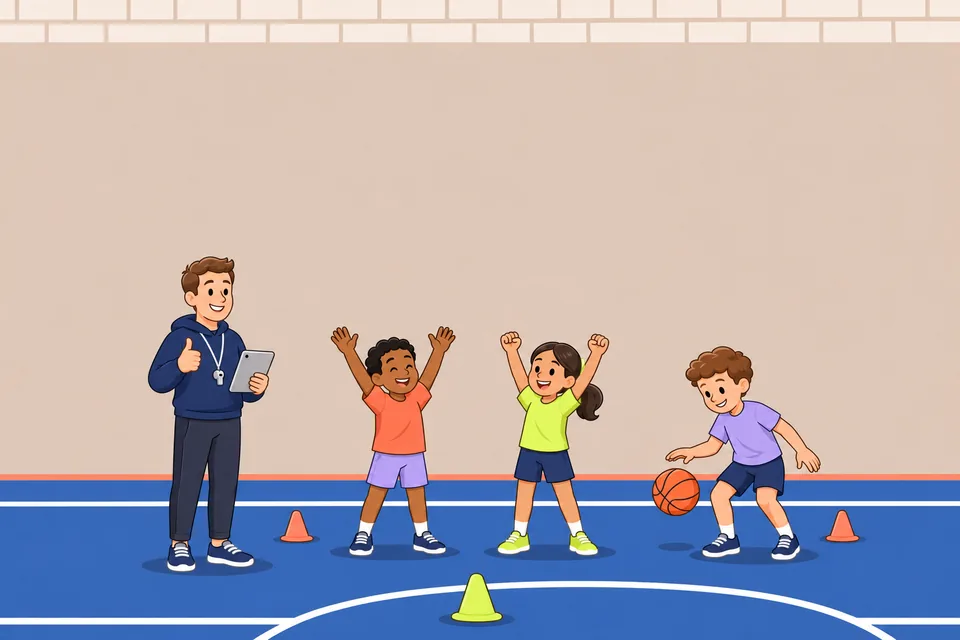
Dribbling games for Grades K–5 keep everyone active when each child has a ball. Use a Size 5 basketball (about 27.5 inches around) for Grades 3–5, a smaller Size 3 or Size 4 ball for Grades K–2, or a bouncy playground ball. For chase games without a ball, see these tag games for PE in Grades K–8.
Grades K–5, 12–30 players, about 4 minutes with one ball per minnow and four cones.
Grades K–5, 10–28 players, about 4 minutes with one ball each, 24 poly spots, and four corner hula hoops.
Grades K–5, 10–30 players, about 3 minutes with one ball per student and 24 tall cones.
Passing and shooting games cut waiting time when each hoop has 3–6 players and two balls, or when the class plays in coned end zones with no hoop at all.
Grades 2–8, 3–5 players per hoop, about 5 minutes with two balls and 10 poly spots per basket.
Grades 3–10, 8–12 players per court, about 5 minutes with one ball, eight cones, and pinnies.
Grades 3–8, 4–6 players per hoop, about 4 minutes with two balls and two baseline cones per basket.
Small-sided games in Grades 6–12 give each player more touches and more floor space than 5v5. The 2024 SHAPE America National Physical Education Standards for US K–12 PE (Standards S1–S4, released March 2024 to replace the 2013 five-standard edition) cover motor skills, movement and fitness concepts, social skills, and personal skills. Small-sided games let students practice shooting mechanics and teamwork in the same possession.
Grades 6–12, 6–9 players per hoop, about 6 minutes with one Size 6 or Size 7 ball and pinnies.
Grades 6–12, 12–20 players per court, about 6 minutes on a full court with one ball and pinnies.
Knockout and Around the World work in PE when groups of 3–6 players keep shooting and counting points until the buzzer. Classic Knockout eliminates the weakest shooters first, and classic Around the World leaves most of a group standing in line. For more indoor ideas on cold days, see indoor winter PE games for gym class.
Grades 4–12, 4–6 players per hoop, about 5 minutes with two balls and one free-throw cone per basket.
Grades 4–12, 3–5 players per hoop, about 5 minutes with two balls and five arc poly spots per basket.
Running basketball games for PE across four hoops is easier to supervise when you cone off a midcourt buffer lane, split teams before handing out balls, and rotate clockwise on one whistle.
In a four-hoop gym rotation, set Center Safety Cones in a lane about 6 feet wide down midcourt as a buffer between the left side (Hoop 1 and Hoop 4) and the right side (Hoop 2 and Hoop 3). Groups stay on their own side, and nobody crosses the lane to chase a loose ball while play is live. Check for dry floors, park carts behind the bleachers, and cone off unpadded baselines. In Grades K–2, use foam or light rubber balls, keep passes below head height, and stand where you can see every hoop.
Sort groups with pinnies, or see the guide to building fair random teams for PE class. On a phone or tablet, the 6 gym tools in the PhysEdPrep app for iOS and Android also split saved rosters with Team Creator and build round-robin schedules for 2 to 10 teams on up to 4 courts with Tournament Planner.
Most gym-class basketball breakdowns happen when balls go out before directions, 10-foot rims force hip heaves, or one player takes every shot.
| Mistake | Cause | Quick Fix |
|---|---|---|
| Bouncing during directions | Balls handed out early | Cue "ball between feet" on the whistle before speaking |
| Two-hand hip heaves | 10-foot rims and heavy balls | Lower adjustable rims to about 8 feet, or hang hula hoops at a height kids can reach, and use Size 5 balls for Grades 3–5 or Size 3–4 balls for Grades K–2 |
| One player dominates | No pass rule in 3v3 | Require three passes before opening the rim |
| Push-ups for turnovers | Exercise used as penalty | Use a quick skill reset like five waist wraps instead |
Single games like End-Zone Basketball fit emergency PE sub plans for grades K–12 alongside Capture the Flag games for PE class. For a multi-week progression, see our basketball unit plan for grades 3–12 or open 3 free units (including Basketball for Grades 5–7) without an account.
Put most of the class in a no-hoop game such as End-Zone Basketball or a dribbling game, and send one group of 3–5 players to each hoop for Poly Spot Hot Shots or Team Around the World. Rotate groups at the whistle after about 5 minutes so every student gets shooting time at the rim.
Minor games in PE are simplified, quick-setup activities with few rules that isolate one or two motor skills before students play a regulation sport. Basketball examples include Dribble Sharks and Minnows and End-Zone Basketball, which build dribbling in traffic, passing, and cutting without 5v5 fouls or set plays.
You need about 8 to 15 basketballs to run station, partner, or half-court games for 24 to 30 students, and one ball per child for whole-class K–5 dribbling games. With fewer than 10 basketballs, run two-ball shooting hoops alongside one-ball End-Zone Basketball.
Dribble Sharks and Minnows, Poly Spot Dribble Collectors, Builders and Bulldozers Dribble, and End-Zone Basketball all work without hoops on blacktop or a flat, dry multipurpose floor. End-Zone Basketball also works on a grass field because nobody dribbles. For a shooting target without a rim, lay a hula hoop flat for bounce-pass points or set a bin inside a coned circle with no defenders.
Most Grades 3–5 classes do well with a Size 5 ball (about 27.5 inches around), and Grades K–2 do better with a smaller Size 3 or Size 4 ball or a foam ball. Middle school students usually move to Size 6 (about 28.5 inches). Older boys often use Size 7 (about 29.5 inches). If a student has to heave the ball from the hip to reach the rim, give them a smaller ball or lower the rim before you change the drill.
January and February bring cold days and no holiday theme to lean on. These games are built for classes of 12 to 32 students in a standard…
Capture the flag is a two-team tag game: each side guards a flag on its own half of the gym or field and tries to carry the other team's…
Elementary PE teachers, classroom teachers without a PE background, middle school coaches, and substitutes can run these tag games for…

Each game comes with grades, group size, hoop count and a full rule set, followed by safety rules, fixes for common problems and ways to…
Download the free PhysEdPrep app for iOS and Android to open 3 free units without an account, including Basketball: Shooting, Passing & Dribbling for Grades 5–7. Start a 7-day free trial on a yearly plan in the app whenever you want all 40+ unit plans, 240+ lessons, 8 game collections, and 6 gym tools across Grades K–12.
App for iPhone, iPad and Android.