
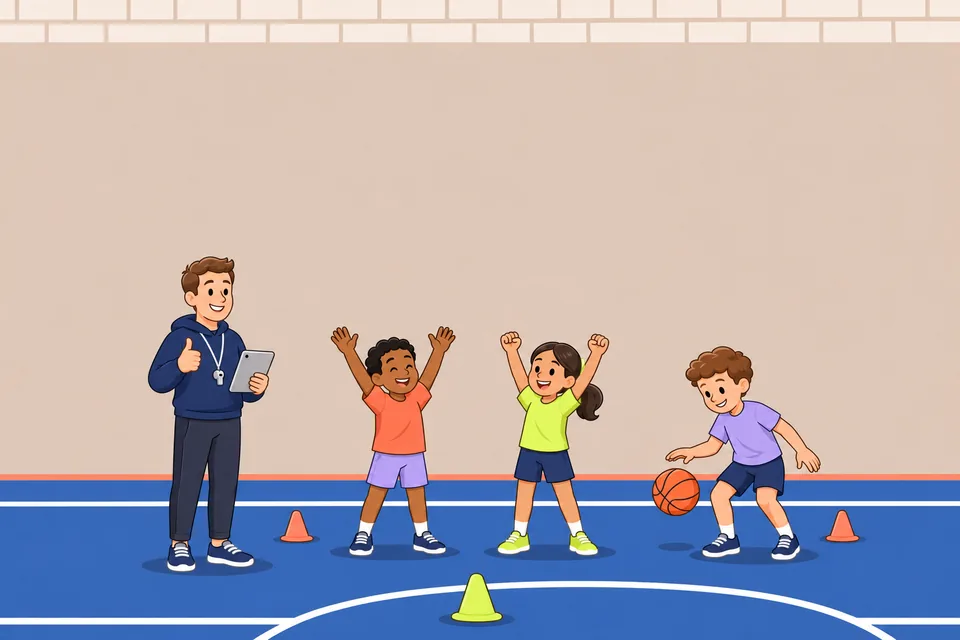
I Can Statements for PE by Standard
This guide is for PE specialists and classroom teachers who need I can statements for PE that students can read, say and rate.
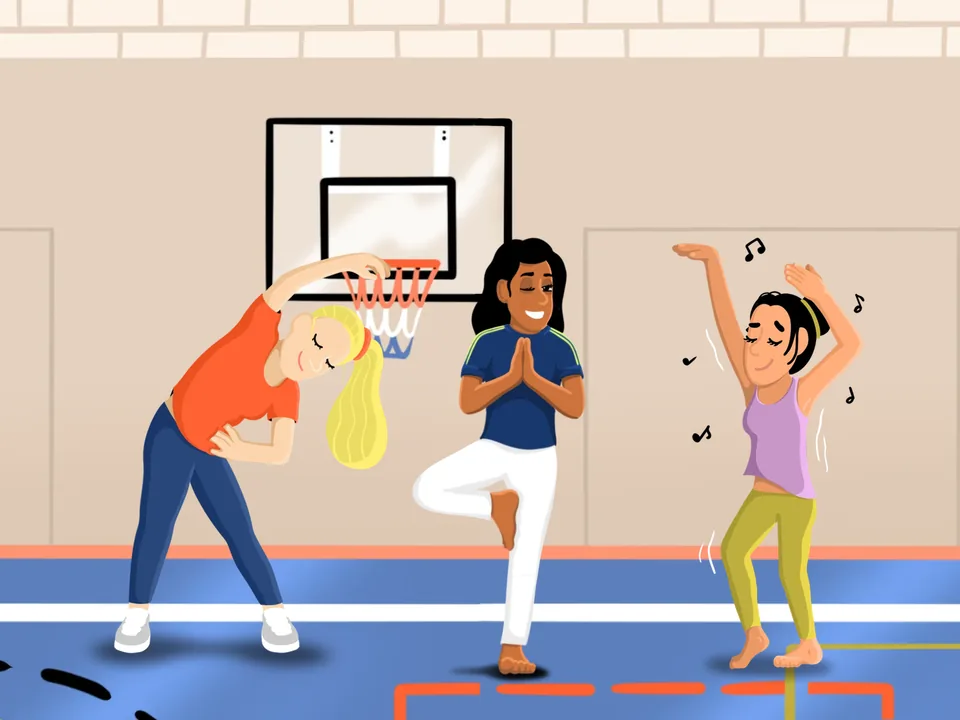
A physical education teaching philosophy fits on one page, roughly 300 to 400 words. Write it in first person and cover five parts: why PE matters, how students learn, how your gym runs, how you assess and include every student, and how you keep growing. Back each belief with something an observer could see in your class, then tie it to a SHAPE America standard.
This is for student teachers, first-year teachers and classroom teachers who need a statement for a job application, a portfolio or an interview. It compares the main PE philosophies, maps beliefs to the SHAPE America standards and ends with a fill-in template and three sample statements to adapt to your grade band.
A PE teaching philosophy statement names what you believe about movement and learning, then shows how each belief changes what happens in your gym. It sits next to your PE teacher resume in an application or portfolio: the resume lists where you worked, the statement shows how you think.
Build it from five parts, one short paragraph each:
Five parts at 60 to 80 words each add up to the one-page target of 300 to 400 words, unless the posting sets its own limit. Still deciding on your route into the field? Start with becoming a PE teacher.

Physical education rests on old questions about how body, character and learning relate, and Greek writers such as Aristotle already argued about them. In Book VIII of the Politics (Jowett translation), Aristotle treats bodily training as part of a good upbringing, but he wants children's exercise kept lighter, “avoiding severe diet or painful toil” that could stunt growth. He adds that physical training should not be the main aim of education.
The field is often sorted into five schools of thought: idealism, realism, pragmatism, naturalism and existentialism. They differ on what PE is for, from building character to learning by doing to free choice of activity.
A practical reading for your statement: scale the load to the age of your students, and keep PE in balance with the rest of their learning. The schools of thought give you words for your own stance.
Essentialism is the education philosophy that every student should learn a core set of essential skills, taught mostly through teacher demonstration and direction; William Bagley and E. D. Hirsch Jr. are its best-known names (SUNY HVCC education course). In a gym, that means explicit teaching of fundamental skills with clear cues. The table sets it next to pragmatism, naturalism and existentialism.
| Philosophy | Core idea | What a visitor sees |
|---|---|---|
| Essentialism | Core skills for everyone, taught by a teacher who leads | Teacher demonstrates, students practice one fundamental skill, such as overhand throwing, with one cue at a time |
| Pragmatism (John Dewey) | Learning comes from experience and problem solving | Students play a small-sided game, spot a problem and change a rule to fix it |
| Naturalism | Play is central, teaching follows developmental readiness | Open-ended play and exploration stations in the early grades |
| Existentialism | Freedom to choose and to create | Students pick among stations or design a game for their group |
Many teachers blend two. One workable pairing is essentialism for skill instruction and pragmatism for game play. Name your lead philosophy in one sentence, the second in another, and give a gym example for each.
SHAPE America's 2024 National Physical Education Standards have four standards, and each belief in your statement should point to at least one of them. The 2013 edition had five (S1–S5), and some districts and curricula still reference it, so check which edition your target school uses.
| Belief you might write | Standard | SHAPE America wording |
|---|---|---|
| Every student leaves with skills they can use outside class. | Standard 1 (S1) | Develops a variety of motor skills |
| Students can explain why a warm-up, a pacing plan or a game strategy works. | Standard 2 (S2) | Applies knowledge related to movement and fitness concepts |
| Cooperation and fair play are taught like skills. | Standard 3 (S3) | Develops social skills through movement |
| Students find a personal reason to stay active. | Standard 4 (S4) | Develops personal skills, identifies personal benefits of movement, and chooses to engage in physical activity |
Name the standard in one clause, such as “I teach pacing through S2 tasks.” For student-friendly targets under each standard, see I Can Statements for PE by Standard. For lesson-level alignment, see aligning PE lessons with the SHAPE America standards.
The template below has five parts, and each row pairs a sentence starter with a filled-in example for a Grades 6–8 teacher. Replace the example with your own words and keep the structure.
| Part | Sentence starter | Filled-in example |
|---|---|---|
| Purpose | I believe PE matters because … | I believe PE matters because it is where students practice skills they can keep using outside school (S1, S4). |
| Learning | Students learn best when … | Students learn best when they see a clear demonstration, get many turns with equipment and work on one cue at a time (S1, S2). |
| Gym | In my gym, you will see … | In my gym, you will see small groups, equipment ready at stations and a routine that has students moving as they enter (S3). |
| Assessment and inclusion | I check progress by … and adapt by … | I check progress with skill checklists and student self-ratings, and I adapt target size, distance or equipment so a mixed-ability class works on the same skill (S1, S2). |
| Growth | I keep improving by … | I keep improving by asking a colleague to observe one lesson per unit and revising the next unit from the notes. |
Fill each row, add one SHAPE America standard tag (S1–S4), then expand every row into a paragraph of 60 to 80 words.
Each of the three samples below condenses a full statement into one paragraph, written for a different role. Borrow the structure and write your own sentences.
I believe elementary PE gives children their first experiences of succeeding at movement, and those experiences shape whether they keep playing. I teach one skill at a time through short games in which every child has equipment and most of the time is spent moving. I measure progress against each child's earlier attempts and change target size, distance or ball type so every child can succeed (S1, S4).
I believe secondary PE should leave students able to plan and run their own activity. I teach skills with a demonstration and focused practice, then move students into modified games where they solve tactical problems and adjust the rules (S1, S2). In later units students choose their activity, because choosing is a skill adults need (S4).
I am new to teaching PE, and my philosophy comes from my placement observations and my own years as a player. I believe a predictable gym lets students take risks with new skills. Before I plan a game, I plan how students enter, space out and stop on my signal, and I ask my mentor teacher to watch one routine each week (S3).
Four mistakes weaken a statement, and each has a quick fix.
| Mistake | Cause | Fix |
|---|---|---|
| Slogans such as “every child can succeed” | No example attached | Add one visible gym example per belief |
| Three philosophies in one paragraph | Copying from several samples | Pick a lead philosophy and one second |
| Beliefs your units contradict | A claim of “everyone is active” next to long lines or elimination games | Check each belief against your latest unit plan, then change the game or the belief |
| No mention of ability differences | Writing for the average student | Name one adaptation, such as changing target size or distance |
In an interview, answer “What is your philosophy?” in about 30 seconds: one belief, one gym example, one standard. In a portfolio, place the statement next to two lesson plans that show those beliefs. The PE lesson plan template shows how to write them up.
Yes. A statement of personal beliefs reads best in first person, with phrases like “I believe” and “In my gym.” Third person sounds like a school policy. Keep sentences short, name real activities such as tag, volleyball or fitness stations, and skip jargon that a principal outside PE would not know.
Yes. Keep the five parts and swap the example sentences to match the grade band, the equipment and the prompt in each posting. For an interview, shorten it to one belief, one gym example and one standard that you can say in about 30 seconds.
Use placements, coaching, camps, youth sports or volunteering as your evidence. Write what you saw work and what you would try, and say so plainly, for example “During my practicum I watched …”. A short statement with one clear example is better than a long list of ideals.
Review it about once a year and after every new placement or grade band. Check each belief against your latest unit plans, replace examples that no longer match your gym, and update the standards reference if your district moves from the 2013 edition with five standards to the 2024 edition with four.
Name the goal you share, then say what you would adapt. If a school stresses fitness testing and you stress student choice, you can say you will run the tests as written and build choice into the games. That shows you can work within a program. Do not rewrite your beliefs to mirror a posting.
This guide is for PE specialists and classroom teachers who need I can statements for PE that students can read, say and rate.
Student teachers, first-year teachers and PE specialists applying to K–12 positions will find a copy-ready template with a filled sample…
Open the 3 free units, no account needed, and mark where each of your beliefs would show up in a lesson. Yearly and 12-month plans start with a 7-day free trial; see current prices in the app.
App for iPhone, iPad and Android.