Games & warm-ups
10 Hula Hoop Games for PE
Each game comes with grades, group size, hoop count and a full rule set, followed by safety rules, fixes for common problems and ways to…
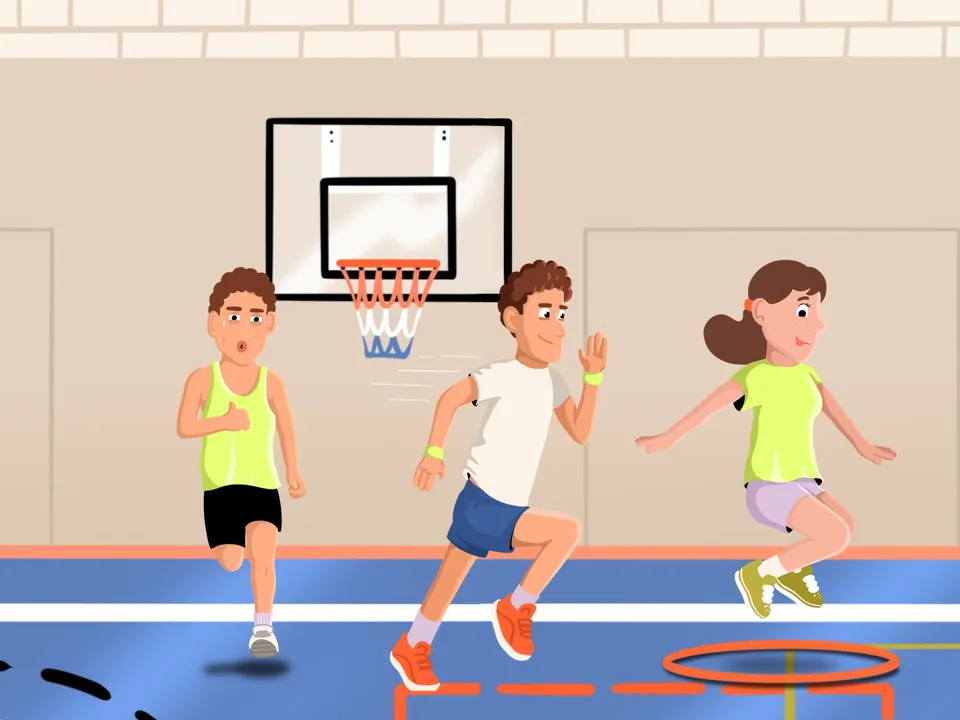
Good PE relays use teams of 3–4 players and one lane per team, so nobody stands in line for long. Animal walk shuttles suit Grades K–2, dribble and scooter board shuttles Grades 3–8, and fitness challenge relays Grades 6–12. Ten relays follow, and three work without a losing team. Rounds last 1–3 minutes, then the order or the movement changes.
Full classes turn relay races for PE into long lines: one student runs while the rest of the team stands and watches. You get a shuttle layout that cuts the wait, relays grouped by grade band and gear, and scoring that does not punish the slowest team.
Pick by grade band first, then by the gear and floor space you have.
| Relay | Grades | Team size | Gear | One round |
|---|---|---|---|---|
| Animal Walk Shuttle | K–2 | 3–4 | 2 cones | 1–2 min |
| Lily Pad Hop | K–2 | 3–4 | 4 hoops, 2 cones | 1–2 min |
| Dribble Shuttle | 3–8 | 3–4 | 1 ball, 2 cones | 2 min |
| Over-Under Rotation | 2–8 | 4 | 1 playground ball | 1–2 min |
| Scooter Board Shuttle | 3–8 | 3–4 | 1 scooter board, 2 cones | 2–3 min |
| Mystery Skill Relay | 6–12 | 4 | skill cards, 2 cones | 2 min |
| Fitness Challenge Relay | 6–12 | 3–4 | 2 cones | 2–3 min |
| Growing Chain | K–5 | 4 | 1 cone | 2 min |
| Hoop Pass Circle | K–8 | 6–8 | 1 hoop per circle | 1 min |
| Beat-Your-Own-Count Relay | K–12 | 3–4 | any shuttle relay, a timer | 3 min |
For mixed-ability classes, let students choose to walk, jog or skip in rounds where each team chases its own count, so a slower choice does not cost the team a race.
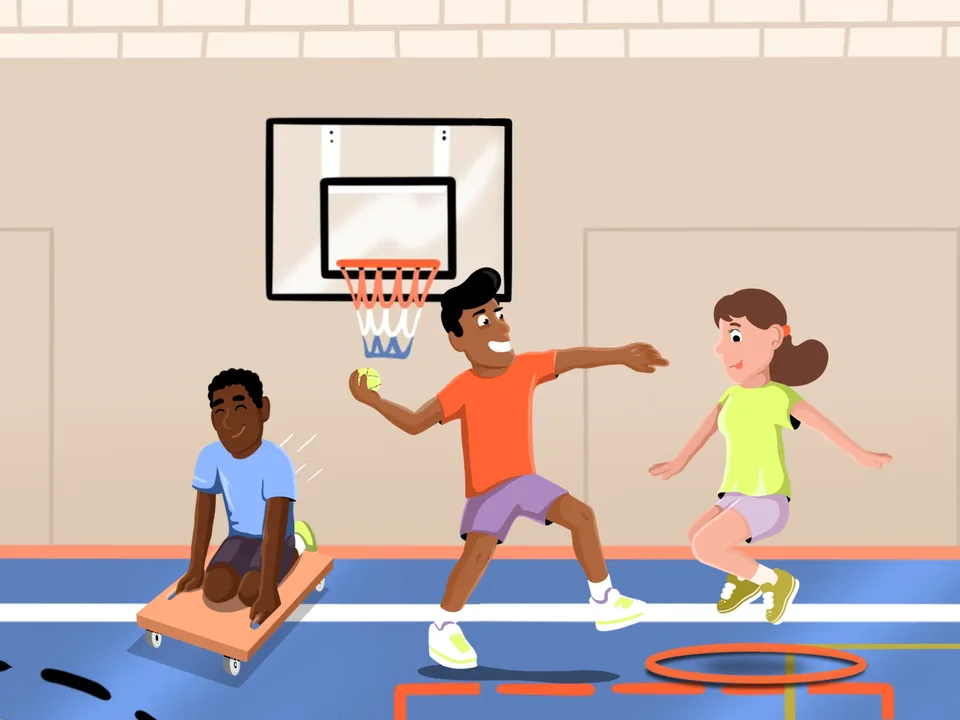
Keep teams at 3–4 players and split each team across both ends of its lane, so every student waits behind one teammate at most. With 6 to 8 players in a single file, each student runs once and then stands for most of the round. SHAPE America recommends moderate- to vigorous-intensity activity for 50 percent of PE class time (cited in its 2017 dodgeball position statement), and a long line works against that target. The guide on MVPA in PE class goes deeper.
In the sketch, each of the 3 teams has a left cone and a right cone. In a team of 4, players A and C start at the left cone and B and D wait at the right cone. A runs to the right cone and tags B, who runs to the left cone and tags C. C runs to the right cone and tags D, who runs back to the left cone and finishes. The team sits down at the left cone. Walk the layout once at a walking pace so every student knows which cone to start from.
Animal walks and hoop hops work for Grades K–2 because each uses one simple movement over a short distance. They are fun relay races to start with while students are still learning to wait for a turn.
Grades K–2, teams of 3–4, 2 cones per team. Call an animal such as bear walk, crab walk or frog hop. The first player moves to the opposite cone in that animal walk and tags the first waiting teammate. A runner who drops out of the animal position gets back into it where they are and continues. The round ends when the last runner reaches the finish cone and the team sits. Call a new animal each round.
Grades K–2, teams of 3–4, 4 hoops and 2 cones per team. Four hoops lie flat in a row between the two cones. The runner hops from hoop to hoop with both feet landing inside, then tags the first waiting player at the far cone. A foot outside means the runner repeats that hoop. The round ends when the last runner has hopped the row and reached the finish cone. Check that the hoops do not slide on a slick floor.
For preschoolers, about ages 3–5, use these two relays with teams of 3 and a short lane. Skip the finish order: the round ends when every team has sat down. Let the next child start when the runner crosses the line instead of requiring a tag, and keep an adult at the far end of each lane.
Dribbling, passing and scooter boards add a skill to the run while teams stay at 3–4 players.
Grades 3–8, teams of 3–4, 1 ball and 2 cones per team. The first player dribbles to the opposite cone, by hand with a basketball or by foot with a soccer ball, and hands the ball to the first waiting teammate. A player who loses control retrieves the ball and continues from where control was lost. The round ends when the last player crosses the finish cone with the ball in control. More dribbling and ball games are in the basketball games and soccer games guides.
Grades 2–8, teams of 4, 1 playground ball per team. Teams line up front to back, an arm's length apart, with the ball at the front. The ball goes backward, over the head to the second player, between the legs to the third, over the head to the fourth. The player at the back runs along the side to the front, everyone steps back one spot, and the pattern repeats. The round ends when all four players have run to the front once. A dropped ball is picked up by the player who passed it, and the pass repeats. Leave a gap of a few steps between teams so the runner has a free path along the side.
Grades 3–8, teams of 3–4, 1 scooter board and 2 cones per team. The rider sits on the board, pushes with the feet to the opposite cone and hands the board to the first waiting teammate. Boards are used seated only, on a clear, smooth floor with a wide gap between lanes, hair tied back and fingers clear of the wheels. A rider who falls off waits for your check, then sits back on and continues from that spot. Stand where you can see every lane. The round ends when the last rider crosses the finish cone.
Relays for Grades 6–12 work when the turnaround asks something of the runner, such as a random skill or a fitness challenge. Both relays below use the two-cone shuttle layout.
Grades 6–12, teams of 4, a face-down stack of skill cards and a cone at each end. The runner flips the top card at their cone, then moves to the opposite cone in the movement it names, such as carioca, backpedal, high knees or side shuffle, and tags the first waiting player. A runner who ignores the movement repeats the crossing. The round ends when the last runner reaches the finish cone. Backpedaling needs a clear lane and a runner who checks over a shoulder.
Grades 6–12, teams of 3–4, 2 cones per team. The runner jogs to the opposite cone, completes the posted challenge, such as 8 air squats or 5 push-ups with knees allowed, and tags the first waiting player. A waiting teammate counts the reps aloud, and a rep without good form does not count. Start after a warm-up, offer an easier version of each challenge and scale the reps to what your class can do with good form. For a final round, each team writes a challenge for the next team.
Growing Chain, Hoop Pass Circle and Beat-Your-Own-Count Relay work without a losing team, because each team's goal is the task or its own number.
Grades K–5, teams of 4, 1 cone per team. The first player jogs around the cone and back, takes the second player's hand, and the pair does the same loop. The pair then takes the third player, and the three take the fourth. If hands break, the chain stops, reconnects and continues from that spot. The round ends when the chain of four crosses the start line. Rotate who starts, use flat ground and let the slowest player set the pace.
Grades K–8, circles of 6–8, 1 hoop per circle. Students hold hands in a circle with a hoop hanging over one pair of joined hands. The hoop travels around the circle as each student steps through it without letting go, slowly and without pulling on a neighbor's hands. If hands break, the circle reconnects and continues from that spot. The round ends when the hoop is back at its starting point. The hula hoop games guide has more ideas.
Grades K–12, teams of 3–4, any shuttle relay above and a timer. Set the timer for 3 minutes, for example with the Countdown Timer gym tool, which has quick picks for 1, 3, 5, 10 or 15 minutes and a whistle at the end. Each team repeats the same relay as often as it can until the whistle. A lap counts when every player has run once. Teams write down their lap count, change one thing such as the order, and try to beat that number next round.
Score completed laps or each team's own count, and never assign exercise to the team that finishes last. SHAPE America's position statement, released in 2021, calls exercise as punishment inappropriate. Give a point for clean handoffs and for cheering teammates, so slower teams have a way to score. Balanced teams matter as much as the scoring: the Team Creator gym tool in the PhysEdPrep app builds random, skill-balanced or gender-split teams from saved class rosters, and fair ways to pick teams covers other methods.
| Problem | Cause | Fix |
|---|---|---|
| Lines get long again | Teams of 6–8 in single file | Rebuild to teams of 3–4 and split them across both cones |
| The same team wins every round | Teams are unbalanced by speed | Rebuild teams by skill, or score each team's own count |
| Runners skip the turn | No clear cone to touch | A waiting teammate checks the touch, and a skipped cone means repeating the crossing |
| Collisions at the finish | Lanes too close, no stop zone | Leave a gap between lanes and keep the space past the finish cone clear |
| Waiting students drift off | No job while waiting | Give them a role: counting reps, holding equipment or checking handoffs |
Running relays as stations on field day? See field day stations and tournament planning.
PE relays fall into four formats: shuttle relays, where runners alternate between two ends of a lane; single-file relays, where each runner returns to the same line; chain relays, where the group grows or moves together; and circle relays, where teammates pass an object around. In track and field, runners pass a baton inside a marked exchange zone.
Mix teams of 3 and 4, and in a shuttle relay let the first runner on each 3-player team also take the last leg, so every team runs the same number of legs. With 26 students, that makes 5 teams of 4 and 2 teams of 3. If the double run still feels unfair to your class, score each team against its own lap count instead.
Yes, if you shorten the lanes and run fewer teams at a time. Shuttle relays need only the width of one lane per team, and Lily Pad Hop and Over-Under Rotation need little distance. Skip scooter boards unless the floor is clear and each lane has a gap beside it. Let half the class run while the other half counts and checks, then switch.
Adapt the task or the distance and keep the student on the team. Options include a shorter lane, walking or wheeling instead of running, a partner who carries the tag, or the counting job. Agree on the change with the student and, where one exists, follow the student's IEP or 504 plan. This is general information, not advice for an individual case.
Set the finish rule before the first round: the team sits down at the finish cone after the last runner has crossed it. Name one checker per lane and rotate that job. For a very close finish, rerun the round instead of arguing. Scoring each team against its own count cuts down on disputes.
Place the cones about 30 feet apart for Grades K–2 and about 40 to 50 feet apart for older grades. In most gyms, that fits across the width of the basketball court. Keep about 10 feet clear between each cone and the wall so runners can stop safely. Shorten the lane for scooter boards, animal walks and fitness challenge relays, and for any class still learning to stop.
Each game comes with grades, group size, hoop count and a full rule set, followed by safety rules, fixes for common problems and ways to…

Elementary PE teachers, classroom teachers without a PE background, middle school coaches, and substitutes can run these tag games for…
In a 30- or 40-minute period with 24 to 36 students, much of the lost movement time comes from routines like roll call, team picks and…
For PE teachers who need soccer lead-up games that work in a crowded gym, on a wet field, or with a class that has never played.
Open the 3 free units without an account, then plan whole units in the app for iOS & Android. Yearly plans start with a 7-day free trial; see current prices in the app.
App for iPhone, iPad and Android.