Games & warm-ups
Station Setups for PE Class
PE stations split a class into small groups that rotate through different tasks, so more students handle equipment and fewer stand in line.
Ten traverse wall activities fit a PE class when a trained adult supervises, the mats match the manufacturer's specs and one student climbs per wall section. Five are skill challenges, and five are games for pairs, small groups or two teams. Teach the challenges first, because students need three-point contact and quiet, controlled foot placement before any game. Add the games once the class steps down instead of jumping and follows your wall rules.
This guide is for K–12 PE teachers who have a low climbing wall in the gym and one class period to fill with it. A traverse wall is a low, rope-free climbing wall that students cross sideways over mats. You get a safety checklist, ten activities with scoring and restart rules, a station layout, and fixes for common problems.
Each activity below has a grade band, a group size and a turn length, so you can match it to your class before you set up the wall.
| Activity | Type | Best for | Group | Time per turn |
|---|---|---|---|---|
| Three-Point Traverse | Challenge | K–12 | 1 climber per section | about 2 minutes |
| Silent Feet | Challenge | K–12 | Pairs | about 2 minutes |
| Color Hands | Challenge | Grades 2–8 | 1 climber per section | about 2 minutes |
| Freeze and Shake | Challenge | Grades 3–12 | Pairs | about 2 minutes |
| Mirror Traverse | Challenge | Grades 3–12 | Pairs on neighboring sections | about 3 minutes |
| Animal Traverse | Game | K–5 | Groups of 4 to 6 | about 3 minutes |
| Move Count | Game | Grades 3–12 | Pairs | 1 minute per climber |
| Caller Says | Game | Grades 2–12 | Pairs | about 3 minutes |
| Route Makers | Game | Grades 4–12 | 2 groups of 3 or 4 | about 6 minutes per round |
| Relay Crossing | Game | Grades 3–12 | 2 teams of 3 or 4 | about 4 minutes |
Grade bands are teaching suggestions; the wall maker's age rules and your district policy come first. For games away from the wall, see our PE games for every grade, K–12. Climbing works grip, arms, legs and core, and each crossing asks students to plan the next hold. The HHS Physical Activity Guidelines recommend muscle- and bone-strengthening activity on at least three days a week for ages 6–17, and a wall station can add to that when students climb at a steady pace.
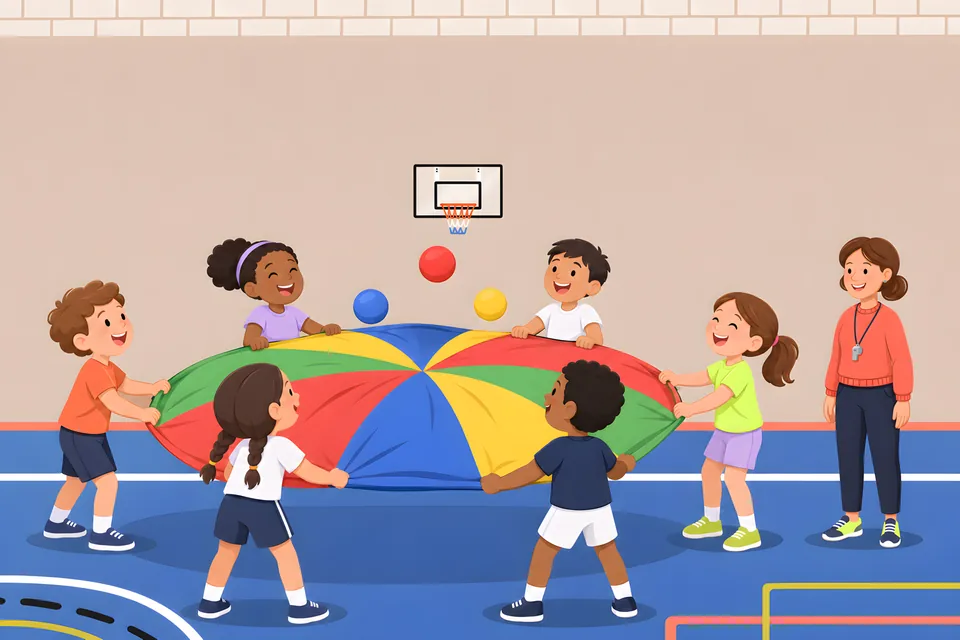
Check four things before any activity: landing mats, a marked height line, adult supervision and student rules. The wall maker's manual and your district policy set the exact requirements; this is a working checklist.
Give each hold a quick hand check for spinning or looseness before class. If one moves, close that section until the person who maintains the wall has fixed it.
Five skill challenges teach the habits every game depends on: three-point contact, quiet feet, hold choice, resting and partner communication.
K–12, one climber per section, about 2 minutes. Tape a start mark and a finish mark. The climber crosses moving one hand or one foot at a time, so three limbs always touch the wall. After a step-off, the climber walks back to the start mark and tries again.
K–12, pairs, about 2 minutes. One partner climbs. The other stands outside the landing zone and counts each scrape or stomp as a loud foot. The climber crosses twice and tries to lower the count. A step-off ends that crossing, and the next one starts at the start mark.
Grades 2–8, one climber per section, about 2 minutes, on a wall with color-coded holds. The teacher names a color before each crossing. Hands touch only holds of that color; feet use any hold. A hand on a wrong color means a restart from the start mark.
Grades 3–12, pairs, about 2 minutes. The partner calls “freeze” from beside the mat, up to three times per crossing. The climber stops with three limbs on holds, shakes the free hand or foot loose for a slow count of three, then continues. A step-off means a restart.
Grades 3–12, pairs on neighboring sections, about 3 minutes. The leader crosses at a steady pace while the partner copies each hand and foot move. Keep an arm's length of wall between them. If either steps off, both restart. At the finish they swap roles and cross back.
Three climbing wall games for PE need only a partner or a small group, and each has a score, a restart rule and an end point.
K–5, groups of 4 to 6, about 3 minutes. The teacher calls sloth (a slow count of three before each move) or mouse (silent feet). A crossing in the called style scores one group point. After a step-off, the climber retries once at the back of the line. The round ends when everyone has crossed.
Grades 3–12, pairs, one-minute turns on a timer with a whistle. The climber crosses back and forth while the partner tallies each new hand or foot placement. Stomping feet and feet above the height line do not count. A step-off ends the turn and the tally stands. Partners swap, and the higher total goes on the class board.
Grades 2–12, pairs, about 3 minutes, on a wall with color-coded holds. One partner climbs. The other stands beside the mat and calls a limb and a color, such as “right hand, blue.” The climber has a slow count of five to place that limb while keeping three limbs on the wall, and callers may only call moves the climber can reach. The pair scores one point per completed call across six calls. A step-off ends the turn and the points stand. Partners swap.
Two team games, Route Makers and Relay Crossing, each need two wall sections, one per team, and work best after the class has practiced the challenges.
Grades 4–12, two groups of 3 or 4, about 6 minutes per round, on a wall with color-coded holds. Each group picks six hand holds in order and writes them on a whiteboard, such as “red, low left.” One of its own members must finish that route before the other group tries it, so no route is impossible. Each climber who finishes the other group's route scores one point for their own group, and a step-off scores nothing. The round ends when everyone has had one try.
Grades 3–12, two teams of 3 or 4, about 4 minutes. Each team has its own section, with teammates waiting beside the mat, split between the two ends. The first climber crosses and steps down, and the next teammate at that end crosses back. Tags happen at the mat edge, nobody runs, and the next climber steps onto the mat only after the previous climber has stepped off. A foot above the height line or a step-off means that climber restarts. The first team with every member across wins. Use it only once the class climbs steadily in the challenges.
Run the wall as one station among several, with the supervising adult at the wall and self-running tasks at the other stations. SHAPE America recommends moderate- to vigorous-intensity activity for 50 percent of PE class time (a figure it cites in its dodgeball position statement), so students waiting for a turn need a floor task within sight of the wall, such as a bean bag toss or a balance line. A timer with a whistle keeps turns moving.
In the plan, the climbing wall runs along the top with the landing mat in front of it. Students wait at the waiting spot, outside the mat, and walk to the wall when called. The teacher position gives a view of the wall and both floor tasks: a bean bag toss (floor task A) and a balance line (floor task B). Group sizes and rotation timing are in our guide to station setups for PE.
| Mistake | Cause | Fix |
|---|---|---|
| Long line at the wall | The whole class waits for turns | Send waiting students to a floor task within sight of the wall |
| Students jump down | Step-downs were never practiced | Rehearse step-downs from the lowest holds before each session |
| Feet above the height line | Rushing, or the line is not marked | Mark the line with tape; the climber resets after a call of “feet low” |
| Mats slide apart | Students step on the seams between turns | Re-check the landing zone at every rotation change |
Adapt the wall by changing the crossing distance, the holds students may use or the student's job. Every student should be able to pick a challenge level, including a role off the wall.
If the wall is part of a gymnastics unit, the gymnastics PE lesson plan template covers mat setup, spacing and supervision for the rest of a gymnastics unit.
In a PE context, “transverse wall” is usually a misspelling of traverse wall, the low climbing wall this guide covers. Transverse describes something that lies across, while traverse means moving across, which is why students cross the wall sideways. Look for manuals and district policies under traverse wall to find the mat and inspection rules.
Traverse rock climbing means moving sideways across a rock face or wall instead of going up, which on a low boulder or school wall keeps the climber close to the ground. Outdoors, climbers traverse low boulders above crash pads, and indoors, bouldering gyms set traverse routes. School walls use the same idea with mats, rules and supervision, so a class can climb without ropes.
No single wall holds that title, because difficulty belongs to individual routes. Steeper angles, smaller holds and longer reaches make a route harder, and climbers rate routes on grading scales for that reason. On a school wall, the hardest section is the steepest or widest-spaced one, so keep beginners on low, closely spaced holds and make easy sections harder by restricting hold colors.
Not by default. A traverse wall is low and rope-free, so the usual protection is the right mat setup, supervision and student rules, and spotting is a decision you make before class. Use student spotters only if your district allows them, the wall maker's manual does not rule them out and you have taught the technique. Otherwise, keep spotting to trained staff.
PE stations split a class into small groups that rotate through different tasks, so more students handle equipment and fewer stand in line.
Balance games in PE start with the floor plan: every student needs personal space and a clear signal for start, stop and rotation.
This list is for PE specialists and classroom teachers who run bean bag toss games for kids in Grades K–5, with a few options for Grades…
Games in PE class usually fall apart for two reasons: students spend too much time waiting, and the rules or the space don't fit the group.
Get the PhysEdPrep app for iOS & Android and open the 3 free units without an account. Every plan includes the 6 gym tools; see current prices in the app.
App for iPhone, iPad and Android.