10 Ways to Differentiate in PE
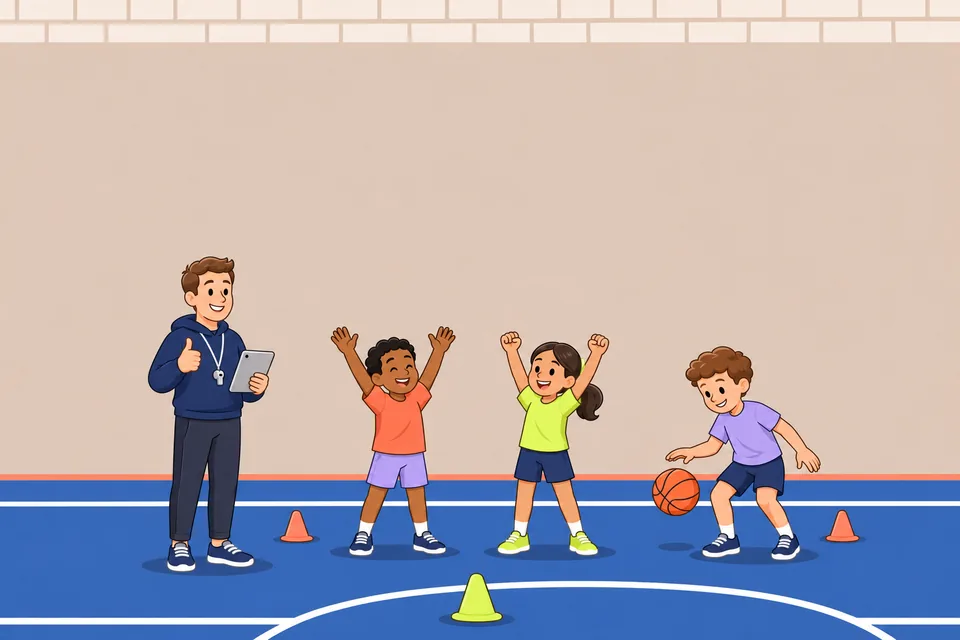
Some students in your class have played a sport for years, and others are touching it for the first time.
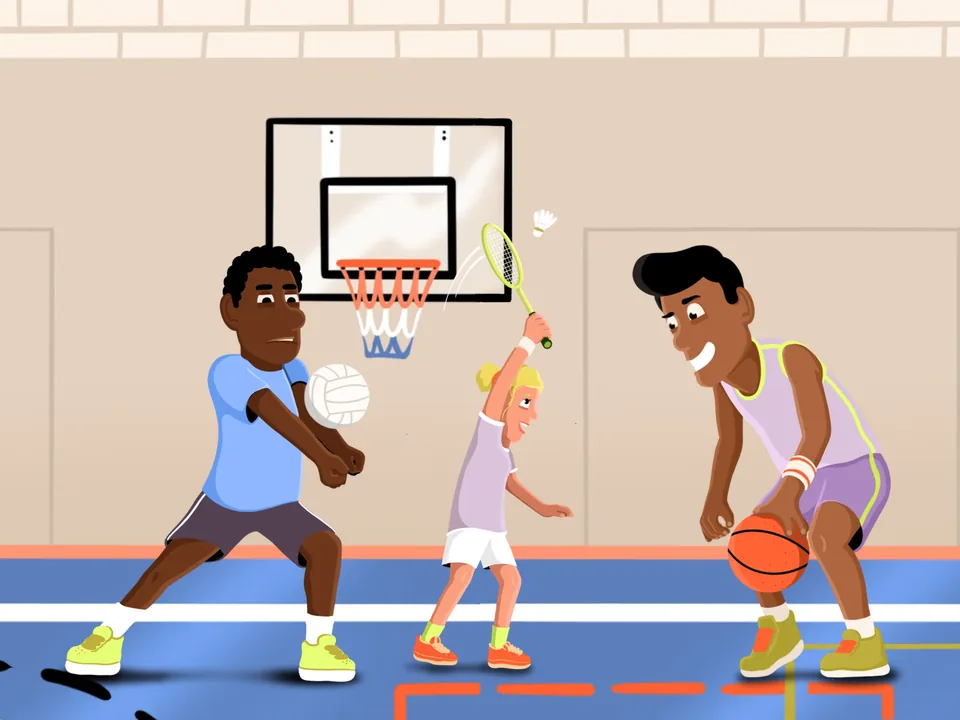
Ten volleyball games for PE class cover the full progression, from catch-and-throw Newcomb in the lower grades to 2v2 and 3v3 rallies in Grades 5–12. Start with a lowered net, a soft ball and a one-bounce rule, then drop the catches and bounces once teams string together three contacts. Most games run with 2 to 6 players per side, so a class fills several courts.
This list is for PE teachers in Grades 1–12 who have one gym, a few nets and a class that has never bumped a ball. Each game comes with its grade range, group size, equipment, scoring and what happens after a miss. After the games come a layout for running several courts, net height starting points and a table of common problems with fixes.
Catch-and-throw games fit Grades 1–6, bump and set games Grades 4–12, and mini rallies Grades 5–12. A lead-up game changes one rule, such as catching instead of bumping, so students can rally before the full skills are there.
| Game | Grades | Per side | Equipment | Main skill |
|---|---|---|---|---|
| Newcomb | 2–5 | 5–6 | soft ball, net or rope | catching, throwing |
| Three-Catch Volleyball | 3–6 | 4–6 | soft ball, net or rope | pass, set, send over |
| Beach Ball Volleyball | 1–5 | 6 | beach ball, low net or rope | open-hand touches |
| One-Bounce Volleyball | 4–8 | 4–6 | trainer balls, net | bump, set, spacing |
| Hoop Bump Challenge | 5–9 | groups of 3 | trainer ball, hoop | forearm pass aim |
| Setting Ladder | 6–12 | pairs | 1 ball per pair | overhead set |
| Target Serving | 4–12 | 4–5 | balls, 3 hoops, net | underhand serve |
| Mini 2v2 or 3v3 | 5–12 | 2–3 | trainer ball, low net, cones | all contacts |
| Volley Four Square | 4–9 | 4 per court | four-square court, trainer ball | bump and set control |
| King of the Court | 6–12 | 3 | trainer ball per court | rally play, rotation |
Grade ranges are starting points: a Grade 7 class that has never played can start with Newcomb, and a strong Grade 4 class can move on early. In the rally games (Newcomb, Three-Catch, Beach Ball, One-Bounce and Mini Volleyball), each rally scores a point, the rally winner serves next, and a team rotates one spot clockwise each time it wins the serve back. For a multi-week sequence, see the volleyball unit plan guide.
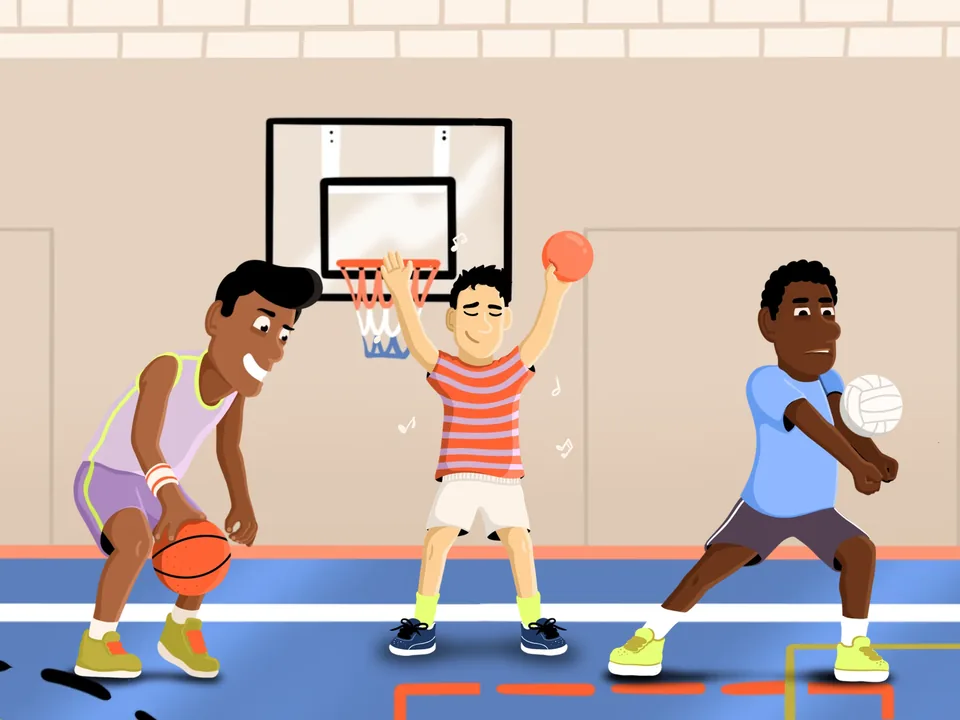
Newcomb, Three-Catch Volleyball and Beach Ball Volleyball let students rally over a net before they can bump, because every contact is a catch or an open-hand touch. They work as volleyball games for kids in Grades 1–6 who are new to the net.
Grades 2–5, 5 or 6 players per side, one soft ball per court. The server throws the ball over the net from behind the back line. The receiving team catches it, may pass it once to a teammate, then throws it back at open floor, never at a player. A ball that hits the floor on your side, or a throw that hits the net or goes out, scores for the other team. Play to 10 points.
Grades 3–6, 4 to 6 players per side, one soft ball per court. Each team gets three contacts, and every contact is a catch: the first player tosses to a teammate, who tosses high near the net, and the third player throws the ball over. A fourth contact, a drop, a net touch or an out ball scores for the other team. Play to 10 points. When rallies hold, make the second contact a set.
Grades 1–5, 6 players per side, one beach ball per court and a low net or rope. Students serve and hit with open hands, never fists. After the serve, at least 3 different players on a side must touch the ball before it crosses. Fewer touches, a ball on the floor on your side or an out ball scores for the other team. Play to 10 points.
One-Bounce Volleyball, the Hoop Bump Challenge, the Setting Ladder and Target Serving each turn one skill into a scored game.
Grades 4–8, 4 to 6 players per side, trainer balls. The ball may bounce once on a team's side before it is played, each team gets at most 3 contacts, and players hit the ball instead of catching it. Serve underhand from a line close to the net and step back as serves improve. Two bounces on your side, a fourth contact, a net touch or an out ball scores for the other team. Play to 10 points.
Grades 5–9, groups of 3, one trainer ball and one hoop per group. The hoop lies on the floor 10 ft (3 m) in front of the bumper. The tosser stands beside the bumper and tosses underhand at waist height, and the bumper bumps the ball toward the hoop. The third student retrieves from beside the hoop. Rotate roles after 5 tosses and try to beat the last round's number of hoop landings.
Grades 6–12, pairs, one ball per pair. Each rung needs 5 clean sets in a row, and a miss restarts that rung; the round ends when a pair clears rung 4 or time is called. Rung 1 is self-sets above the forehead, rung 2 is a partner toss set back to the tosser's hands, and rungs 3 and 4 are continuous sets between partners 6 ft (1.8 m) apart, then 12 ft (3.7 m). Use trainer balls to protect fingers.
Grades 4–12, teams of 4 or 5, one ball per server, a net and 3 hoops on the far side. Servers choose a near line (1 point for an underhand serve that lands in) or a far line (2 points), and a serve into a hoop adds 1 bonus point. Servers stand an arm's length apart and serve together on a whistle, one ball each, while the other team waits behind them. After a second whistle the servers collect the balls from the far side and hand them to the other team, who serve next. After 3 turns per team, the higher total wins.
Small-sided games put fewer players on each court, so every student touches the ball more often and waits less. In a class of 24, 6v6 on one court keeps 12 students playing and 12 waiting, while four 3v3 mini courts keep all 24 active. That makes the SHAPE America recommendation of moderate to vigorous activity for 50 percent of class time, cited in its dodgeball position statement, easier to reach.
Grades 5–12, 2 or 3 players per side, one trainer ball per court. Tape or cone a court about 15 ft wide and 30 ft long (4.5 × 9 m) and lower the net or rope. Serve underhand from behind the end line. Each side gets 3 contacts, and catching or hitting twice in a row is a fault that scores for the other team. Play to 7 points, then swap sides and opponents.
Grades 4–9, 4 players per court plus a waiting line, one trainer ball. The player in square 4, the highest square, serves by bumping or setting into any other square. The receiver may let the ball bounce once, then bumps or sets it into a different square. A player is out after letting the ball bounce twice in their square, hitting it onto a line or out of bounds, catching it or touching it twice in a row. The out player joins the end of the line, players below move up and the first in line enters square 1. Play until time is called.
Grades 6–12, 3 players per side, a row of mini courts with a trainer ball each, the last one the King court. Rounds run on a countdown timer. When time is up, the team ahead on each court moves one court toward the King court and the other team moves one court away, with ties going to the team that scored last. Winners on the King court stay and earn 1 King point, and losers on the lowest court stay. The most King points after the last round wins.
Give every court its own net, ball and fixed team size, and change courts on one signal. Tie a rope to stable poles or wall hooks and clip pinnies on it so students can see it. Stand on the sideline where you can see every court.
In the sketch, Net 1, Net 2 and Net 3 stand side by side, the ball cart sits at one end and the teacher spot is on the sideline at the center. A regulation court measures 9 × 18 m (about 30 × 60 ft), so four 4.5 × 9 m (about 15 × 30 ft) mini courts fit in its footprint.
Make teams before class with the Team Creator in the PhysEdPrep app (random, balanced by skill or split by gender) so no time goes to picking sides. Set the Countdown Timer so one whistle ends every round on all courts. To run a mini tournament across courts, see the round-robin tournament in one class period guide.
Start with the net or rope at about 5 to 6 ft (1.5 to 1.8 m) in Grades 2–5 and about 6.5 to 7 ft (2 to 2.1 m) in Grades 6–8, then adjust: if most balls fail to clear it, lower it. These are starting points for lead-up games, not competition heights. USA Volleyball's simplified youth guide gives 5 to 6 feet for younger players and up to 7 feet for ages 12 and under.
Stay in view of every court, and keep rounds short with Grades 1–3.
Most problems trace back to net height, team size or the rules, and each has a quick fix.
| Problem | Cause | Fix |
|---|---|---|
| Rallies end after one contact | Net too high or ball too heavy | Lower the net, switch to a beach ball or trainer, allow one bounce |
| Students smash the ball at the net | Everyone wants to hit hard | Require every ball to arc up before it crosses; a flat hit scores for the other team |
| Long waiting lines | Too many players per court | Cut teams to 2 or 3 per side and add mini courts |
| One strong player takes every ball | Mixed ability in open play | Require 3 different players to touch the ball, or balance the teams by skill |
| Missed serves lead to push-ups or laps | Teacher wants misses to carry a consequence | Give a retry instead; SHAPE America calls exercise as punishment inappropriate |
For more ways to adjust a game to mixed-ability classes, see ways to differentiate in PE.
In Newcomb, players catch the ball and throw it back over the net, while in volleyball players must hit the ball and may not hold it. Newcomb works for students who cannot yet bump, set or serve. Once rallies hold, replace the catch with a bump or set, as in Three-Catch Volleyball and One-Bounce Volleyball.
Move to 6v6 when most rallies in 3v3 reach three contacts and most serves land in play. Before that, 6v6 often brings serves into the net and long waits for the back row. A middle step is 4v4 with one bounce allowed on the first contact only.
Give them an easier version of the same task: a closer serving line, a catch on the first contact, or a beach ball instead of a trainer ball. In Target Serving, they can choose the near line for 1 point, and in Mini Volleyball they can start at 2v2, where every student gets many touches.
Yes. A rope tied to stable poles or wall hooks works as a net for every game here. Mini Volleyball needs only a court of about 15 × 30 ft (4.5 × 9 m), a quarter of a regulation court, and Beach Ball Volleyball works with fewer players per side.
About 5 to 8 minutes per game suits most of these before you switch games or courts. Shorter rounds suit Grades 1–3. Volley Four Square and King of the Court can run longer because players rotate through the courts.
Volleyball lead-up games mainly address Standard 1 (motor skills) and Standard 3 (social skills) of the 2024 SHAPE America National PE Standards, which have four standards, S1 to S4. Bumping, setting and serving practice S1. Calling the ball, rotating and fair scoring practice S3. Talking about rally tactics also touches S2, movement concepts.
Some students in your class have played a sport for years, and others are touching it for the first time.
For PE teachers who need soccer lead-up games that work in a crowded gym, on a wet field, or with a class that has never played.
Full classes turn relay races for PE into long lines: one student runs while the rest of the team stands and watches.
The 10 games below fit elementary through high school gyms and outdoor blacktop, with player counts, scoring, turnover restarts, and a…
Get the app for iOS & Android and start with the 3 free units without an account. Yearly plans start with a 7-day free trial; see current prices in the app.
App for iPhone, iPad and Android.