Games & warm-ups
Bean Bag Games for PE
This list is for PE specialists and classroom teachers who run bean bag toss games for kids in Grades K–5, with a few options for Grades…
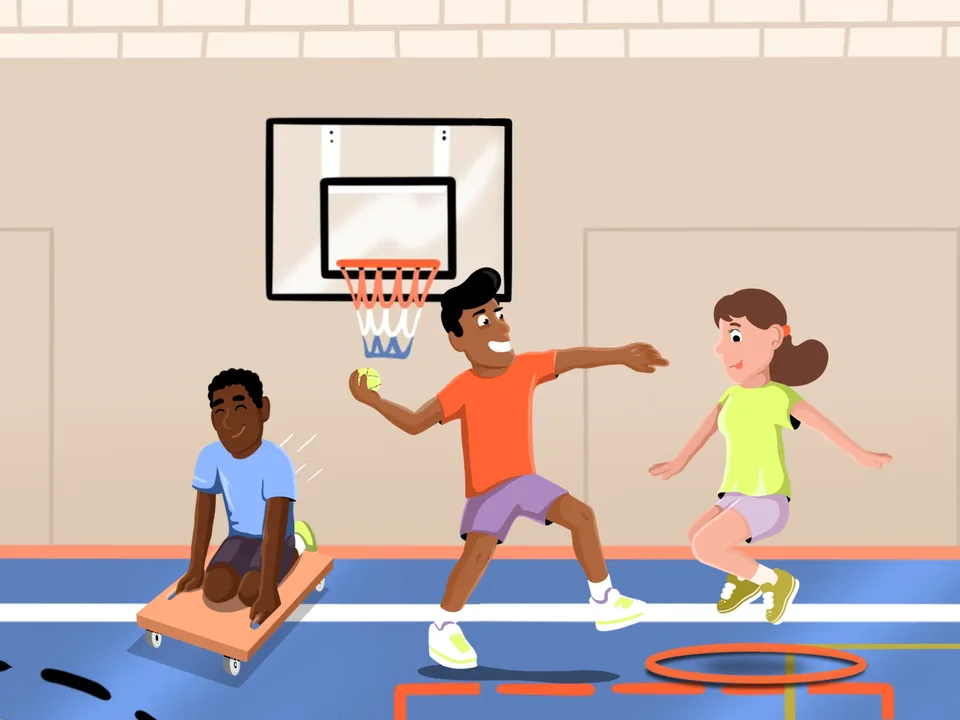
Ten scarf activities for PE build tossing, tracking, rhythm, and beginner juggling skills in Grades K–5 with 1 to 3 hemmed nylon scarves per student. Air resistance slows every drop, giving young learners extra time to track and snatch the fabric before moving on to faster beanbags or balls. All 10 games need a dry, clear floor and arm's-length spacing.
Elementary PE specialists, classroom teachers without a PE degree, and substitutes can pull from this list whenever mixed-ability classes need manipulative practice indoors. Every game lists grade band, group size, scarf count, a scoring target, and what to do after a drop. A juggling diagram and tips for washing scarves round it out.
Lightweight nylon juggling scarves fall much slower than balls or beanbags because air drag holds the fabric open, giving Grades K–5 beginners extra tracking time. Practicing tosses and overhead snatches works on the motor skills covered by SHAPE America's 2024 National Physical Education Standards (four standards, S1–S4, released in March 2024 to replace the 2013 five-standard edition).
Run scarf activities for PE on a dry, clear gym or classroom floor under supervision with arm's-length spacing, and pick up dropped scarves immediately so sneakers never slip. Once students catch cleanly, progress to bean bag games for PE.
| Activity | Grades | Group Size | Scarves | Primary Skill |
|---|---|---|---|---|
| Claw Catch | K–2 | Solo | 1 per student | Overhead tracking |
| Clap Ladder | K–3 | Solo | 1 per student | Hand speed |
| Body-Part Landing | K–2 | Solo | 1 per student | Spatial balance |
| Mirror Switch | 1–4 | Pairs (2) | 1 per student | Partner timing |
| Triangle Trade | 2–5 | Groups of 3 | 1 per student | Group footwork |
| Circle Color Call | 1–5 | Groups of 4–6 | 1 per student | Visual scanning |
| Two-Scarf Cross Toss | 2–5 | Solo | 2 per student | X-pattern rhythm |
| Three-Scarf Cascade | 3–5 | Solo | 3 per student | Three-scarf juggling |
| Tail Scarf Tag | 1–5 | Groups of 8–12 | 1 per student | Dodging and MVPA |
| Tempo Freeze Shapes | K–3 | Whole class | 1 per student | Rhythm and freezes |
Solo challenges let Grades K–3 students practice vertical releases and eye tracking in personal space with 1 scarf per student.
Solo players in Grades K–2 use 1 scarf per student at arm's-length spacing for overhead tracking.
Solo players in Grades K–3 use 1 scarf per student in personal space to build hand speed.
Solo players in Grades K–2 use 1 scarf per student to practice spatial balance.
Partner and small-group scarf games build shared timing and footwork in Grades 1–5 while still requiring only 1 scarf per student. Grouped scarf challenges also fit cleanly into a station rotation of manipulative skills activities for PE.
Pairs in Grades 1–4 face each other 6 feet apart with 1 scarf per student for partner timing.
Groups of 3 in Grades 2–5 form an arm's-length triangle with 1 scarf per student for group footwork.
Groups of 4–6 in Grades 1–5 form an 8-foot circle around one caller with 1 scarf per student in mixed colors for visual scanning.
Scarf juggling for kids in Grades 2–5 starts when students throw diagonally up to eye level in an X-pattern instead of passing scarves across the waist.
Solo players in Grades 2–5 stand at arm's-length spacing with 2 scarves per student (one in each hand) for X-pattern rhythm.
Solo players in Grades 3–5 use 3 scarves per student in personal space, holding 2 in the right hand and 1 in the left hand, for three-scarf juggling.
Scarf tag and music games keep Grades K–5 students moving without elimination sidelines, because a drop or a pulled tail only means a short reset. Those resets help toward SHAPE America's 50 percent MVPA recommendation for PE class time and add to the daily 60 minutes or more of moderate-to-vigorous activity recommended for ages 6–17 in the Physical Activity Guidelines for Americans.
Groups of 8–12 in Grades 1–5 play in a coned zone on a dry floor with 1 scarf per student tucked by 2 inches of one corner at the hip (never tied to clothes, wrists, or necks) for dodging and MVPA.
The whole class in Grades K–3 spreads beyond arm's length with 1 scarf per student and music for rhythm and freezes.
Sorting hemmed nylon scarves by color into breathable mesh laundry bags cuts down on knots and makes hand-out and end-of-class counting quick. With 6–8 scarves per color, student helpers can spot a missing scarf at a glance.
| Common Mistake | Why It Happens | Quick Fix |
|---|---|---|
| Passing sideways across the waist | Rushing the second throw early | Wait for the Eye-Level Peak |
| Slipping during tag or group play | Loose nylon slides under sneakers | Pick up drops immediately on dry floors |
| Torn hems or pulled waistbands | Knotting or deep pocket tucking | Tuck only 2 inches of one corner |
| Static-clinging storage knots | Stuffing crumpled scarves into bins | Shake by one corner into mesh bags |
Hemmed nylon chiffon scarves measuring about 16 by 16 inches to 24 by 24 inches suit Grades K–5. Larger 24-inch scarves trap more air and fall slower, so start beginners and Grades 3–5 learning three-scarf juggling with them. The smaller 16-inch size falls faster and fits students who already catch cleanly.
A set of about 90 to 96 scarves equips 30 students for solo three-scarf juggling with spares for worn hems. With only 30 to 36 scarves, you can still run 8 of the 10 games here (1 scarf per student) and rotate juggling through one station.
Bandanas or squares of lightweight cloth work as a stand-in for Grades K–5. They fall faster than nylon scarves, so start with high, slow tosses and keep fans off. Skip plastic grocery bags, because thin plastic is a suffocation hazard for young children.
Use larger 24-inch scarves in a bright color that contrasts with the gym walls, and count any forearm, chest, or wheelchair-tray trap as a clean catch. Seated players can also partner with a peer feeder who drops the scarf from above eye level.
Most kids can start two-scarf cross tosses around Grade 2, at about age 7, and three-scarf cascades in Grades 3–5. Kindergarten through Grade 2 students build the groundwork with single-scarf tosses, overhead claw catches and claps before the catch. Move a student up a level once they can do 10 clean catches in a row at the current level.
Yes. Most single-scarf activities work in a classroom if you push desks back and each student has about an arm's length of space on every side. Use solo tosses, body-part landings and slow music freezes. Save tail tag and partner swaps for the gym, because they need running room and a clear, dry floor.
This list is for PE specialists and classroom teachers who run bean bag toss games for kids in Grades K–5, with a few options for Grades…
PE specialists, classroom teachers covering gym periods, and student teachers can run these games on a dry gym floor using foam balls…
PE specialists, classroom teachers covering gym, and substitutes often work with a wood floor, a mixed equipment cart, and a class ready…
This list is for PE teachers who have a few minutes left and a gym full of sweaty, loud students.
Download the free PhysEdPrep app for iOS and Android to open 3 free units with no account needed right from the login screen. When you want all 40+ unit plans, 240+ lessons, and 6 gym tools across grades K–12, yearly and 12-month plans include a 7-day free trial (see current prices in the app).
App for iPhone, iPad and Android.