Games & warm-ups
Calm Brain Breaks for Classrooms
When students return from outdoor recess or a loud hallway transition with racing voices, jumping straight into a lesson rarely works.
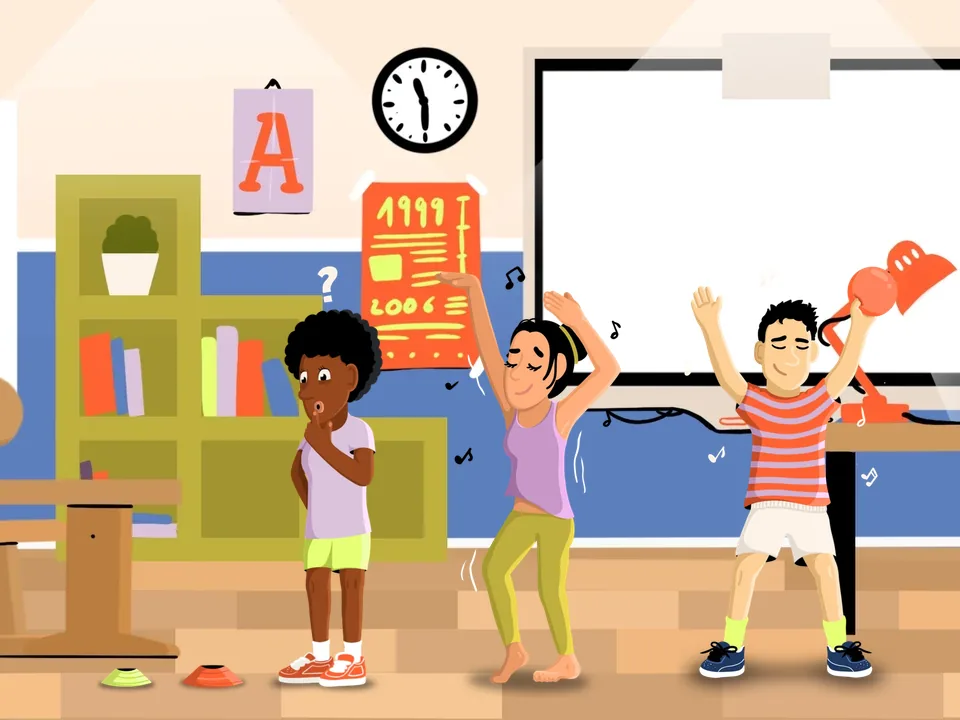
Good fall brain breaks run roughly 2 to 5 minutes and need no equipment. Each pairs one clear movement with a seasonal image, such as falling leaves, apple picking, or a scarecrow pose. Pick by the energy you need: fast breaks to wake a class, balance and memory breaks to focus it, slow breathing breaks to settle it. Every break needs a start signal and a stop signal.
K–5 classroom teachers and PE specialists who want seasonal breaks without a screen get complete rules for six classroom breaks, five steps for teaching the routine in the first weeks, a table of common mistakes, and an outdoor game with a field sketch for dry days.
Seasonal breaks give a new routine a repeatable shape. When a break starts with the same cue, happens in the same personal space, and ends with the same stop signal, students practice moving in a crowded room and returning to work. The leaf or apple image gives a second grader a reason to join in again in week six.
Each break adds a few minutes toward the 60 minutes of moderate-to-vigorous activity that ages 6 through 17 should get every day, as long as students move briskly. A break does not replace PE or recess.
Stick to images from nature and the harvest, such as falling leaves, apple picking, scarecrows, and weather. They include every student regardless of which holidays a family celebrates. If your school marks Halloween, Halloween brain breaks for classrooms cover the last week of October. When Thanksgiving week arrives, switch to Thanksgiving brain breaks for the short week. For a year-round menu, see brain breaks for Grades K–5.
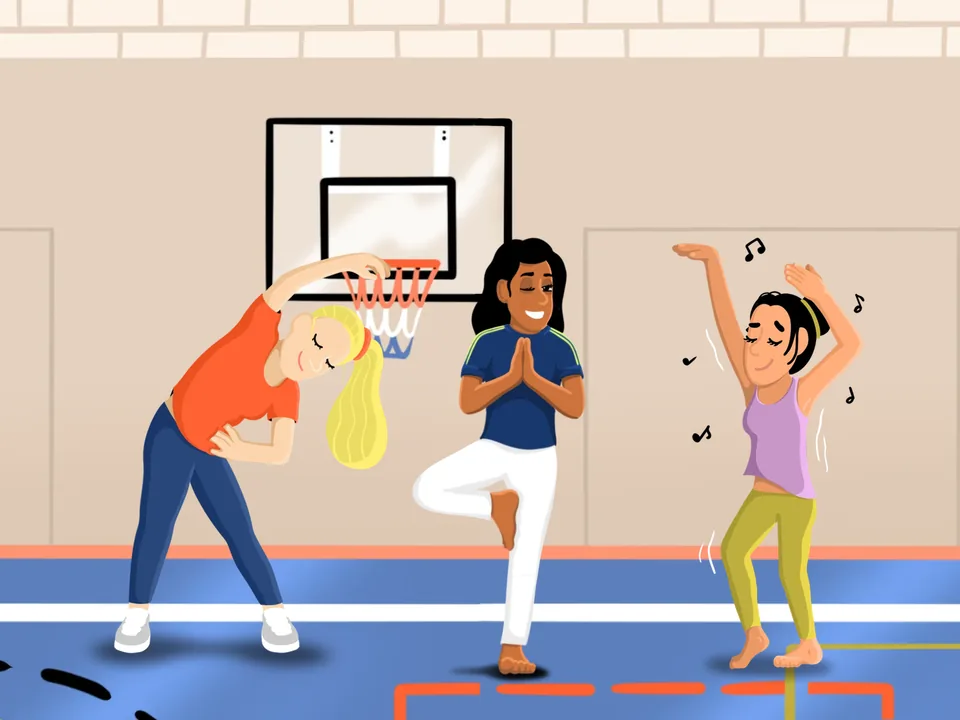
Leaf Fall Freeze and Apple Tree Heights raise the heart rate quickly and end on a command, which suits the stretch before a long reading block.
Students stand in their own space, an arm's length from anyone else. Call “Wind!” and they sway their arms like branches and step quickly in place. On “Leaf fall!” they spiral slowly down into a low crouch. On “Pile!” they freeze, silent, until you call “Wind!” again. Nobody is out: a student who drifts off the spot or bumps a neighbor steps back and joins the next call. The round ends after about six calls, when you say “Sunny day” and everyone sits. For a music version, see no-video dance brain breaks.
Call a branch height and the class picks an imaginary apple there. “High branch” is a reach with a small hop if there is room, “middle branch” is a tiptoe stretch, and “low branch” is a squat. Each pick ends with a clap over an imaginary basket while you count the apples aloud. The class goal is 12 apples. If the count gets muddled, call “Fresh basket” and start again from zero. The break ends when the class reaches 12 together.
Scarecrow Statue asks for balance and stillness, and Pumpkin Patch Sequence asks students to remember a growing sequence, so both fit the minutes before independent work.
Students stand beside their desks with one hand ready to touch the desk. On your signal they lift one foot, spread their arms like a scarecrow, and hold while you count slowly to 10. A foot that touches down is part of the game: the student takes the pose again and picks up at your count. Each student holds twice on each foot, then shakes out both arms. For a harder version, students slowly turn their heads left and right while holding.
Show three moves in order: a small hop for “pop,” a body twist for “vine,” and a clap for “stem.” Students copy the sequence once with you. Each round adds one move, first a knee pat for “seed,” then a high reach for “sprout.” The goal is a five-move sequence performed together. A student who loses the order watches one round and rejoins. If most of the class slips, replay the last sequence that went well. The break ends once the class completes all five moves in order.
Weather Forecaster and Falling Leaf Breath bring a class's energy down, which helps on indoor-recess days.
You or a student act as the forecaster and call the weather. “Wind” means swaying side to side. “Rain” means fingertips tapping the desk, then a pat on the thighs. “Thunder” means one big clap. “Fog” means walking in place in slow motion. A student who mixes up a call copies a neighbor, and the round goes on. After six forecasts, the forecaster calls “Clear skies,” everyone reaches up once, and the class sits.
Students breathe in for a count of four while raising their arms like a leaf lifting on the wind, then breathe out for a count of six while their hands drift down with wiggling fingers. Repeat five times, then sit. Everyone breathes at a comfortable pace, and a student who feels lightheaded sits and breathes normally. For more slow options, see calm brain breaks for classrooms.
Teach the signals before the games, in five short steps.
PE specialists can use the same stop signal in the gym. The first week of PE class routines and rules is a good companion for opening-week planning.
Most problems with seasonal breaks come from missing structure: no spot, no stop signal, or no end point.
| Mistake | Likely cause | Fix |
|---|---|---|
| Students run around | No marked spot or stop signal | Rehearse the freeze before adding the theme |
| Students bump each other | Fast moves in tight rows | Move in place; use slow breaks in tight rooms |
| The break drags on | No set end | Decide the end first: six calls, 12 apples, five moves |
| The class stays wound up | Fast break with no slow finish | End with Falling Leaf Breath or “Sunny day” |
| Students tune out after a few weeks | Same break every day | Rotate three or four breaks |
SHAPE America's position statement calls exercise as punishment, and withholding PE or recess as a consequence, inappropriate. Following the same logic, schedule brain breaks for everyone instead of letting students earn or lose them.
Take a fall break outside only on dry, flat, cleared ground, with a marked boundary and an adult watching the whole group.
Acorn Gatherers needs two hoops, four cones, and one beanbag per student. Set the four zone cones at one end of the area, roughly 50 ft from the start line, and scatter the beanbag acorns inside. Split the class into two teams, each lined up behind a nest hoop (A and B) at the start line. On “Go,” every student jogs to the zone, walks inside it to take one acorn, and jogs back to drop it in the team's hoop. Nobody takes acorns from the other hoop, and a dropped acorn is picked up where it fell. If the zone gets crowded, send each team in two waves. The first team with one acorn per player in its hoop wins the round, and the round ends once both teams are done. To restart, each team carries its acorns back to the zone and sets them down, never throwing them. In later rounds, change the travel to skipping or galloping.
Wet leaves are slippery and can hide sticks, acorns, and holes, so walk the area first and clear hazards. Leaf piles can hold mold and pollen that bother some students with allergies or asthma, so keep the game on cleared ground and follow each student's health plan. More field options are in outdoor PE games when the gym is closed.
Most of the classroom breaks can be done seated. Leaf Fall Freeze becomes arm sways and a slow lean forward, Apple Tree Heights becomes seated reaches, and Scarecrow Statue becomes arms out with a straight back. Offer the seated version to the whole class so no student stands out, and follow any IEP or 504 plan on file.
Yes, when you can pause the video on your stop signal and the movements fit your space. Run-in-place adventures and freeze-dance videos work well. Preview it for any jumping or running, since desk rows are tight. A spoken game like Leaf Fall Freeze needs no screen and adapts on the spot, so alternating the two keeps both fresh.
Yes. In Leaf Pile or Puddle, you read two options, such as “jump in a leaf pile” or “splash in a puddle.” Students show their choice by standing tall for the pile or crouching for the puddle, then do the matching move in place five times. No one is eliminated, and anyone can switch sides next round. The game ends after six pairs.
A workable start is two a day: one after arrival or recess and one before the longest seated task. Add a third if students get restless at the same time each day. Keep each break to roughly 2 to 5 minutes, and use a timer or a set round count so the break ends when you planned it to.
When students return from outdoor recess or a loud hallway transition with racing voices, jumping straight into a lesson rarely works.
The week before Thanksgiving brings shortened schedules, early dismissals and students who are already halfway out the door.

Outdoor PE games when the gym is closed need different planning than gym games: no walls, no painted lines and a surface you did not pick.
Loading a follow-along video on the projector can take longer than the movement break itself.
Open the 3 free units, no account needed, and run one of the 13 classroom movement breaks this week. When you want the unit plans and gym tools, get the app for iOS & Android.
App for iPhone, iPad and Android.