Games & warm-ups
Bean Bag Games for PE
This list is for PE specialists and classroom teachers who run bean bag toss games for kids in Grades K–5, with a few options for Grades…
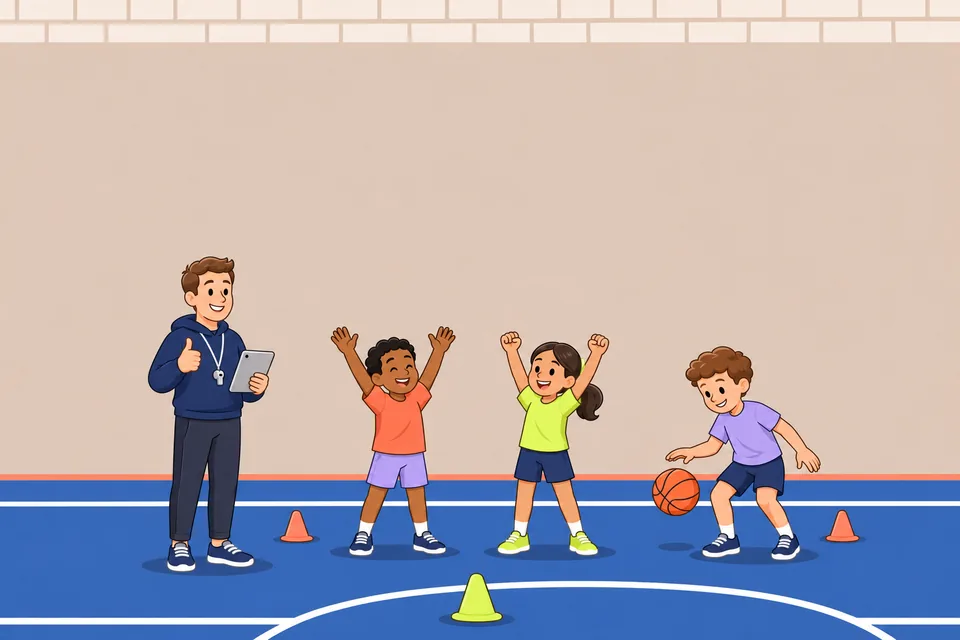
Most cone games for PE need 20 to 30 cones for a class of 24, with rounds of 1 to 6 minutes. The ten games here suit groups of 4 to 30 students: five are flip, knock-down or capture games, three are agility and dribbling courses, and two are cooperative challenges. For Grades K–2, start with cone bowling, color dash or the weave relay.
These games are for PE specialists and classroom teachers with a bag of cones and a full class. They are grouped by skill focus: flipping, aiming and guarding, agility and dribbling, and teamwork. The last section covers storage, safety and the mistakes that eat class time.
Pick by grade and group size, then check the cone count in the table.
| Game | Grades | Group size | Cones | Round |
|---|---|---|---|---|
| Cone Flip Relay | 3–8 | teams of 4–6 | 6 per team | about 4 min |
| Up-and-Down Cone War | 3–8 | 12–30 players, 2 teams | 24 | 90 seconds |
| Cone Keeper | 3–8 | groups of 6–8 | 1 per group | 1 min per guard |
| Cone Bowling | K–3 | groups of 4–6 | 6 per lane | about 5 min |
| Capture the Cone | 4–8 | 16–30 players, 2 teams | 12 | 6 min |
| Cone Weave Relay | K–8 | teams of 4–6 | 5 per team | about 3 min |
| Dribble Gates | 3–8 | up to 30 players | 20 (10 gates) | 60 seconds |
| Color Dash | K–2 | 10–30 players | 24 in 4 colors | about 5 min |
| Stepping Stone Crossing | 3–8 | teams of 4 | 5 flat cones per team | 5 min |
| Pattern Copy Relay | 2–8 | teams of 4–6 | 6 per team | about 5 min |
Flip games work best with light plastic cones of about 9 to 12 inches. Flat disc cones suit courses and stepping stones. SHAPE America recommends moderate to vigorous activity for 50 percent of PE class time and calls traditional elimination dodgeball inappropriate for K–12 PE; none of these games sends a student out for the rest of the round. For a full gear count, see the K–12 PE equipment list.
A flip game asks students to turn an upside-down cone upright with one wrist snap: grip the rim of the wide base, lift the cone about a foot and flick it through a half turn so it lands on that base. Use cones with a flat, cut-off tip, because pointed cones will not balance upside down. If a cone falls over, it counts as down and is flipped from its side.
Grades 3–8 · teams of 4–6 · 6 cones per team
Each team stands behind a row of 6 upside-down cones about 15 ft away. The first runner takes up to 3 tries to flip one cone upright, runs back and tags the next player; a cone still down stays for the next runner. The first team with all 6 upright wins, or after about 4 minutes the team with more upright cones wins, and equal counts are a draw. Reset all cones and rotate the first runner.
Grades 3–8 · 12–30 players in 2 teams · 24 cones
Scatter 24 cones in a marked area, half upright and half upside down. The Up team flips cones upright, the Down team flips them upside down, one cone at a time, jogging only, with no guarding, kicking or throwing cones. After 90 seconds, whistle and count: more cones upright means the Up team wins the round, more upside down means the Down team wins, and a tie is replayed. Swap roles for the next round.
In these three games a cone is the target or the prize, so students aim at cones and never at each other. For tossing at other targets, see these bean bag games.
Grades 3–8 · groups of 6–8 · 1 cone and 1 soft foam ball per group
One guard stands beside a cone while the others form a circle about 15 ft across, pass the ball and throw at the cone, below waist height, to knock it over. The guard may block with hands and body but may not hold the ball or the cone; a held ball means the throw is replayed. A guard whose cone is still standing after 1 minute earns 1 point; a cone the guard tips over counts as a knock-down. The guard stays standing and swaps with a thrower after a knock-down or after 1 minute, the new guard stands the cone back up, and the game ends when everyone has been guard once. Throwers stay on the circle; the nearest player fetches a loose ball and restarts from their own spot. Everyone with a point shares the win.
Grades K–3 · groups of 4–6 · 6 cones and 1 soft ball per lane
Set 6 cones in a triangle at the end of a lane and mark a rolling line about 10 ft away. Each bowler gets 2 rolls per turn, and every cone knocked down is 1 point. The bowler then resets the cones and hands the ball to the next bowler. After 2 turns each, about 5 minutes, the group adds its points and tries to beat that total in the next round. The ball is rolled along the floor, never thrown.
Grades 4–8 · 16–30 players in 2 teams · 12 cones and 2 hoops
Divide the space with a center line, put 6 cones at the back of each side and lay a hoop behind each end line as the jail for players tagged on that side (more ideas in these hula hoop games). Players cross over, take one cone at a time and carry it home. A player tagged by a two-finger tap on the shoulder in enemy territory returns any cone and waits with one foot in that side's jail hoop until a teammate tags them free; both then walk home untagged along the sideline. At the 3-minute mark, call a jailbreak so every waiting player goes home. The round ends after 6 minutes or when one side holds all 12 cones; more cones wins. Return all cones to their spots to restart.
The plan shows the center line, the 6 cones of Team A and Team B, and a jail hoop at each end. The arrow is a Team A runner going for a cone.
Cone courses turn cones into lanes, gates and color targets that students move through. Ages 6–17 are advised to get 60 minutes or more of moderate-to-vigorous activity daily, and short running rounds like these add to that total (Physical Activity Guidelines for Americans).
Grades K–8 · teams of 4–6 · 5 cones per team
Set 5 cones in a straight line, about 3 ft apart, in front of each team. The first player weaves out through the cones, runs straight back and tags the next player. Anyone who knocks over a cone stands it up before moving on. The first team with every player finished and seated wins; a round takes about 3 minutes. In later rounds use a side shuffle, a skip or a dribbled ball.
Grades 3–8 · up to 30 players · 10 gates of 2 cones, 1 ball each
Scatter 10 gates, each made of 2 cones about 3 ft apart, and give every student a ball: a soccer ball for foot dribbling or a basketball for hand dribbling. For 60 seconds, students dribble through as many gates as they can, never the same gate twice in a row. Students count their own gates, and a gate counts only if the ball stays under control. A runaway ball is chased down before play continues from the nearest gate. Each student tries to beat their own count in the next round. Repeat with narrower gates or the weaker hand. More ball ideas: soccer games and basketball games.
Grades K–2 · 10–30 players · 24 cones in 4 colors
Scatter 6 cones of each of 4 colors across a marked space. Call a color and a movement, such as “blue, hop” or “red, gallop”, and every student moves to touch a cone of that color without bumping anyone; cones can be shared. After 8 to 10 calls, about 5 minutes, the game ends. Nobody is out and there is no scoring; call “rainbow” to touch one cone of each color.
Cooperative cone challenges ask a team to solve one problem together, and a wrong attempt costs time, never a turn. They give you a natural place to teach social skills, the third of four standards in SHAPE America's 2024 National PE Standards.
Grades 3–8 · teams of 4 · 5 flat disc cones per team
Mark a “river” about 20 ft wide. Each team must cross it with all 4 players standing on cones only. The lead player places a cone within one step and moves onto it, and everyone behind moves up one cone. The last cone, now empty, is passed forward by hand and becomes the next step. If anyone touches the floor, the whole team returns to the start line. A round ends when all 4 players are across or after 5 minutes. Students step onto the cones and never jump. Use discs that lie flat on carpet or dry grass; on a polished gym floor, swap them for rubber-backed spots. Play again with no talking.
Grades 2–8 · teams of 4–6 · 6 cones per team and a sketch card
Give each team 6 cones at one end and a sketch card of a 6-cone pattern at the other end, about 40 ft away. Runners take turns: look at the card, run back and move the cones to copy it; the card stays in place, and the next runner fixes mistakes. When the team thinks it matches, it sits and you check. The first correct copy wins the round, and a wrong one goes back for fixes. If no copy is correct after about 5 minutes, the team with the most cones in the right spot wins. Then hand out new cards.
Mark the playing area with corner cones, keep a clear buffer of about 6 ft or more to walls and equipment, and teach one stop signal before the first round (see these attention getters).
| Mistake | Cause | Fix |
|---|---|---|
| Long waits in relays | Teams larger than 6 | Split into teams of 4–6 and cap flips at 3 tries |
| Cones fly across the gym | No rule for handling cones | State “no throwing, no kicking” before round one and restate it when needed |
| Arguments over tags and scores | Unclear boundaries | Mark edges with cones, use two-finger tags, call the count yourself |
| Cone Keeper stalls | Guard stays too long | Swap after each knock-down or 1 minute |
Most of these games run on 20 to 30 cones for 24 students: 24 for the flip relay, cone war, color dash, bowling (4 lanes of 6 cones) and pattern copy, 20 for the weave relay and dribble gates, and 30 flat cones for stepping stones with 6 teams of 4. Capture the Cone needs 12, and Cone Keeper needs 1 per group. With fewer cones, let half the class play while the other half counts and resets, then switch.
Cone bowling (Grades K–3), color dash (K–2) and the weave relay (K–8) work in kindergarten. Keep bowling and weave groups at 4 to 6, roll soft balls along the floor, and swap running for walking or hopping if space is tight. The flip games ask for a quick wrist snap and are listed here for Grades 3–8.
Shorten the time limit, widen the river in Stepping Stone Crossing from 20 ft or add a skill. Run the weave relay with a dribbled ball, play dribble gates with the weaker hand or foot, narrow the gates from about 3 ft, and cap the flip relay at 1 try instead of 3. Change one thing per round so students can see what made it harder.
Fill a bag with equal numbers of 4 colors and have each student pick a cone on the way in; the color sets the team, so 4 colors make 4 teams. Swap a few players if skill is uneven. Keep the same teams for two or three rounds, then have two players per team trade places.
Plastic cups, bean bags, rubber spots or empty plastic bottles can replace cones in most of these games. Cups work for flip relays on a table or floor, bottles for bowling, and bean bags for gates, capture games and pattern copying. For stepping stones, use only flat rubber-backed spots, since cups, bottles and bean bags slip or roll underfoot.
Cone Flip Relay, Cone Bowling and Pattern Copy Relay fit small spaces best because students move in lanes and only one per team is active. Shorten the flip distance from about 15 ft to 8 ft and the pattern distance from about 40 ft to 15 ft, switch running to fast walking, and clear desks and bags from every lane first.
This list is for PE specialists and classroom teachers who run bean bag toss games for kids in Grades K–5, with a few options for Grades…
Each game comes with grades, group size, hoop count and a full rule set, followed by safety rules, fixes for common problems and ways to…
For PE teachers who need soccer lead-up games that work in a crowded gym, on a wet field, or with a class that has never played.
The 10 games below fit elementary through high school gyms and outdoor blacktop, with player counts, scoring, turnover restarts, and a…
Get the app for iOS & Android, or try the 3 free units first; they run without an account. The yearly and 12-month plans start with a 7-day free trial; see current prices in the app.
App for iPhone, iPad and Android.