Games & warm-ups
9 Tag Games for PE (Grades K–8)
Elementary PE teachers, classroom teachers without a PE background, middle school coaches, and substitutes can run these tag games for…
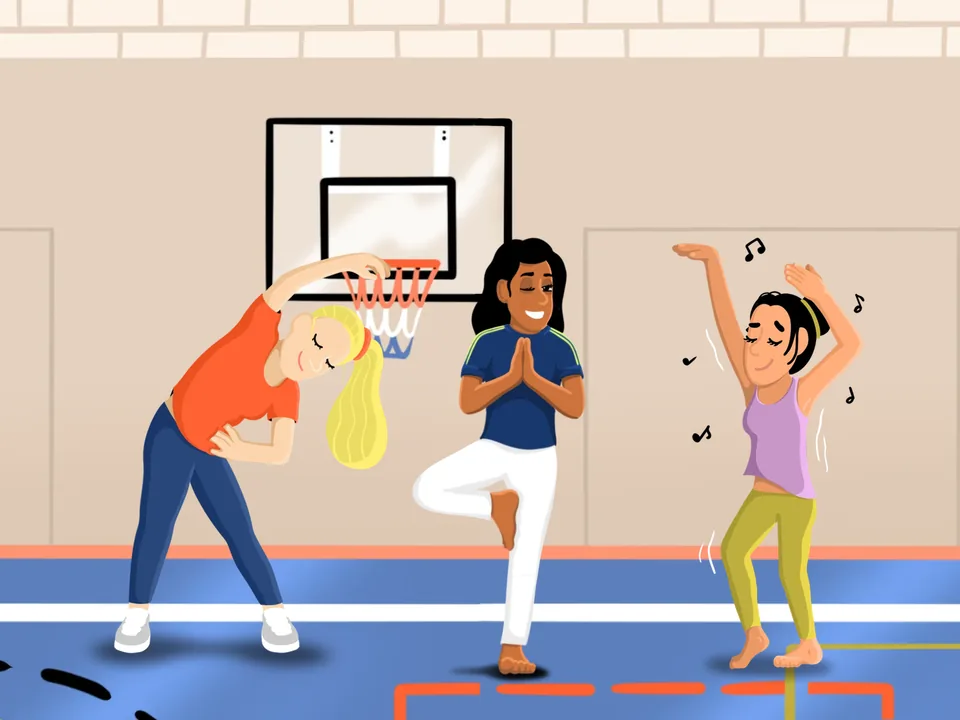
You can run 10 elementary PE games with zero equipment, using only clear space and sometimes lines that are already there. Elbow Tag and Crows and Cranes get a class running, Four Corners and Who Started the Motion? fit a classroom, and Squirrels in the Trees suits Grades K–2. Plan about 5 minutes per game.
These games are for PE specialists and classroom teachers who need a K–5 activity with no gear to hand out. Each one comes with full rules, and you also get a comparison table, simpler versions for the youngest classes and fixes for common problems.
A game works without equipment when students create the challenge themselves and existing lines or corners mark the space. Drop knockout rules as well, because students on the sideline miss activity time, and SHAPE America recommends moderate-to-vigorous activity for 50 percent of PE class time. Children ages 6 through 17 need 60 minutes or more of moderate-to-vigorous activity a day, according to the Physical Activity Guidelines for Americans. The games below mostly train locomotor skills and cooperation. Those are the motor skills (S1) and social skills (S3) in SHAPE America's 2024 National PE Standards. Treat the grades and group sizes below as starting points.
| Game | Grades | Players | Where |
|---|---|---|---|
| 1. Elbow Tag | 3–5 | 12 or more | Gym or field |
| 2. Crows and Cranes | 2–5 | 10–40 | Gym or field |
| 3. Triangle Tag | 3–5 | Groups of 4 | Gym or grass |
| 4. Four Corners: Pick the Move | K–5 | 8–40 | Classroom, cafeteria or gym |
| 5. Who Started the Motion? | K–5 | 8–30 | Classroom or gym |
| 6. Silent Line-Up | 2–5 | Teams of 8–15 | Classroom or cafeteria |
| 7. Ships and Shores | K–5 | Whole class | Gym or blacktop |
| 8. Rock-Paper-Scissors Evolution | 1–5 | 10 or more | Blacktop, field or gym |
| 9. Squirrels in the Trees | K–2 | 10 or more | Gym or blacktop |
| 10. Mother, May I? | K–2 | Groups of 4–6 | Gym or blacktop |
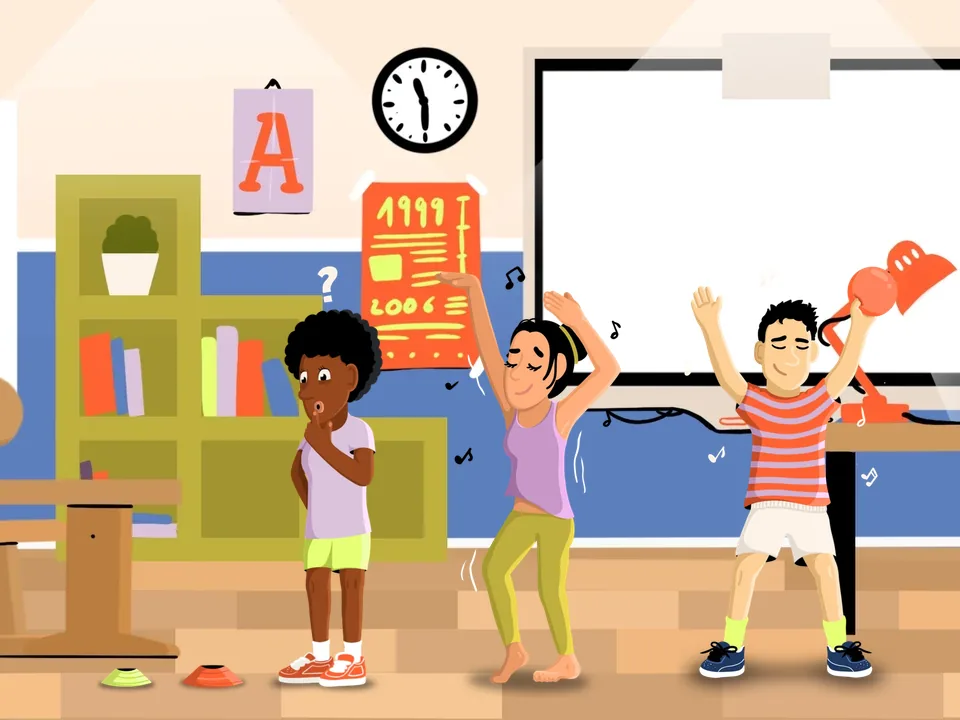
Elbow Tag, Crows and Cranes and Triangle Tag need only open floor or level grass, plus existing lines for Crows and Cranes. Our tag games for PE add more options.
Grades 3–5 · 12 or more players · about 5 minutes · gym or field
Pairs link elbows and spread out while a chaser pursues one free runner. The runner escapes by slowing down and linking elbows with one partner in a pair, and the other partner becomes the new runner. A tag, or the runner leaving the area, swaps chaser and runner, and the new chaser counts to three. Play without a score until time is up. Linked students never pull.
Grades 2–5 · 10–40 players · about 5 minutes · gym or field
A Crows line and a Cranes line face each other about 8 feet apart. The Crows' safe line and the Cranes' safe line sit about 25 feet behind their own teams, with about 10 clear feet beyond. Call one team's name (the diagram shows “Cranes”): it chases the other team to that team's safe line. Tagged runners switch teams. After a wrong-way start, call “freeze” and reset. Every call starts from the middle, and the larger team at the end wins.
Grades 3–5 · groups of 4 · about 5 minutes · gym or grass
Three students hold hands, one of them the target, and the fourth tries to tag the target's back from outside. The triangle turns to protect the target without yanking arms, and reaching across the middle doesn't count. A legal tag scores the tagger a point. Reset after a tag or a broken grip. Rotate roles about every 30 seconds, with groups spaced well apart. The most points at the end wins.
Four Corners, Who Started the Motion? and Silent Line-Up work indoors because students only walk or move on the spot. Push in chairs and clear bags first.
Grades K–5 · 8–40 players · about 5 minutes · classroom, cafeteria or gym
Number the corners 1 to 4. A caller with closed eyes counts down from 10 as students walk to a corner, then names a number. Everyone outside that corner scores a point. Those inside get no point but pick the class's next walking move, such as tiptoe. Stragglers join the nearest corner. After 10 calls, the high score wins and a new caller starts.
Grades K–5 · 8–30 players · about 5 minutes · classroom or gym
A guesser faces a wall inside the room while you point to a secret leader. The leader switches between moves on the spot every few seconds, and the class copies from a circle or beside desks. The guesser turns around with three tries: a hit earns the guesser a point, while three misses earn the leader one. The leader guesses next, with a new secret leader. If someone gives the secret away, switch leaders. Play until time is up; the top score wins.
Grades 2–5 · teams of 8–15 · about 5 minutes · classroom or cafeteria
Teams line up alphabetically by first name, or by birthday month, using only gestures. A team that talks freezes for a count of five. A finished team raises hands and reads its line aloud. A correct order scores a point and ends the round; after a mistake, play goes on. Change the order each round and keep students off benches. The team ahead at the end wins.
For more movement near desks, try these brain breaks for Grades K–5.
Ships and Shores and Rock-Paper-Scissors Evolution suit a blacktop, where a whole class has room to move, and both also work in a gym.
Grades K–5 · whole class · about 5 minutes · gym or blacktop
Use boundary lines about 10 feet in from walls and fences. Name one end “bow,” the other “stern” and the sides “port” and “starboard.” Students jog or gallop to the line you call and stop there. On “scrub the deck” or “captain's coming,” they crouch to scrub or stand and salute where they are. The class earns a point when everyone gets it right. After a miss, show the answer and call again. Ten points end the round.
Grades 1–5 · 10 or more players · about 5 minutes · blacktop, field or gym
Players start as eggs, arms circled overhead, and play rock-paper-scissors with someone at the same stage. Winners move up to chicken (flapping elbows), then dinosaur (giant steps), then human. Losers drop a stage, eggs stay eggs and ties replay. A new human scores a point and starts over as an egg. Everyone walks, including players looking for a match. At your stop signal, the most points wins.
Check the surface for puddles, gravel and holes before class. In hot weather, play during the cooler parts of the day when you can, offer water and shade breaks, and watch young children closely. For play that students can lead, see these outdoor recess games.
Kindergartners and first graders do best when a game starts with one rule, uses walking or pretend moves and knocks nobody out.
Grades K–2 · 10 or more players · about 5 minutes · gym or blacktop
Two students hold hands to make a tree around a squirrel, and one or two extra squirrels start without a tree. You make the first call. On “squirrels,” trees raise their arms and each squirrel walks to a new tree. On “trees,” each pair, still holding hands, walks to a new squirrel. On “forest fire,” everyone walks into new threes. A leftover student calls the next word, or you do if nobody is left over. Nobody keeps score, pairs that let go simply join hands again and play lasts until time is up.
Grades K–2 · groups of 4–6 · about 5 minutes · gym or blacktop
The caller stands about 20 feet from a line of players and offers one player at a time a move, such as three bunny hops. The player asks “Mother, may I?” and moves only after “Yes, you may.” A “No, you may not” or a forgotten question means staying put. The first to reach the caller wins and calls the next round, with everyone else back on the line. If time runs out, the closest player wins.
Three other games on this list also suit young classes with small changes:
Safe, fair rounds need clear space, a light tag, a practiced stop signal and rules that keep every student playing. Leave about 10 feet between running boundaries and walls or fences, and keep everyone at a walk in classrooms and cafeterias. A legal tag is a light, open-hand touch on the shoulder or back. Stay where you can see every player. Practice the stop signal before the first round, for example with one of these attention getters for PE class. Before chase games, check health plans for students with asthma or other conditions.
Skip penalty push-ups and laps for students who lose or get tagged: SHAPE America calls physical activity used as punishment inappropriate.
| Typical mistake | Cause | Fix |
|---|---|---|
| Students stand and wait | One chaser for a big class | Add chasers or split into two games |
| Collisions | Too little space for the speed | Enlarge the area or switch to walking |
| Tag arguments | No clear touch rule | Show a legal tag and settle disputes with rock-paper-scissors |
| Slow start | Every rule explained at once | Teach the goal and stop signal, then add details between short rounds |
| Same students keep getting caught | Large speed gaps | Rotate chasers often and pair students of similar pace |
Make one group bigger so nobody sits out. Elbow Tag works with one trio among the pairs, and five students can play Triangle Tag as a square with one tagger. Squirrels in the Trees already uses extra players, and Silent Line-Up teams can differ by a student or two.
Assign them yourself by counting off, and in whole-class tag, swap taggers every minute or two. Counting off also avoids captain picks that leave someone chosen last. Have taggers raise a hand before the start signal so classmates know who is chasing, and use only as many taggers as players can keep track of.
Change the rule or the space for the whole group so the student plays the same game. Speed-walking rounds, a smaller area and calm games such as Silent Line-Up can all help. Rotate the caller job among everyone, check the student's IEP or 504 plan and ask your adapted PE specialist.
Plan on about four games in a 30-minute class. At about 5 minutes per game, four games take roughly 20 minutes. That leaves time for a warm-up, short rule demos and a calm cool-down. In a 45-minute class, five or six games fit, or you can repeat a class favorite with one new rule.
Elementary PE teachers, classroom teachers without a PE background, middle school coaches, and substitutes can run these tag games for…
With clear floor boundaries and modified rules, you can run indoor PE activities that keep students moving safely without knocking over…
A good brain break needs a clear stop signal, a bubble of space for each child, and a game students can learn fast.

Recess supervisors and classroom teachers in Grades K–5 need games that start fast and run without a referee.
The game collections come with a plan in the app for iOS or Android, and yearly and 12-month plans start with a 7-day free trial. To look around first, open the 3 free units, including Classroom Brain Breaks, with no account needed.
App for iPhone, iPad and Android.