
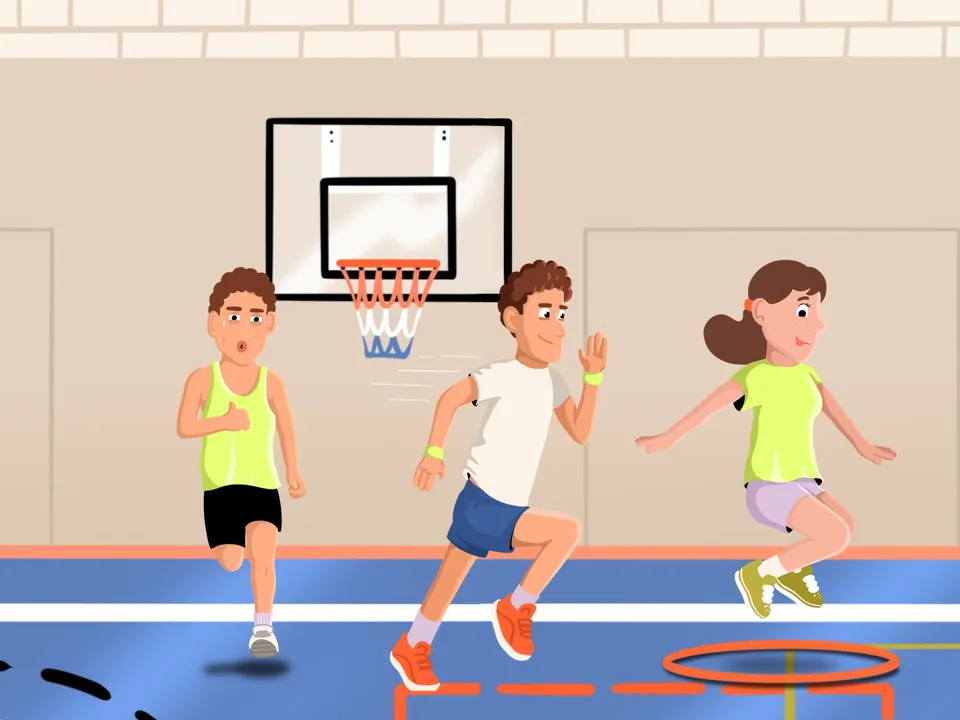
8 Sportsmanship Games and Routines for PE
This guide is for PE specialists, secondary PE teachers, and classroom teachers who teach mixed-ability classes in Grades K–12. Beyond the…
Kickball in PE class uses 4 bases and 3 outs per turn, and a run scores when a runner touches all 4 bases in order. Fielders get runners out by tag, force or fly catch. Teams switch after 3 outs or 9 runs, or in a large class once the whole lineup has kicked. Runners wait on base until the kick: no leading off, no stealing.
These kickball rules for PE class come from Playworks and league play, adapted for a full class on a gym floor or field. They add changes that cut waiting time, outs that need no throwing at runners, a diamond layout and variations for Grades K–5 and 6–12.
Three fouls by one kicker make an out, forced runners must advance, and a caught fly ball ends the kicker's turn. Kickball plays like baseball with a rolled rubber ball and a kick: one team kicks and runs, the other fields. The core rules follow Playworks:
No. League rules state that neither leading off nor stealing a base is allowed, so runners keep contact with the base until the ball is kicked. In PE, announce it before the first kick and send an early runner back to the base.
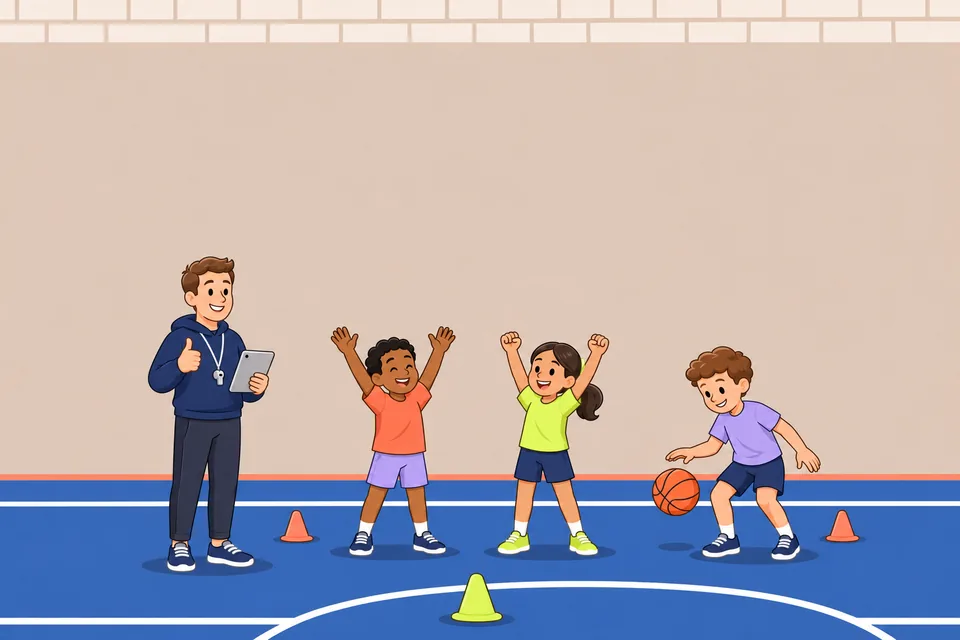
Standard kickball leaves most of the class standing still, because only the kicker, the runners and the fielders near the ball move. SHAPE America recommends moderate- to vigorous-intensity activity for 50 percent of PE class time, so change the rules that create waiting.
| What goes wrong | Cause | Fix |
|---|---|---|
| Long kicking line | Too many players on one diamond | Split a class of 30 into two games of 15, with 7 or 8 per side |
| Three quick outs, and half the lineup never kicks | Switch only after three outs | Switch when everyone in the lineup has kicked, whatever the number of outs; a runner who is out still leaves the bases, and play after the last kick ends when the pitcher has the ball |
| Fielders idle in the outfield | The ball rarely reaches them | Rotate fielders one position after each kick |
| Fielders chase the same ball | No assigned jobs | Give each fielder a base or zone; every fielded ball goes to the pitcher |
| Arguments over calls | Rules unclear, no neutral decision | Post the rules before play (see first-week routines and rules); settle disputed calls with rock-paper-scissors and replay the kick |
| Kicks stall or miss | Ball rolled too fast or bouncing | Slow, straight roll; re-roll misses, no strikeouts |
Use three kinds of outs in PE: a caught fly ball, a force out and a tag with the ball held in hand. The standard Playworks rules ban sliding and throwing the ball at runners, although the page lists below-the-waist or below-the-shoulders throws as an option for older players. Adult league rules allow throwing a runner out but ban hits to the head or neck, which is hard to police in a class with mixed sizes and skills. SHAPE America's position statement calls traditional elimination dodgeball inappropriate for K–12 PE. The statement covers elimination dodgeball only. A throw-out rule in kickball still makes students targets in the same way (see school rules on throwing at students).
These safety habits assume adult supervision and a clear, dry surface:
One soft rubber kickball, four bases and three cones are enough for one diamond. Add pinnies for one team and a whistle.
The plan shows home plate, first, second and third base, the pitcher, the kicking-line cone and the two foul-line cones. Runners circle counterclockwise.
Lap Race Kickball gives every student a kick and a full lap with no outs. It needs no tags and no throwing at runners.
Fielders stay off the base path while a runner is on it.
For Grades K–2, let kickers kick a stationary ball at home plate or take a very slow roll, and set the bases closer. For mixed-ability classes, let each kicker choose a stationary or rolled ball, and offer a hand push or a partner who runs the bases; the adaptive PE curriculum guide covers this in more depth. In Grades 6–12, play the full rules above, with fly outs and tagging up. Playworks lists more versions on its kickball page, such as Kindergarten Kickball and Crazy Kickball.
Balance the teams first, keep one run tally per team, and settle disputed calls with rock-paper-scissors. For picking sides, see fair ways to pick teams without captains. The Team Creator in the PhysEdPrep app builds teams that are random, balanced by skill or split by gender from your saved class rosters.
No. The only related basketball rule is the kicking violation: intentionally kicking or striking the ball with the foot or leg. Accidental contact with the foot or leg is not a violation. In class, teach the difference between a ball that bounces off a shoe and a deliberate kick.
Run each game for about 10 to 15 minutes, or until every student has kicked once, whichever comes first. Switching sides by lineup keeps turns equal, and a countdown timer with a whistle gives the game a hard stop so the last kicker doesn't run into the next transition.
Set the rule before the first kick, because no official rulebook covers school gyms. A simple choice: a ball that touches the ceiling, a hoop or hanging equipment is dead and the kicker kicks again, while a ball that bounces off a wall stays live. Post the rule where students can see it.
Let them kick a stationary ball placed on home plate, or ask the pitcher to roll the ball very slowly. Students with limited mobility can push the ball by hand from their seat, and a partner can run the bases for them. Ask the student what works best, and let any classmate choose the same option so nobody is singled out.
Introduce force outs and tagging up once students can follow the ball and the bases at the same time, typically around Grades 3–5. In Grades K–2, skip outs and use stationary kicks or Lap Race Kickball. Add one new rule at a time and let students play a full game with it before adding the next.
About 7 or 8 students per side works well for one diamond: a pitcher, a catcher, three base fielders and two or three outfielders. Adult league rules call for 8 to 10 fielders. With fewer students, drop outfielders first; with an uneven class, let one team send a kicker up twice so both teams get the same number of turns.
Yes, unless you rule it out before the game. Playworks suggests a no-bunting rule to make play fairer across skill levels. A simple PE version: mark a line about 10 ft in front of home plate, and any kick that stops short of it is kicked again. Waive the line for students who need an adapted kick.
This guide is for PE specialists, secondary PE teachers, and classroom teachers who teach mixed-ability classes in Grades K–12. Beyond the…
If a principal, a parent or a class has asked you about dodgeball, the answer depends on three different things: law, professional…
You teach PE with a rack of scooter boards and a class that cannot wait to ride.
Download the app for iOS & Android and try 3 free units with no account. The 7-day free trial on the yearly plan opens all 6 gym tools, including Team Creator and Scoreboard & Game Counter, for your next kickball game.
App for iPhone, iPad and Android.