Games & warm-ups
10 Basketball Games for PE (Grades K–12)
The 10 games below fit elementary through high school gyms and outdoor blacktop, with player counts, scoring, turnover restarts, and a…
Eight indoor gym ball games keep about 12 to 30 students in Grades K–12 moving at once in rounds of about 4 to 6 minutes using 1 to 15 balls. Relay, target, kicking, and keep-away games replace elimination formats, so no one has to sit out. Soft foam and low-bounce balls help keep play below waist height and off the walls.
PE specialists, classroom teachers covering gym, and substitutes often work with a wood floor, a mixed equipment cart, and a class ready to move. Each of the 8 gym games with balls below lists player count, ball type, scoring, turnover rules, and restart cue, and fits either a full court or a half gym.
Coated-foam balls around 6–7 inches wide suit most indoor throwing and target games because the skin grips well and the ball stings less than a rubber one. Uncoated high-density foam balls move slowly enough for short passes in half-gym grids, 8.5-inch rubber playground balls fit two-hand relays, and low-bounce foam soccer balls or a lightweight 18–24-inch gym ball keep floor kicks low. For K–1 classes still building catching skills, start with bean bag games for PE.
Check inflation before first period begins: slightly softer rubber playground balls bounce lower instead of bounding toward ceiling lights. Park a ball cart or mesh bag on the sideline so spare balls stay off ankles between rounds.
| Game | Grades | Players | Balls and Gear | Round |
|---|---|---|---|---|
| Over-Under Sprint Relay | Grades K–6 | About 16–25 | 4–5 rubber playground balls, 8–10 cones | About 4 minutes |
| Alaskan Baseball | Grades 3–8 | About 16–24 | 2 coated-foam balls | About 6 minutes |
| Monster Ball | Grades 2–10 | About 16–30 | 1 large exercise ball, 14 coated-foam balls, boundary cones | About 5 minutes |
| Pin Knockdown | Grades 3–8 | About 16–28 | 8 coated-foam balls, 10 plastic pins | About 5 minutes |
| Crab Soccer | Grades 3–8 | About 14–24 | 1 lightweight gym ball, 4 cones | About 5 minutes |
| Four-Corner Cone Kick | Grades 2–6 | About 16–28 | 4 foam soccer balls, 12 cones | About 5 minutes |
| Endzone Keep-Away | Grades 4–12 | About 12–24 | 2–3 uncoated foam balls, pinnies, cones | About 4 minutes |
| Hoop Bounce Keep-Away | Grades 3–10 | About 12–24 | 2–3 uncoated foam balls, 4–6 hoops, pinnies | About 5 minutes |
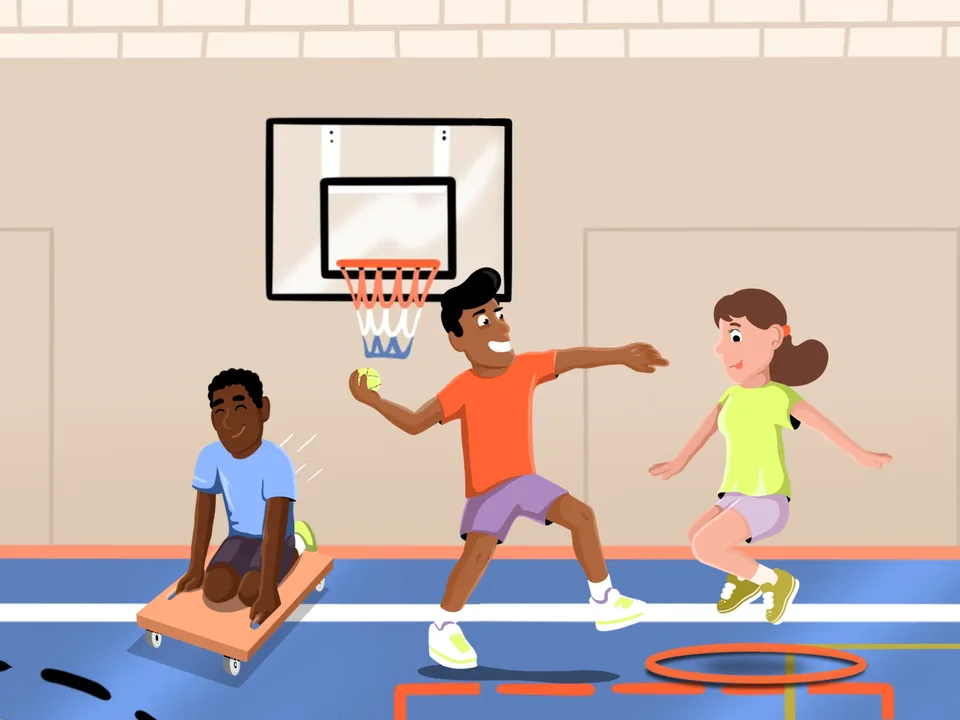
Two to five balls keep a whole class moving when relay lines cap at 4–5 students or two half-court games run at once. PE class contributes to the 60 minutes or more of moderate-to-vigorous activity that ages 6–17 need daily, according to the Physical Activity Guidelines for Americans.
Grades K–6, about 16–25 players in teams of 4–5, 4–5 rubber playground balls and 8–10 cones, about 4 minutes.
Grades 3–8, about 16–24 players in two half-court games, 2 coated-foam balls, about 6 minutes.
Throwing at pins or a large exercise ball keeps energy high without hitting players, in line with SHAPE America's position statement on dodgeball, which calls elimination dodgeball inappropriate for K–12 PE and recommends 50 percent moderate-to-vigorous class time (see what PE teachers should know about dodgeball).
Grades 2–10, about 16–30 players, 1 large exercise ball, 14 coated-foam balls, and boundary cones, about 5 minutes.
Grades 3–8, about 16–28 players, 8 coated-foam balls and 10 plastic pins, about 5 minutes (pairs well with a bowling unit for PE).
Indoor kicking games stay controlled on wood or synthetic floors when players use low-bounce foam soccer balls or a lightweight 18–24-inch gym ball and keep kicks below knee height with the soccer balls and below waist height with the gym ball.
Grades 3–8, about 14–24 players in two teams, 1 lightweight gym ball and 4 cones, about 5 minutes.
Grades 2–6, about 16–28 players in four teams, 4 foam soccer balls and 12 cones, about 5 minutes.
Splitting a gym into two or three coned grids of 6 to 8 players keeps everyone involved in tight spaces, working alongside other PE games for small spaces and half gyms.
Grades 4–12, about 12–24 players in 3v3 or 4v4 grids, 2–3 uncoated foam balls, pinnies, and cones, about 4 minutes (good prep for basketball games for PE).
Grades 3–10, about 12–24 players in 3v3 or 4v4 grids, 2–3 uncoated foam balls, 4–6 hoops, and pinnies, about 5 minutes.
Safe indoor ball games depend on soft foam or low-bounce balls, a below-waist rule with zero head shots, a dry floor with about 5 feet of clearance from walls and bleachers, and perimeter supervision across all grids. Before Crab Soccer or stability-ball play, verify tied laces and have crab-walking students keep a walking pace and stop if a wrist hurts. Keep glasses straps handy and match smaller 6-inch balls to K–2 hands so catches stay clean.
Enforce high throws or line faults with a ball turnover rather than push-ups or sitting students out, since SHAPE America's position statement on physical activity as punishment classifies exercise penalties and withholding PE as inappropriate.
| Mistake | Cause | Fix |
|---|---|---|
| Throws rise near faces | Close-range overhand throws | Keep a center zone about 15 feet out or require bounce throws |
| Slips on loose balls | Stray balls rolling across lanes | Store extras in a mesh bag or ball cart on the sideline and call "Freeze" on strays |
| Long waiting lines | One ball for the whole class | Run 2–3 grids of 6–8 players with multiple balls |
| Wall or light hits | Hard outdoor soccer balls | Use low-bounce foam balls and call turnovers above knee height |
Name Toss Circle works in about 4 to 5 minutes with circles of 8 to 10 students and 1 to 3 coated-foam balls. Players call a classmate's name, make eye contact, and toss underhand, and every student receives the ball once before it returns to the first thrower. Repeat that pattern, then add a second ball. A dropped ball goes back to the thrower for another toss.
Wall squats, seated balance marches, forearm plank holds, and overhead partner passes work well with an 18–24-inch stability ball in sets of about 20 to 30 seconds. Space students about 6 feet apart on non-slip mats, and spot beginners so balls cannot roll out from under them.
Dribble and Freeze works as a short warm-up before skill work. Each student dribbles or rolls a foam or playground ball inside a coned area, stops it on your "Freeze" call, and starts again on "Go." A student whose ball escapes chases it and rejoins right away, so nobody waits in line. Change the cue each round, such as switching hands or dribbling low.
Swap standard foam balls for slower beach balls or audible bell balls, widen target zones, and allow bounce passes or ramp rolls, following the accommodations in a student's IEP or 504 plan. Letting all players choose between seated rolling and standing throws keeps everyone in the same grid.
Plan on about one ball per student for warm-ups and skill practice, so about 25 balls for a class of 25. The team games above need fewer: between 1 and 15 balls per game. A mixed cart of coated-foam balls, uncoated foam balls, 8.5-inch playground balls and a few foam soccer balls covers every game in this guide.
The 10 games below fit elementary through high school gyms and outdoor blacktop, with player counts, scoring, turnover restarts, and a…
This list is for PE specialists and classroom teachers who run bean bag toss games for kids in Grades K–5, with a few options for Grades…
When the 100th day arrives in January or February, asking young classes for 100 straight repetitions of one movement often ends in lost…
When an assembly, a testing day or a second class takes half your gym, the students still show up. PE games for small spaces work when you…
Split your class into fair teams with the Team Creator, time each round with the Countdown Timer and keep points on the Scoreboard & Game Counter in the free PhysEdPrep app for iOS and Android. You can try 3 free units without an account, including Basketball: Shooting, Passing & Dribbling for Grades 5–7. Start a 7-day free trial on a yearly or 12-month plan to open all 40+ unit plans, 240+ lessons, 8 game collections, and 6 gym tools across Grades K–12 (see current prices in the app).
App for iPhone, iPad and Android.