10 Locomotor Activities for K–5 PE
Elementary PE specialists, classroom teachers covering gym periods, and student teachers can use any game below as a quick warm-up or…
Each of these eight manipulative skills activities takes about 6 to 10 minutes and gives Grades K–5 PE classes practice in throwing, catching, kicking, striking, dribbling, or rolling. Working individually, in pairs, or in groups of 3 to 4 maximizes touches, and ball and distance swaps keep mixed-ability classes in the same game.
PE specialists, classroom teachers covering gym periods, and student teachers can run these games on a dry gym floor using foam balls, cones, beanbags, paddles, and hoops. Each entry gives student groupings, safety spacing, scoring, and restart rules, followed by a troubleshooting table and a four-station floor plan.
Manipulative movements, also called object control skills in PE, are actions where children use their hands, feet, or another body part, or hold an implement like a paddle or racket, to send, receive, or control an object such as a ball, hoop, or beanbag. In elementary gym classes, core examples include throwing, catching, kicking, trapping, striking, dribbling, and rolling. Many PE teachers sort them into sending skills (throwing, kicking, striking, rolling), receiving skills (catching, trapping) and control skills (dribbling or moving an object while traveling).
Under SHAPE America's 2024 National Physical Education Standards (four US K–12 standards, S1–S4, released in March 2024 to replace the five-standard 2013 edition), gross-motor object control sits in Standard 1 next to locomotor skills, which move the body across space (see locomotor skills activities for K–5 PE). Fine-motor work, such as pinching or lacing at a desk, uses small finger motions. The eight games below are gross-motor: they build throwing force, foot contact, and visual tracking.
| Activity | Skill | Grades | Group | Time |
|---|---|---|---|---|
| 1. Hoop Target Toss | Underhand throw | Grades K–2 | Pairs | About 8 minutes |
| 2. Step-Back Partner Catch | Overhand throw, catch | Grades 2–5 | Pairs | About 8 minutes |
| 3. Gate Pass Challenge | Foot pass, sole trap | Grades 1–5 | Pairs | About 8 minutes |
| 4. Pin Knockdown Kick | Instep kick | Grades K–3 | Groups of 3 | About 10 minutes |
| 5. Balloon Tap Keep-Up | Open-palm strike | Grades K–2 | Individual | About 6 minutes |
| 6. Paddle Bounce-and-Hit Rally | Paddle strike | Grades 3–5 | Pairs | About 10 minutes |
| 7. Poly Spot Dribble Freeze | Hand dribble | Grades 1–5 | 6–28 students | About 8 minutes |
| 8. Tunnel Roll Relay | Two-hand roll | Grades K–2 | Teams of 4 | About 8 minutes |
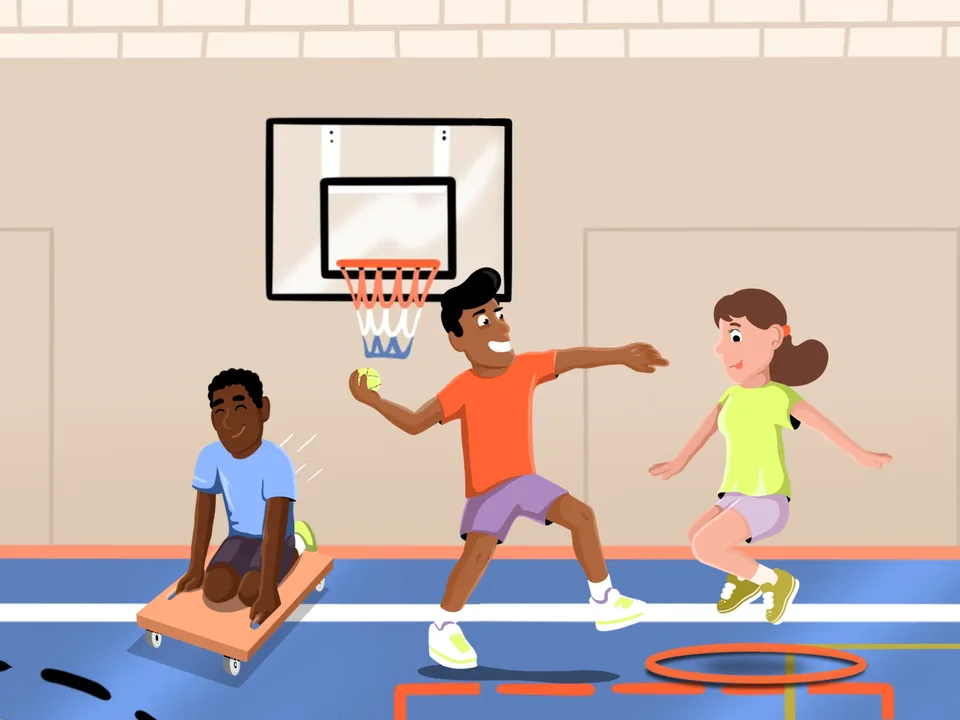
Pair tosses and partner catches build accuracy and tracking without sitting anyone out. SHAPE America's 2017 dodgeball position statement calls traditional elimination dodgeball (hitting players out) inappropriate for K–12 PE and recommends moderate-to-vigorous activity for 50 percent of PE class time. All eight games here score points instead of eliminating players. For more tossing targets, see bean bag games for PE, and for hoop-based tossing and rolling games, see hula hoop games for PE.
Grades K–2 play in pairs for about 8 minutes with 1 beanbag, 1 hoop, and 2 cones on a dry floor, spaced about 6 feet apart.
Grades 2–5 play in pairs for about 8 minutes with 1 soft 6-inch foam ball and 2 spots in lanes about 6 feet apart.
Ground-pass gates and wall kicks teach students to plant the support foot beside the ball, keep kicks low, and cushion passes with the sole or inside of the foot.
Grades 1–5 play in pairs for about 8 minutes with 1 foam soccer ball and 2 cones on a dry floor, spaced about 8 feet apart.
Grades K–3 rotate in groups of 3 for about 10 minutes with 1 foam ball, 3 plastic pins, and 2 cones per lane, spaced about 8 feet apart facing a wall.
Striking works best when early grades track slow balloons with an open palm before older classes add a short-handled paddle and a bounce. Spot markers on the floor help young players hold safe self-space while looking upward.
Grades K–2 play individually for about 6 minutes with 1 latex-free 12-inch balloon and 1 spot, spaced about 6 feet from walls and peers. Supervise closely and pick up popped pieces right away, since broken or uninflated balloon pieces are a choking hazard for children under 8.
Grades 3–5 play in pairs for about 10 minutes with 2 short-handled foam paddles, 1 foam tennis ball, and 4 cones, leaving about 6 feet between courts.
Hand dribbling and floor rolling train steady finger-pad force and low pendulum releases while students scan open gym space.
Grades 1–5 play together (6–28 students) for about 8 minutes with 1 junior basketball and 1 spot per player, scattered about 6 feet apart on a dry floor.
Grades K–2 play in teams of 4 for about 8 minutes with 1 foam bowling ball and 2 cones about 12 feet apart, spacing lines about 6 feet apart.
Two- or three-word cues given while pairs play correct form without lining students up for a skills check. Walking the floor with a three-level roster code (emerging, developing, consistent) lets you track progress while everyone keeps moving. Children and teens ages 6 through 17 should get 60 minutes or more of moderate-to-vigorous physical activity daily, with muscle- and bone-strengthening activity on at least three days a week, according to the Physical Activity Guidelines for Americans (2nd edition, HHS 2018).
Coach one cue per round so feedback stays clear, check five or six students per rotation until you cover the full roster, and use this chart to correct frequent form errors:
| Common Mistake | Likely Cause | Quick Cue or Fix |
|---|---|---|
| Stepping with same-side foot | Rushing throw without trunk turn | Set a poly spot ahead for the opposite foot ("step and point") |
| Trapping balls on the chest | Stiff elbows or fear of impact | Swap to a juggling scarf first and cue "pinkies or thumbs together" |
| Toe-poking kicks upward | Hitting with toes while leaning back | Name the shoelaces as the contact spot and cue "nose over toes" |
| Slapping dribbles with palms | Watching the ball instead of space | Cue "spider fingers at the waist" and hold up fingers for students to call out while dribbling |
Once about three-quarters of the class holds consistent form across two straight rounds, move targets back 1 pace or switch to a smaller ball.
Offering two or three equipment options in a shared bin lets mixed-ability classmates practice the same manipulative skill at a comfortable speed and grip size.
For 24 students (6 per corner), store swap bins in the Center Equipment Zone with about 8 feet of buffer space, and rotate clockwise after each round through Station 1: Hoop Target Toss, Station 2: Gate Pass Challenge, Station 3: Step-Back Partner Catch, and Station 4: Poly Spot Dribble Freeze:
All four games in this rotation fit Grade 2. For another grade, pick four games from the table that match it and keep the same corner layout. Multi-week sequences for Grades K–5 are outlined on the elementary PE curriculum for Grades K–5 page.
Hand skills cover gross-motor gym actions like underhand tossing, overhand throwing, two-hand catching, hand dribbling, and open-palm striking, plus fine-motor tasks like pinching clothespins and lacing cards. Pairing scarf tosses with foam-ball catches in Grades K–2 builds tracking before paddle units.
Manipulative play activities for preschool and kindergarten children include rolling balls down ramps, tossing beanbags into baskets, scooping foam balls with plastic catchers, and stacking large blocks. Free-choice stations let kids explore bounce and force; use only large, non-choking items around children under age 3.
Typical in-hand manipulation drills include picking up 3 to 5 plastic counters one by one into the palm and slotting them into a tub, walking fingers along a pencil, and flipping a marker in one hand. Keep small counters away from children under age 3.
Teach the easier version of each skill first: rolling and underhand tossing before overhand throwing, catching large soft objects before small balls, and striking with the hand before paddles. Practice standing still first, then while moving. Scarves and balloons give slow flight for kindergarten. Grades 3–5 can move to smaller balls, longer distances and partner games with a moving target.
A mature overhand throw shows four checkpoints: the student stands side-on to the target, steps with the opposite foot, turns hips and trunk before the arm comes through, and follows through across the body. Check one point per round while pairs play. A student who keeps all four across two rounds is ready for longer distances or a smaller ball.
Elementary PE specialists, classroom teachers covering gym periods, and student teachers can use any game below as a quick warm-up or…
This list is for PE specialists and classroom teachers who run bean bag toss games for kids in Grades K–5, with a few options for Grades…
Each game comes with grades, group size, hoop count and a full rule set, followed by safety rules, fixes for common problems and ways to…
Some students in your class have played a sport for years, and others are touching it for the first time.
Download the free PhysEdPrep app for iOS and Android to try 3 free units without an account, including Parachute Games from Grade 1 and Basketball: Shooting, Passing & Dribbling for Grades 5–7. Yearly and 12-month plans start with a 7-day free trial and include all 6 gym tools across Grades K–12 (see current prices in the app).
App for iPhone, iPad and Android.