
Kickball Rules for PE Class
These kickball rules for PE class come from Playworks and league play, adapted for a full class on a gym floor or field.
Matball is indoor kickball with 4 gym mats as bases, and several runners may share one mat. Each runner who gets back to the home mat scores a run. The kicker must run to first, and anyone who steps off a mat has to continue. Outs come from caught fly balls, plays at first and tags. Rules vary, so announce yours before the first kick.
These matball rules suit PE teachers and classroom teachers who move kickball into the gym for winter or a rainy day. You also get mat distances by grade, a floor plan, safety setup, variations that cut standing time and fixes for large classes.
Matball swaps small bases for gym mats and lets several runners wait on the same one. The kicker still has to run to first, but other runners can stay put until a later kick.
| Rule | Matball in this PE version | Common PE kickball |
|---|---|---|
| Bases | Four gym mats | Four small bases |
| Runners per base | Any number | One |
| After leaving a base | Must continue to the next mat | May return if not forced |
| Force outs | Only the kicker at first | Any forced runner |
| Teams switch | After everyone has kicked once | Often after 3 outs |
For the field game, see these kickball rules for PE class. The University of Nebraska Medical Center's intramural matball page names the same two core differences: much larger bases and no limit on how many players share one.
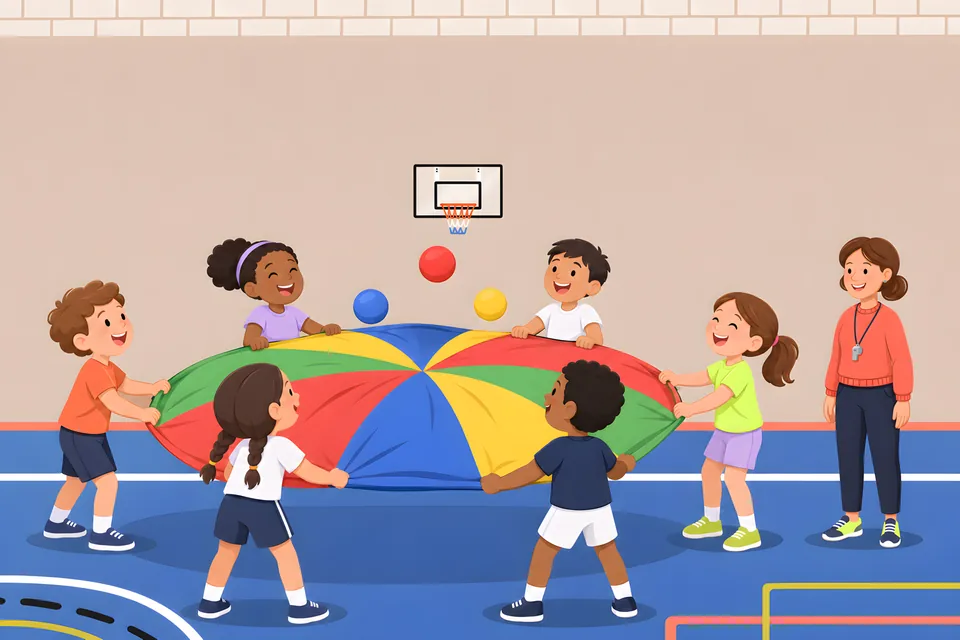
Lay four flat mats in a diamond about 25–45 ft apart, with clear floor between every mat and the walls.
Aim for roughly 10 ft between any mat and a wall, stage or bleacher, and shorten the base paths before you give up that space. A narrow gym can use a rectangle with the long sides running down the court.
Two teams alternate kicking and fielding until an agreed stopping time, and the side with more runs after equal turns wins. Ties can stand.
Crowded mats are easier to control when they stay flat and still, runners arrive on their feet and an adult can see all four.
Allow tags only with the ball in the fielder's hand, so no runner becomes a throwing target. SHAPE America's position statement on dodgeball calls elimination dodgeball, where players are hit out with a ball, inappropriate for K–12 PE. Districts and schools can set their own limits too, as our guide Is dodgeball banned in schools? explains.
A second lap, a mat task or a fielding relay can get more students moving. Add one change at a time.
SHAPE America recommends moderate to vigorous activity for 50 percent of PE class time. If students stand on mats through several kicks, add one of these changes or play two smaller games where space allows.
With more than about 30 students, run two games or rotate three groups so the kicking line stays shorter.
Time a few kickers in your gym. At about 30 seconds per kicker, a team of 15 needs about 7½ minutes to kick through, and a team of 20 needs about 10 minutes.
Set teams before class and give one side pinnies. The Team Creator among the PhysEdPrep gym tools splits saved rosters at random, by skill or by gender. More formats are in our guide to PE games for large classes.
Most trouble comes from runners who never leave, mats that move and calls nobody agreed on in advance.
| Problem | Likely cause | Fix |
|---|---|---|
| Runners camp on a mat | Waiting carries no risk | A runner who stays through two fair kicks must leave on the third |
| A mat overflows | One mat for a long lineup | Add a second mat flush beside it |
| A mat slides | Poor grip on the floor | Stop play, then swap it or use taped zones |
| Fielders chase in a pack | No assigned areas | Give each fielder a zone and rotate positions at every switch |
| “I was on!” disputes | Rule never shown | Demonstrate “any part of a foot counts” before play |
| Bumps near home | Scorers cross the kicker | Move the home mat farther toward the third-base side |
Introduce a new rule only between turns, then have a student repeat it back before the next roll.
Most ball games need five things settled before play: how you score, where the boundaries are, how play restarts, what contact is allowed and when the game ends. Indoors, also decide whether walls and ceiling are live, and ban throwing or kicking the ball at classmates.
Aim for each team to kick at least twice, which takes about 30 minutes with teams of 15 at about 30 seconds per kicker. In a shorter period, play one turn each or split into smaller games. Stop only after both sides have had the same number of turns.
Yes, the name also covers a passing game with a mat at each end. In one simple version, a team scores when its catcher on the far mat catches a pass. Ball holders don't walk, defenders stay off mats and contact is banned. Drops and out-of-bounds passes go to the other team at that spot; interceptions play on. A toss decides the start, the scored-on team restarts from its end, and most points at time wins.
These kickball rules for PE class come from Playworks and league play, adapted for a full class on a gym floor or field.
Here are supervision positions, gear and surface checks, rules students can repeat, steps to follow after an injury, and a weekly…
Teaching 30 or more students in a single gym or combined class period turns standard single-ball games into long waiting lines and…
January and February bring cold days and no holiday theme to lean on. These games are built for classes of 12 to 32 students in a standard…
Get the app for iOS & Android, split your roster with Team Creator and keep score on the gym floor. The Yearly plan and 12-month plan start with a 7-day free trial; see current prices in the app.
App for iPhone, iPad and Android.