Games & warm-ups
PE Games for Large Classes (K–12)
Teaching 30 or more students in a single gym or combined class period turns standard single-ball games into long waiting lines and…
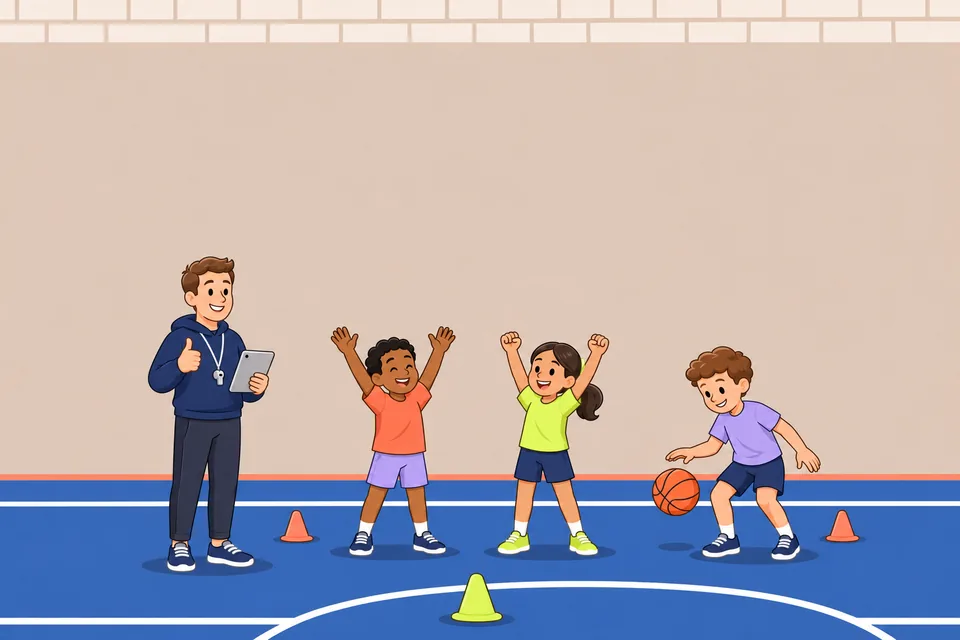
Ten games cover PE groups of 1 to 10 students, and each takes about 5 to 10 minutes. With three players, run Pickle or Two-on-One Keep-Away. Four can play Triangle Tag or Four Square, while six to ten can switch to Four-Goal Soccer or Steal the Bacon. A wall rebound challenge works for a lone student.
Absences, split classes and small schools can leave a K–12 PE teacher with a handful of students. You get complete rules with scoring and restarts, a three-station floor plan, fixes for common problems and a packing list for the next thin day.
Shrink the playing area, keep teams to five players or fewer and make rounds short. More turns per student mean legs tire sooner. Alternate running games such as Pickle with calmer ones such as Beanbag Bocce, and keep an eye on SHAPE America's recommendation of moderate-to-vigorous activity for 50 percent of class time. Younger grades need bigger, softer balls and walking versions of tag games.
| Game | Players | Gear | Time (about) |
|---|---|---|---|
| Pickle | 3 | Foam ball, 2 floor spots | 6 min |
| Two-on-One Keep-Away | 3 | Foam ball, 4 cones | 5 min |
| Triangle Tag | 4 | None | 5 min |
| Four Square | 4 or more | Playground ball, floor tape | 8 min |
| Steal the Bacon | 6–10 | Pinnie, 4 cones | 8 min |
| Newcomb Ball | 4–8 | Soft volleyball, net or rope | 10 min |
| 3x3 Basketball | 6–8 | Basketball, 1 hoop, pinnies | Up to 10 min |
| Four-Goal Soccer | 6–10 | Soft ball, 8 cones, pinnies | 10 min |
| Beanbag Bocce | 2–6 | 7 beanbags, tape line | 10 min |
| Wall Rebound Challenge | 1 or more | Soft ball, flat wall, tape | 5 min |
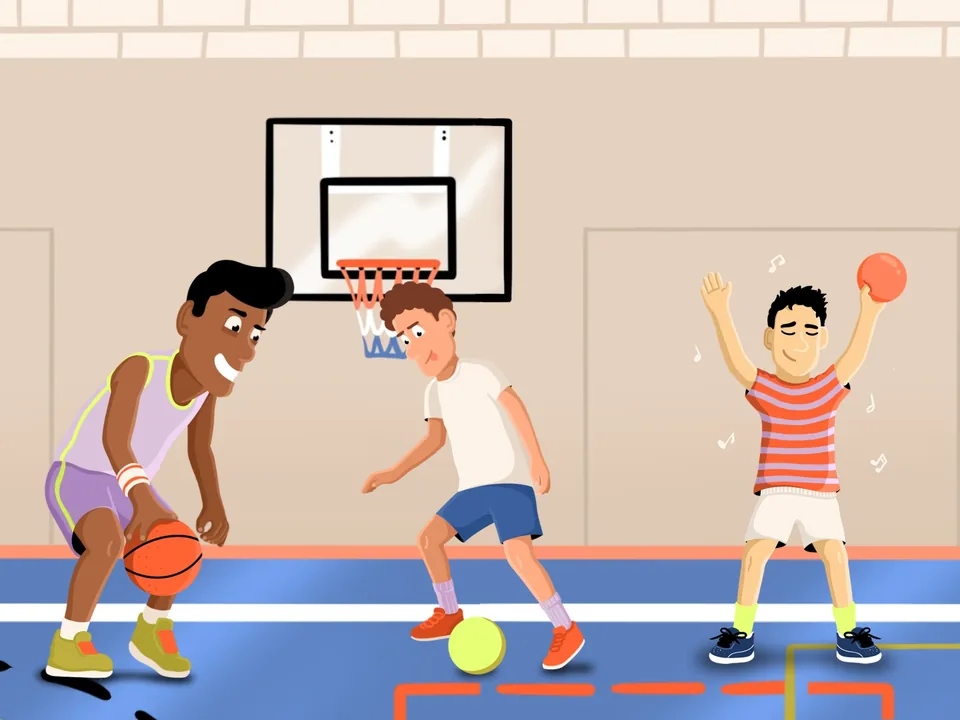
Pickle and Two-on-One Keep-Away need three students, and Triangle Tag takes four. Use a clear, dry floor.
Two fielders play catch with a foam ball beside non-slip floor spots about 25 ft apart. The runner is safe on a spot, scores a point per safe crossing and counts as tagged if still there at the third throw. A tag below the shoulders, ball in hand, sends the runner back. Dropped balls stay live, and a new throw restarts play after each point or tag. Each student runs for two minutes. Most points wins. No sliding or diving.
Mark a square about 15 ft per side with four cones. Two passers score a point per completed pass while the third student defends from at least an arm's length. The ball holder may pivot and has three seconds to throw. A defender's touch on the ball, a late throw or a throw out of the square sends the thrower to the middle; a dropped catch sends the catcher. The new pair restarts at zero. After five minutes, the longest streak wins.
Three students hold hands (or a hoop) and pick one of them as the target. The tagger starts opposite and has 30 seconds to touch the target's back while the trio turns to block. Reaching over or under arms doesn't count. A fair tag scores for the tagger; otherwise the target scores. If the trio lets go, replay the round. Switch roles until everyone has had two turns as tagger; most points wins. The trio side-steps without pulling.
Four Square and Steal the Bacon can absorb an extra student as a line player or number caller.
Tape a square split into four, each about 5 ft wide, and rank them 1 to 4. The player in square 4 drops the ball and hits it underhand into another square. Receivers allow one bounce, then hit the ball by hand into a different square. A double bounce, catch, miss or shot onto a line or out of bounds is a fault. The player at fault moves to square 1 or the back of the line, others move up and a new serve follows. Each serve earns the server a point, and the most points after 8 minutes wins.
Two numbered teams line up behind cone lines about 30 ft apart, with a pinnie midway. Call a number, and the two matching students try to carry the pinnie back over their own line. A safe return scores a point, while a light tag on the carrier before the line scores for the tagger's team. Replay if both grab it or nobody takes it within 15 seconds. Pushing or diving gives the point away. Insist that players slow down near the middle so heads don't collide. First to 7, or the leader after eight minutes, wins; a tie gets one more call.
Keep the sport's key decision, such as finding open space, and cut players and court size.
Catching replaces volleying: use a soft ball and a rope or net above head height. Serve underhand from the back line. A team has three throws to get the ball over, and catchers stand still and throw upward. You lose the rally if the ball lands in your court, your throw lands out or fails to cross, or your team walks with the ball or takes a fourth throw. The rally winner serves. First to 11, or ahead at 10 minutes, wins; a tie gets one more rally.
FIBA's game ends at 21 points or after 10 minutes, counting 1 point inside the arc and 2 outside. In class, restart with a check ball: a defender passes to an attacker at the top. A team gets the ball after being scored on or fouled, or when opponents travel, double-dribble or knock it out. Clear defensive rebounds and steals behind the arc before shooting. Subs enter after baskets, and the next basket breaks a tie.
Each side defends two small cone goals on its end line, without goalkeepers. Half a basketball court suits 3 against 3; give bigger teams more room. No slide tackles. A ground pass through either opposing goal from the attacking half scores a point. Fouls, balls above knee height and balls out of play give the other side a kick-in, with defenders a few steps back. The team scored on restarts at its end line. Play two 5-minute halves; the next goal breaks a tie.
Target throws and personal-best challenges still run with one or two students.
Two sides get three beanbags each in their own color. One side tosses a seventh bag, the marker, about 10–20 ft past a tape line, then the sides alternate underhand throws. After six throws, the side with the closest bag scores a point for each of its bags nearer than the rival's best. Bags thrown from over the line come out, and a tie for closest scores nothing. The scoring side tosses the next marker (after a tie, the previous tosser repeats). First to 7, or the leader at 10 minutes, wins; play another round if tied. Seated students can throw from a chair.
Tape a line about 6 ft from a clear, flat wall and space throwers several steps apart, each with a soft ball. For 30 seconds, students count the catches they make behind the line. After a drop, they fetch the ball, return and keep counting. Three tries give a best score to beat next class. Allow a bounce for beginners or require one-hand catches for more challenge.
Skip penalty push-ups for missed targets. SHAPE America holds that physical activity should not be used as punishment.
Run two or three stations with two to four students each, and give every station an easier and a harder version. With nine students, put a Keep-Away square on the left, a wall challenge line along the far wall and a beanbag bocce lane on the right, with three players apiece. Choose a teacher spot with a view of all three, aim throws away from other groups and rotate on your signal every few minutes.
To adjust a station, resize the square, change to a bigger or softer ball or move the throwing line. See more ways to differentiate in PE.
| Problem | Likely cause | Fix |
|---|---|---|
| One student runs the game | No sharing rule | Every teammate touches the ball before a point counts |
| Players fade early | Running games back to back | Switch to bocce or the wall challenge |
| Same winner every round | One task for unequal skill | Add a weaker-hand or longer-distance condition |
| Arguments after faults | Unclear restart rule | Have a student repeat the rule before play |
Pack one grab bag and sort games by headcount before the holidays.
Attendance can jump back overnight, so keep some PE games for large classes ready. If you lose floor space too, switch to games for small spaces and half gyms. When the group changes daily, a random team generator shortens team picking. Dice games for PE also run with any headcount, and the guide to PE games for every grade sorts more ideas by grade.
Beanbag Bocce, the Wall Rebound Challenge and a walking version of Triangle Tag suit a corner or half gym. Four Square also fits if the floor around the court stays clear. Except for the wall challenge, keep play several steps from walls, bleachers and other groups.
Two-on-One Keep-Away, Triangle Tag, Newcomb Ball and Four-Goal Soccer get students interacting because each move depends on reading a partner or opponent. In the passing games, ask students to call a teammate's name before they pass.
Yes, older students can play the team games above with tougher conditions. Add a two-touch limit to Four-Goal Soccer, a three-second hold limit to Newcomb Ball or a weak-hand layup rule to 3x3. Students can also propose one rule change, test it for a round and vote on keeping it.
Plan three or four games of about 5 to 10 minutes each, plus a warm-up and cool-down. Switch between a running game such as Pickle and a calmer one such as Beanbag Bocce so legs recover. Keep one spare game ready in case the group grows or tires early. End with the Wall Rebound Challenge so every student leaves with a personal best to beat next class.
Teaching 30 or more students in a single gym or combined class period turns standard single-ball games into long waiting lines and…
When an assembly, a testing day or a second class takes half your gym, the students still show up. PE games for small spaces work when you…
Some students in your class have played a sport for years, and others are touching it for the first time.
These games are for PE specialists, substitutes, and classroom teachers who need a low-prep activity in the gym or classroom.
Get the app for iOS & Android to find games by group size, and see current prices in the app. You can start with 3 free units without an account, and yearly plans start with a 7-day free trial.
App for iPhone, iPad and Android.