Cool-Down Activities for PE
This list is for PE teachers who have a few minutes left and a gym full of sweaty, loud students.
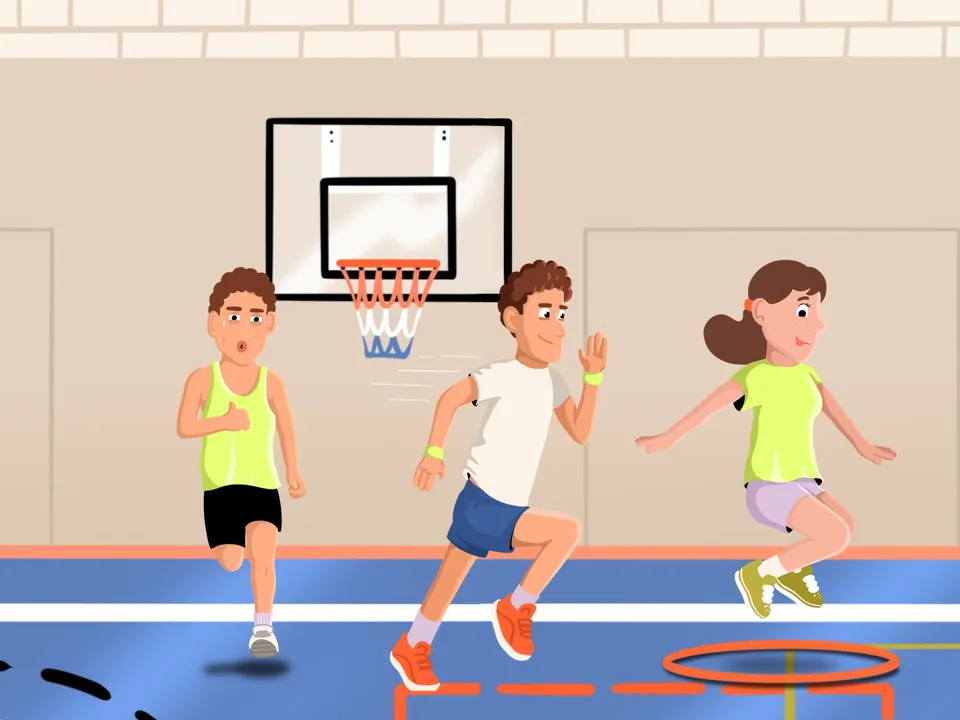
A Tabata workout for kids is 8 rounds of 20 seconds of fast, controlled movement and 10 seconds of rest, which adds up to 4 minutes. This list gives you 10 workouts for PE class and the classroom, from animal moves in Grades K–2 to core circuits in Grades 6–12. Ask for hard but controlled effort, never all-out, and keep the spacing safe.
This list is for PE specialists and classroom teachers who need a short, high-energy block in Grades K–12. The workouts are sorted by gear and grade level, with effort cues that work without heart rate monitors, a mistakes table and timer tips. Each block fits into a warm-up, a station or a classroom break.
This list has 10 Tabata workouts for kids, and each one runs 8 rounds of 20 seconds of work and 10 seconds of rest. The grades are suggestions, so move a workout up or down a grade band to fit your class. Most workouts use four moves, and each move gets two rounds. Hoops, jump ropes, mats and balloons are the only gear, and every workout is a 4-minute block you can drop into a lesson.
| Workout | Grades | Setup | Gear |
|---|---|---|---|
| Zoo Crew | K–2 | Whole class, own spots | None |
| Desk-Side Tabata | 1–5 | Classroom, beside desks | None |
| Mirror Moves | 2–5 | Pairs | None |
| Classic Starter | 3–5 | Whole class, own spots | None |
| Hoop Hops | K–5 | One hoop each | Hoops |
| Jump Rope Tabata | 3–12 | Own spots | Jump ropes |
| Balloon Tabata | K–3 | Own spots | Latex-free balloons |
| Sport Skills | 6–12 | Whole class, own spots | None |
| Core Circuit | 6–12 | Own mat | Mats |
| Choose-Your-Level | 4–12 | Whole class, mixed ability | None |
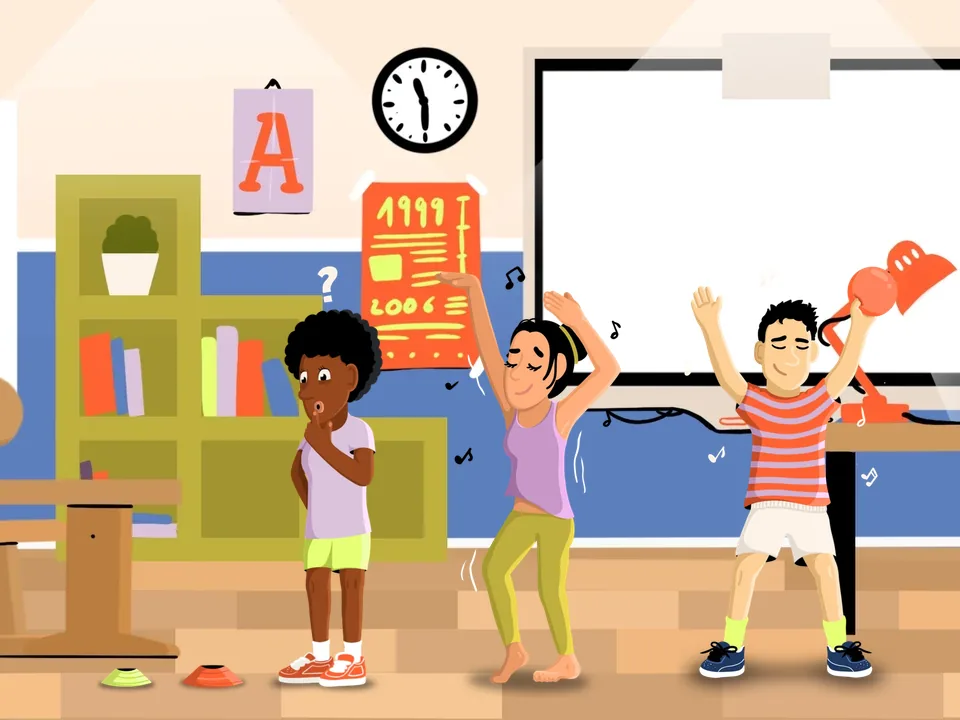
Tabata is a type of high-intensity interval training (HIIT) with a fixed pattern: 20 seconds of work, 10 seconds of rest, repeated for 8 rounds, which adds up to 4 minutes. The 20/10 split is a 2:1 work-to-rest ratio. A Tabata class is therefore a HIIT class, while a HIIT class can use other intervals, such as 40 seconds of work and 20 seconds of rest.
The pattern comes from a 1996 study led by Izumi Tabata. Seven people trained on stationary bikes, doing 7 to 8 sets of 20 seconds at about 170 percent of VO2max with 10 seconds of rest, 5 days a week for 6 weeks.
That effort is far beyond what a class should attempt. A Tabata block for kids keeps the 20/10 rhythm and replaces the all-out effort with fast, controlled movement on exercises students already know.
Four minutes is enough for a warm-up, a station or a movement break, but it does not cover a child's daily activity on its own. The Physical Activity Guidelines for Americans call for 60 minutes or more of moderate-to-vigorous activity a day for ages 6 through 17, and SHAPE America's dodgeball position statement cites moderate-to-vigorous activity for 50 percent of PE class time. In a 30-minute class that is 15 minutes, while one Tabata block holds 160 seconds of work (8 rounds × 20 seconds).
Ask for hard but controlled effort, about 7 out of 10. A talk test helps: during work, students can say a few words but cannot sing; during rest, they can talk in full sentences again. Scale the block by age:
Four workouts for Grades K–5 need no gear, only floor space and a timer. In all ten workouts, students stay in their own spot with at least an arm's length of free space on every side, on a dry, non-slip surface.
Grades K–2 · whole class · 4 minutes · no gear
Four animal moves, each done twice: elephant stomps (slow, high knees), frog squats (squat, then a small hop with soft knees), monkey reaches (reach up, tap the opposite knee) and cheetah feet (fast steps in place). Call the animal at the start of every round so nonreaders can follow. Grades K–1 can stop after round 4.
Grades 1–5 · classroom, beside desks · 4 minutes · no gear
Four low-noise moves: marching with big arm swings, desk-side squats (sit back as if onto a chair, then stand), side reaches (one arm overhead, lean, switch) and step-out jacks. There is no jumping, so the room below stays quiet and nobody lands on a slippery carpet edge. Push chairs in first so nobody trips.
Grades 2–5 · pairs · 4 minutes · no gear
Partners face each other about 4 feet apart. In each round one partner leads a move from a menu on the board (jumping jacks, squats, high knees, side steps) and the other mirrors it; the leader switches every round. Nobody wins: the goal is to stay in sync until the timer signals rest.
Grades 3–5 · whole class · 4 minutes · no gear
Four standard moves, two rounds each: jumping jacks, squats, high knees and standing knee-to-elbow touches. Offer step-out jacks and slow squats to students who need lower impact, and ask for soft landings on every jump. A good first block for a class new to the 20/10 rhythm.
Hoops, jump ropes and balloons add three workouts, and each student still keeps a personal space.
Grades K–5 · one hoop per student · 4 minutes · hoops
Each student lays a hoop flat on a dry floor. Four moves, each done twice: two-foot hops in and out, side-to-side hops across the hoop, high knees inside it, and squats with a tap on the hoop's edge. If a hoop slides, the student steps out and straightens it during rest. More ideas: hula hoop games for PE.
Grades 3–12 · individual · 4 minutes · jump ropes
Students jump in their own space with room to swing the rope without touching anyone. Four moves: basic bounce, alternate-foot step, side-to-side bounce and free choice. Beginners who trip can "ghost jump" without the rope. Check rope length first: standing on the middle, the handles should reach about the armpits.
Grades K–3 · one balloon per student · 4 minutes · latex-free balloons
Each student stays in a marked spot and keeps a balloon up for 20 seconds, using a different body part each round: hands, elbows, knees, then any part, twice through. If the balloon drifts away, the student lets it go and fetches it during rest. Pick up popped pieces right away, because fragments are a choking hazard for young children. Juggling scarves are a quieter swap that cannot pop; more ideas: scarf activities for PE.
Sport skills, core holds and level cards work best for Grades 6–12 and for mixed-ability classes.
Grades 6–12 · whole class · 4 minutes · no gear
Four sport moves: defensive slides in place (low hips, hands wide), block jumps (arms up, soft landing), soccer toe taps and skater hops from side to side. Students can add an air dribble during the slides. Swap skater hops for side steps on a slick floor or for students who need lower impact.
Grades 6–12 · whole class on mats · 4 minutes · mats
Four holds, each done twice: forearm plank (knees down is fine), dead bug (opposite arm and leg, slowly), glute bridge march and side plank, switching sides on the second pass. Cue "slow and straight" instead of "fast", and let students drop to their knees when their hips sag. Keep mats an arm's length apart.
Grades 4–12 · whole class, mixed ability · 4 minutes · no gear
Write four moves on the board (jacks, squats, push-ups, high knees), each with three levels: for push-ups, wall, knee, then standard. Students pick a level every round and may change it during rest, and nobody comments on anyone's choice. More options: ways to differentiate in PE.
Set the timer, the spots and the start and stop signals before students move, then watch form instead of the clock. A block fits after a general warm-up (see warm-ups with little or no equipment), as one stop in a rotation of fitness stations, or as a classroom break. A calm cool-down should follow it.
In the PhysEdPrep app, the Differentiated Phase Timer lets you name every phase and give it its own time, so one phase can be work and the next rest, repeated for 8 rounds. Any timer with an audible signal works too.
| Mistake | Cause | Fix |
|---|---|---|
| Students sprint round 1 and fade by round 4 | "All-out" instruction, no pacing | Cue hard but controlled; run the talk test in round 2 |
| Rests turn into chatting, starts are ragged | No job during rest | Give one rest job (sip water, shake out) and start on the signal |
| Landings get loud and sloppy | Fatigue, hard jumps | Switch to step-out versions in rounds 7 and 8, cue soft knees |
| Collisions during a block | Spots too close | Arm's length on every side; stop and reset spacing first |
SHAPE America's position statement on physical activity as punishment calls exercise as a consequence inappropriate, so never hand out a Tabata block for behavior.
Tabata uses simple bodyweight moves that a student can repeat with good form for 20 seconds. Common choices are jumping jacks, squats, high knees, side-to-side line jumps, forearm planks and knee-to-elbow touches. For kids, pick moves they already know, add a lower-impact option for every jump, and repeat the same four moves in both passes so nobody learns something new mid-block.
The best routine adds up to 60 minutes or more of moderate-to-vigorous activity a day for ages 6–17, with muscle-strengthening and bone-strengthening activity on at least 3 days a week. Tabata can supply a few of those minutes, while PE games, recess and sports supply the rest. Choose activities kids enjoy, because kids are more likely to repeat those.
No, one or two 4-minute blocks fit best, with water and full recovery between them. A whole period of Tabata would leave no room for skills, games and a cool-down, and students lose form as they tire. Treat the block as one tool inside a class that also teaches a skill or plays a game.
No, a timer with a clear start and stop signal is enough. Music helps when the beat is steady, but fade it during the 10-second rests so the class hears your cues. If you play a video or playlist, preview it first for pace, lyrics and moves that fit your students' age and space.
They follow their own health plan, and the school nurse or their doctor decides what is safe. In class, offer a lower-impact version of every move, let any student rest on cue, and keep water within reach. Never require a student to match the pace of the others.
Kids can start a shortened Tabata block in kindergarten, with 4 rounds (2 minutes) of moves they already know. From Grades 2–5, run all 8 rounds. From Grades 6–12, add level choices and a second block with full recovery and water in between. Watch form and the rest signal more than age: a class that stops cleanly on the signal is ready for more rounds.
This list is for PE teachers who have a few minutes left and a gym full of sweaty, loud students.
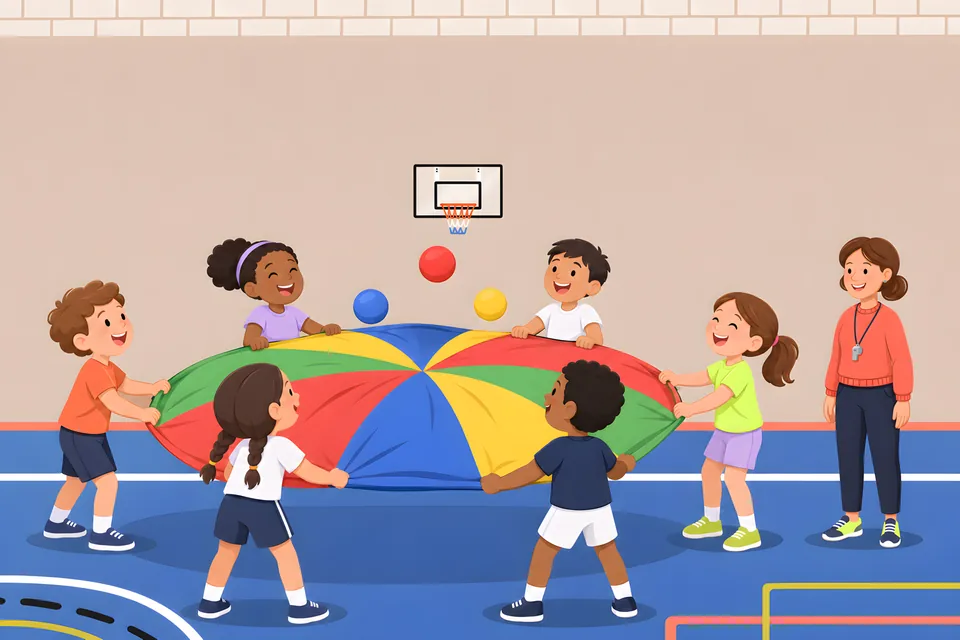
Students who start moving within a minute of walking in lose less class time to roll call and equipment setup.
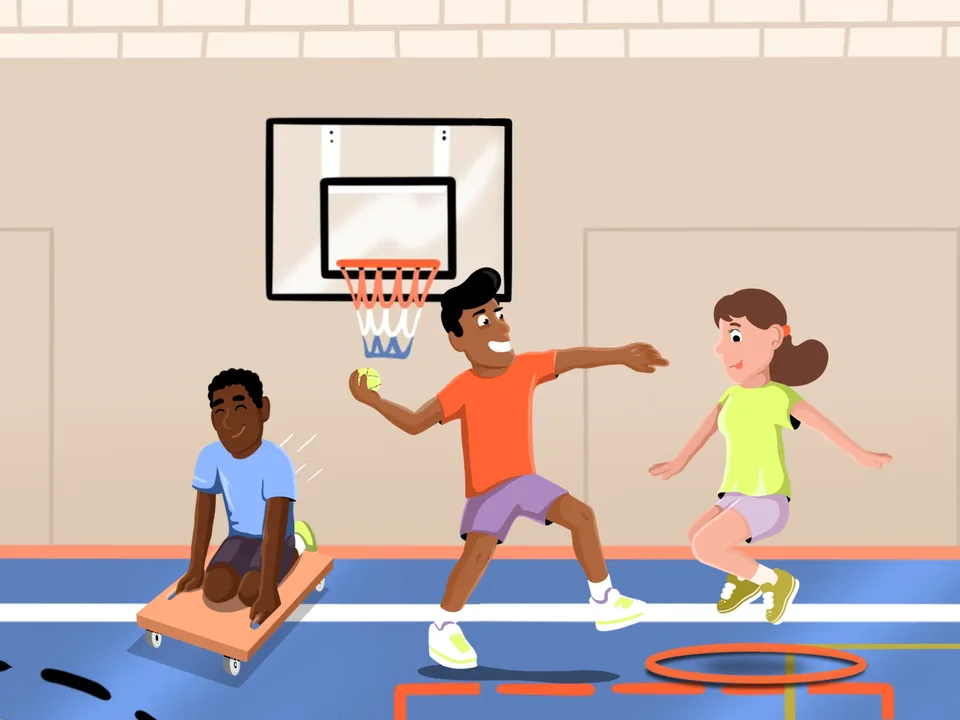
Each game comes with grades, group size, hoop count and a full rule set, followed by safety rules, fixes for common problems and ways to…

Every game lists grade band, group size, scarf count, a scoring target, and what to do after a drop.
Download the PhysEdPrep app for iOS & Android and try the 3 free units, no account needed. Yearly plans start with a 7-day free trial; see current prices in the app.
App for iPhone, iPad and Android.