Games & warm-ups
Brain Breaks for Grades K–5
A good brain break needs a clear stop signal, a bubble of space for each child, and a game students can learn fast.
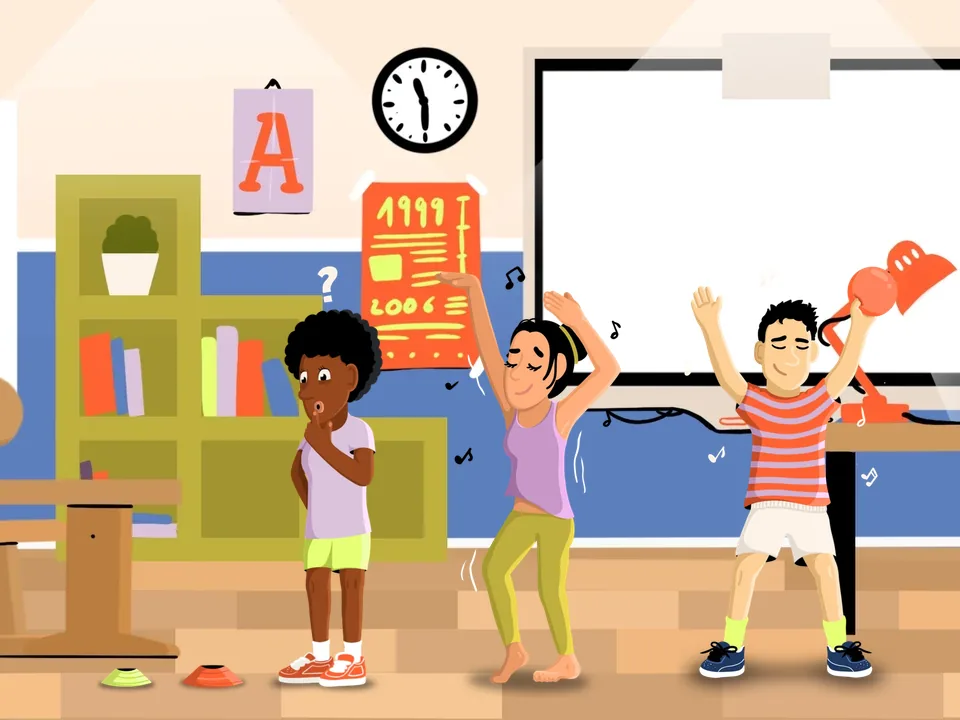
Effective math brain breaks pair one familiar movement, such as marching, squats, or toe taps, with one grade-level number skill for about 2 to 4 minutes. Students stand an arm's length apart beside pushed-in chairs and solve problems through movement repetitions or body shapes. Everyone stays in the game after a mistake by repeating the count together before the next round starts.
Attention often drops halfway through place value or multiplication drills. A short movement pause tied to numbers brings the class back without leaving the lesson topic. The activities below cover counting, fact fluency, and number lines for classrooms and the gym floor, each with rules, a fix for mistakes, and a small-space safety setup.
Pairing physical movement with number practice can reset attention during long math blocks and keep counting and mental calculation going. According to the Physical Activity Guidelines for Americans (2nd edition, HHS 2018), children and adolescents ages 6 through 17 should do 60 minutes or more of moderate-to-vigorous physical activity daily. Short classroom movement pauses of about 2 to 4 minutes can add a little to that daily total, right beside students' desks.
To keep students from getting overwhelmed, match the motor skill to the difficulty of the math concept. When students practice a new or challenging math skill, pair it with a familiar movement like marching in place or two-foot jumps. When they review automatic counting sequences, you can introduce cross-lateral movements like elbow-to-knee touches. For general movement pauses without numbers, see our Brain Breaks for Grades K–5.
| Grade Span | Math Skill Focus | Matching Movement | Typical Duration |
|---|---|---|---|
| Grade K | Counting to 20, subitizing 1–5 | Claps, marches, toe taps | About 2 minutes |
| Grades 1–2 | Skip-counting by 2s, 5s, 10s to 100; complements of 10 | Shoulder taps, marches, small vertical jumps | About 2–3 minutes |
| Grades 3–5 | Multiplication & division facts, rounding, angles | Squats, reverse lunges, arm-angle freezes | About 3–4 minutes |
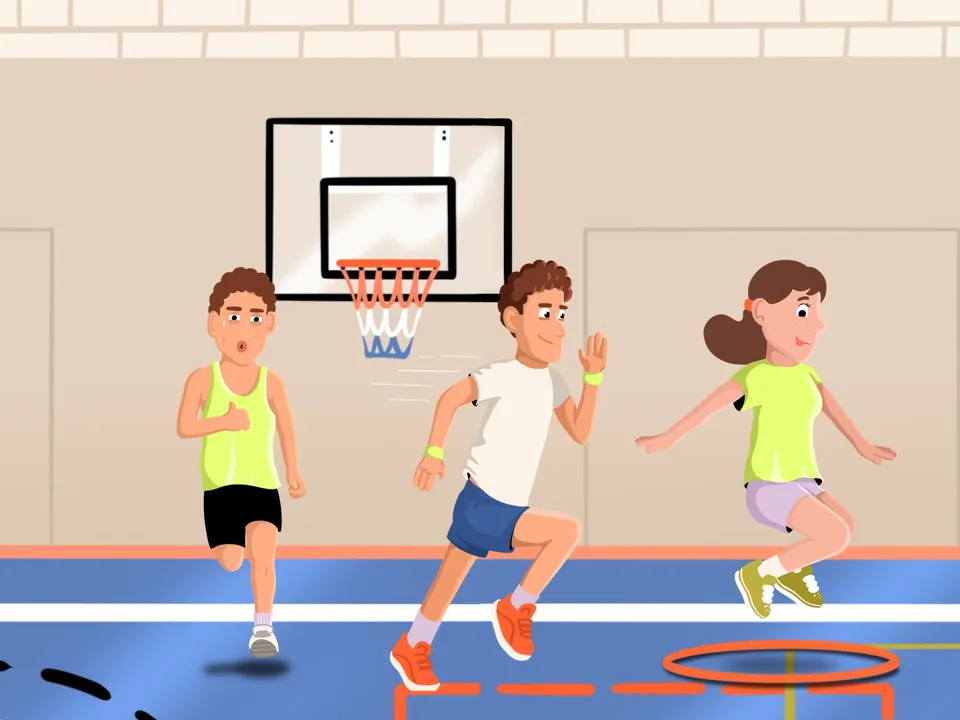
In Grades K–2, every spoken number should match one physical beat, step, or clap. Kindergartners counting to 20 and second graders skip-counting by 5s up to 100 both need clear start and stop signals that keep the group in rhythm. Have students push in their chairs and stand at arm's length on a flat, obstacle-free floor under teacher supervision.
The whole class counts to a target number (such as 20 for Kindergarten or 50 counted by ones for Grade 1) in unison and changes movements at every decade mark. Students march in place for the first ten counts, tap their shoulders for the second ten, and do alternating heel touches for the third ten, then cycle back to marching for every further ten. The class earns one cooperative tally mark on the board for each decade completed together. If several students lose the rhythm or skip a number, hold up a flat palm, state the last ten-benchmark, and restart the count from that benchmark. The round ends when the class reaches the target number or after about 2 minutes.
Students show the missing addend that makes 10 with controlled jumps. They walk softly in place while you call out a single-digit number from 1 to 9. When you call 6, students stop walking and do 4 small two-foot jumps in place, counting on out loud: 7, 8, 9, 10. Each student tracks their own accurate rounds on their fingers. If a student jumps the wrong number of times, they tap both knees twice and rejoin the walking rhythm for the next call. A round ends after 8 prompts, which takes about 2 to 3 minutes.
In Grades 3–5, students get active while practicing multiplication tables and division facts. Run these games beside desks on a flat floor, with backpacks tucked under chairs, students an arm's length apart, and you supervising. Never assign extra squats or push-ups as a penalty for a wrong answer: SHAPE America's 2021 position statement on physical activity as punishment states that using exercise as a consequence is inappropriate.
The goal is to solve a multiplication fact and show whether the product is even or odd. Call out an equation such as 7 times 8 or 9 times 3. Students drop into a slow squat for an even product or step back into a reverse lunge for an odd product, then state the answer together on your cue. Each accurate class response adds one point toward a 10-point class total. If students split between movements, everyone stands tall, checks the fact out loud, and restarts on the next call. A round ends at 10 points or after about 3 minutes.
The class passes a soft foam ball around a circle while skip-counting by 7s, 8s, or 9s. Each catcher says the next multiple before making a gentle underhand toss below chest height; overhand throws and head shots are prohibited. The class tracks consecutive clean catches. If the ball drops or a multiple is missed, the nearest student picks it up, repeats the last accurate number, and restarts the pass. The round ends at the twelfth multiple or after about 3 minutes.
Geometry, rounding, and estimation translate naturally into spatial body positions and two-way directional choices. If your class enjoys two-option movement prompts, you can pair these activities with Would You Rather Brain Breaks for Kids.
Students round whole numbers or decimals by stepping toward the matching benchmark wall. They start at arm's length from each other in the center Student Zone, on a clear floor and under teacher supervision. Designate the left side of the room as the Zero Wall, set a Midpoint Cone at the front center for the halfway mark, and use the right side as the Ten Wall. Write a number on the board, such as 43 (rounding to the nearest ten) or 2.6 (rounding to the nearest whole number). Students take two controlled side-steps toward the Zero Wall to round down, or two side-steps toward the Ten Wall to round up; if the digit is on the 5 mark, they balance on one foot aligned with the Midpoint Cone before stepping to the Ten Wall. Students earn one personal point per accurate round. Anyone who steps the wrong way returns to the Student Zone, states the rounding digit, and restarts on the next number. A round ends after 6 prompts, taking about 2 to 3 minutes.
The goal is to form acute, right, obtuse, or straight angles with both arms. Call out an angle measure such as 45, 90, 135, or 180 degrees. Students freeze their arms at that angle for 3 seconds to score a point. If a student mixes up acute and obtuse, model the 90-degree corner with your forearms and restart with a new measure. The round ends after 6 calls.
A movement pause pays off when the class is back in seats and ready to write within about 30 seconds of the final count. Build the cool-down right into the last math prompt by lowering both the movement speed and voice volume. For example, end a skip-counting game by having students count backward by 2s from 20 in a whisper while slowly sitting down and placing their hands on their desks. For more on keeping control while kids move, see our guide on PE classroom management strategies.
A whistle or timer sound cuts down on negotiations over an extra round. In the PhysEdPrep app for iOS & Android, the Countdown Timer under Gym Tools offers quick picks for 1, 3, 5, 10, or 15 minutes (or your own custom time) with a whistle at the end.
| Common Classroom Issue | Why It Happens | Immediate Fix |
|---|---|---|
| Students speed-count and shout | No physical tempo anchor | Tie each spoken number to a slow knee tap or metronome clap |
| Students copy neighbors instead of calculating | Wait time is too short | Give 3 silent thinking seconds, then call "3, 2, 1, show" |
| Post-break transition takes over 2 minutes | Break ends at peak energy | Make the final 20 seconds a whispered backward count into seats |
On the gym floor or outdoor field, short counting breaks expand into relay lanes and target games. SHAPE America's 2024 National Physical Education Standards organize K–12 PE into four standards (S1 to S4: motor skills, movement and fitness concepts, social skills, and personal skills). For full-period gym lessons, see our guides on math in PE class and elementary PE for classroom teachers. After a loud gym round, calm brain breaks help students settle before the next instruction.
Small teams aim for an exact target sum (such as 25 or 40) by tossing beanbags into floor hoops worth 2, 5, or 10 points. Set up 4 to 6 lanes on a swept gym floor with cones about 6 feet clear of the walls under teacher supervision. Form teams of about 3 to 4 students, for example with the Team Creator in the PhysEdPrep app (random, balanced by skill, or split by gender). The first player skips to a line about 10 feet from the hoops, makes one underhand toss, announces the team's running sum, retrieves the beanbag, and tags the next runner. A beanbag resting inside a hoop scores those points; one that slides out scores 0 before the player retrieves it and tags the next teammate. If a team overshoots the target sum, each made toss after that subtracts from the total until the team lands on the exact number. When a team hits the target, they sit behind their cone and you call a new sum to restart. The activity ends when the whistle sounds on a Countdown Timer set to 4 minutes. You can try the 3 free units without an account. PhysEdPrep units are mapped to the SHAPE America National Standards (2013 edition, S1–S5).
Offer a seated version of every move and let any student choose it without announcing why. Swap jumps, squats, and lunges for seated heel taps, knee lifts, or overhead arm reaches, and keep the math task the same, such as counting on to 10 or showing an angle with both arms. For students with an IEP or 504 plan, follow the plan and check specific movements with your special education team.
Use stationary moves right behind pushed-in chairs, where each student only needs about an arm's length of space. Replace running or wide side-shuffles with vertical toe rises, heel taps, slow squats, or overhead arm reaches for geometry angles. Keep aisles completely clear of backpacks and lunchboxes before starting the count.
Switch the response mode from shouting to physical showing or whisper counting before the next prompt begins. Have students hold up fingers, freeze in a geometric body angle, or tap their shoulders silently while only one designated table group speaks the count out loud. Ending the final 20 seconds with a whispered backward count lowers the volume before seatwork resumes.
Yes, a math movement break needs no projector or video. A whiteboard for the target number or a deck of flashcards is enough to call out prompts while students jump, squat, or clap. Skipping the video also skips loading time and ads. A countdown timer with an end whistle keeps the break on schedule.
Yes, if the math matches the grade level. Older students can take a step forward for a positive integer and a step back for a negative one. They can also hold both arms level when the two sides of an equation balance. Keep the moves controlled and the break at about 2 to 4 minutes. Middle schoolers often move more willingly in small groups than alone in front of the class.
About once every 20 to 30 minutes of seated math work is a practical rule of thumb for elementary classes. Add one sooner when you see fidgeting, rushed answers or blank stares. Each 2- to 4-minute break adds a little toward the 60 minutes of daily activity recommended for ages 6 to 17. A break does not replace recess or PE.
A good brain break needs a clear stop signal, a bubble of space for each child, and a game students can learn fast.
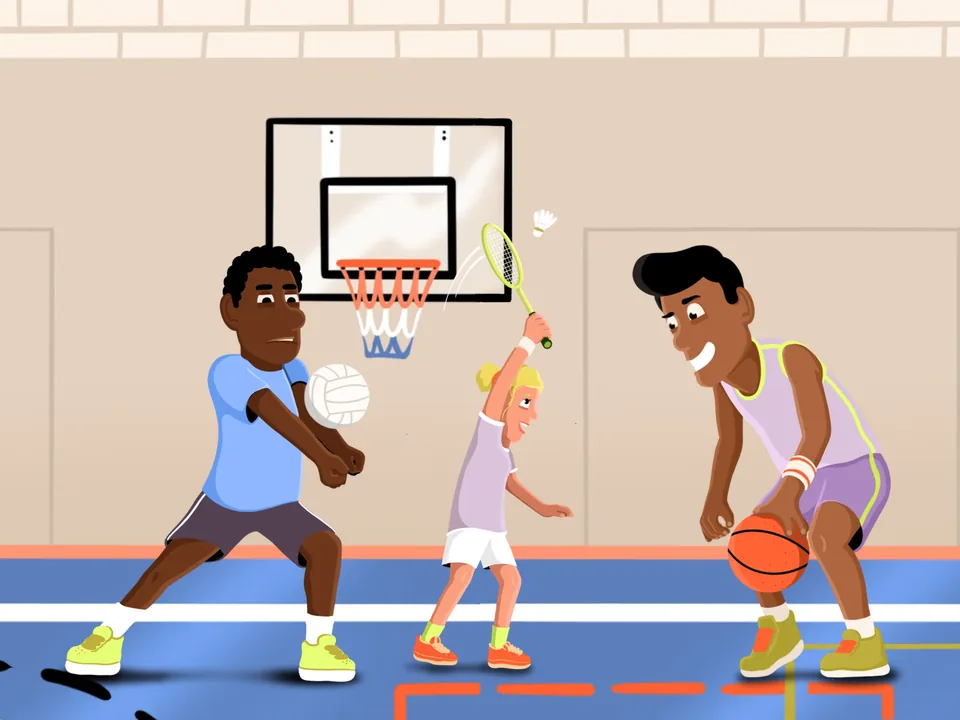
When students return from outdoor recess or a loud hallway transition with racing voices, jumping straight into a lesson rarely works.
Video versions of Would You Rather brain breaks tie you to a screen and a fixed pace.
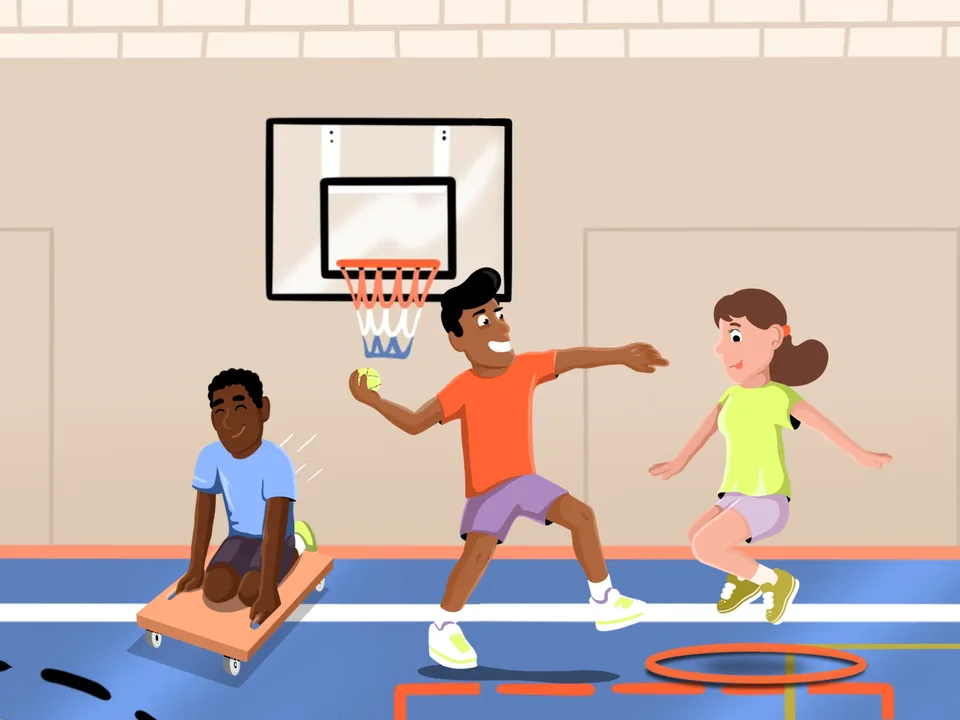
Loading a follow-along video on the projector can take longer than the movement break itself.
Try the 3 free units in the PhysEdPrep app for iOS & Android, including the Classroom Brain Breaks sample pack with 13 movement breaks and no account needed. When you want all 40+ unit plans and 6 gym tools across Grades K–12, yearly and 12-month plans in the app start with a 7-day free trial (see current prices in the app).
App for iPhone, iPad and Android.