Games & warm-ups
10 Pickleball Games for PE
These games are built for that: no-net stations run beside the net games, the rules are short enough to explain at the line, and every…
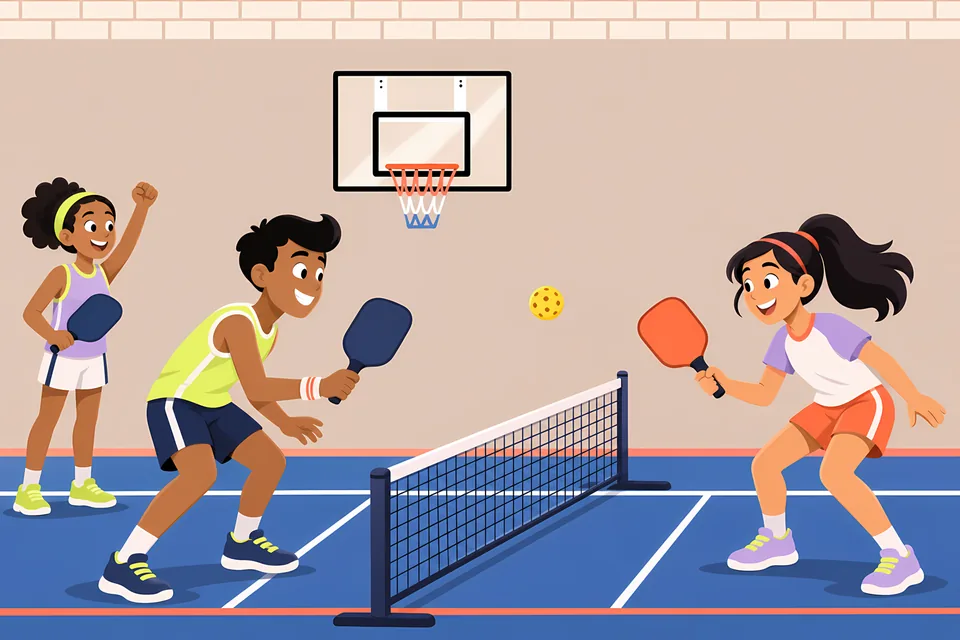
Eight short-court tennis games for PE work in Grades K–12 when you swap yellow tennis balls for slower 3.5-inch foam balls. Start with solo bounce taps, move to partner rallies and serve lead-ups, and finish with rotating doubles. Four courts of about 15 by 30 feet need a floor about 90 feet long and hold up to 24 students in doubles with waiting pairs.
These games are for K–12 PE teachers working with one basketball gym or a blacktop lot and a mixed bin of paddles and junior rackets. Below you get an overview table of all eight games, full scoring and restart rules, a four-court rotation diagram, and quick equipment fixes.
Four short courts of about 15 by 30 feet fit sideways on a gym floor about 90 feet long, with about 6 feet between courts and from the end walls; a floor of about 70 feet takes three. With two pairs playing doubles and one pair waiting, four courts hold up to 24 students. For pair games, split courts lengthwise into two lanes and give extra students a bounce-tap station with its own space. If your floor already has pickleball markings, use those courts. According to USA Pickleball, an official court measures 20 feet wide by 44 feet long with a net 36 inches high at the sidelines and 34 inches at the center, and a 7-foot non-volley zone on each side. Small courts and short waits can help your class work toward the SHAPE America recommendation of moderate- to vigorous-intensity physical activity for 50 percent of PE class time.
Before anyone swings, check that the gym floor is dry or the blacktop is swept clear of gravel. Students need closed-toe athletic shoes and about 6 feet of swing space, with an adult watching all courts.
| Game | Grades | Players | Equipment | Round |
|---|---|---|---|---|
| Pancake Flip Keep-Up | Grades K–3 | 1 player | 1 short racket, 1 foam ball, 1 spot | 3 minutes |
| Floor Lane Trap-and-Send | Grades K–4 | Pairs | 2 short rackets, 1 foam ball, 2 cones | 4 minutes |
| Cone-Gate Cooperative Rally | Grades 3–6 | Pairs | 2 short rackets, 1 foam ball, 2 cones | 4 minutes |
| Two-Bounce Target Squares | Grades 3–8 | Pairs | 2 short rackets, 1 foam ball, 4 flat markers, low line | 5 minutes |
| Drop-Hit Hoop Serve | Grades 3–8 | Pairs | 2 short rackets, 2 foam balls, 2 hoops, low net | 4 minutes |
| Serve-Return Plus One | Grades 4–8 | Pairs | 2 short rackets, 1 foam ball, 4 cones, low net | 5 minutes |
| Four-Square Mini Tennis | Grades 4–12 | 4 players | 4 short rackets, 1 foam ball, 4-square grid | 5 minutes |
| Champs and Challengers Doubles | Grades 5–12 | 4 to 6 players | 4 to 6 short rackets, 1 foam ball, portable net | 6 minutes |
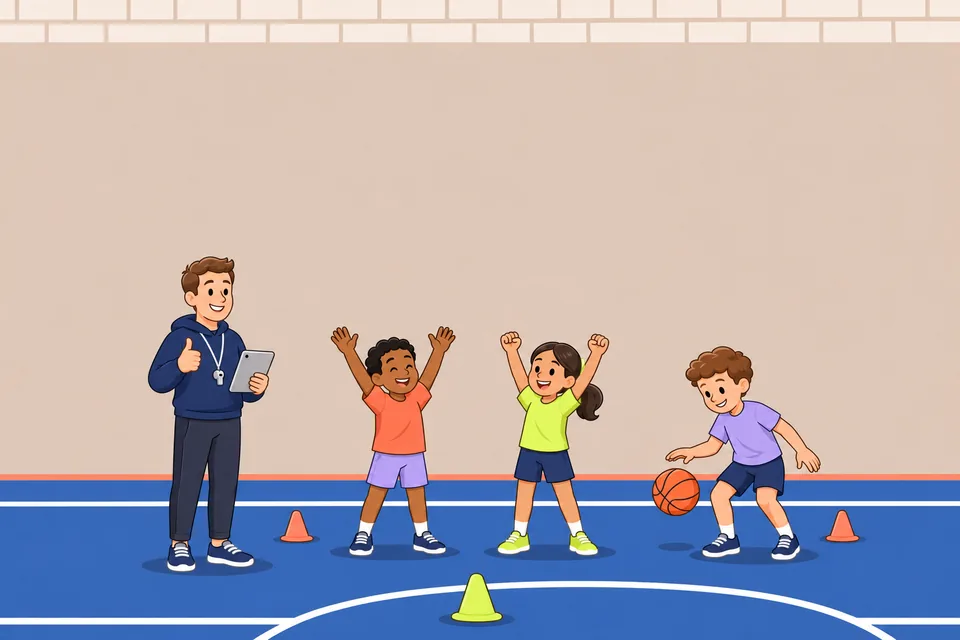
Beginner tennis activities for kids start with flat-string taps and floor pushes so students control racket-face angle before swinging over a net. Early striking tasks support Standard 1, motor skills, in SHAPE America's 2024 National Physical Education Standards. Elementary classes can warm up first with balloon games for PE class.
Single players in Grades K–3 play for 3 minutes with 1 short racket, 1 foam ball, and 1 spot inside a 6-by-6-foot space to build a bounce streak.
Pairs in Grades K–4 play for 4 minutes using 2 short rackets, 1 foam ball, and 2 cones set 12 feet apart on a smooth floor to link passes.
In these partner tennis lead-up games, a floor gate or a two-bounce rule helps pairs keep a rally going before they face a real net. The cones you set out for cone games for PE class work here too: widen the gate for beginners and narrow it for stronger pairs.
Pairs in Grades 3–6 play for 4 minutes with 2 short rackets, 1 foam ball, and 2 cones placed 5 feet apart as a center gate to set a rally high score.
Pairs in Grades 3–8 play for 5 minutes with 2 short rackets, 1 foam ball, 4 flat markers, and a low line on a 15-by-30-foot court, or one lengthwise half of it, to win placement points.
Teach the underhand drop-hit serve first. Contact stays below shoulder height, so beginners can start a rally without chasing wild overhead tosses. Set portable nets at about waist height or lower, well below the net you use for badminton games for gym class, so receivers have time to get ready and return.
Pairs in Grades 3–8 play for 4 minutes with 2 short rackets, 2 foam balls, 2 hoops, and a low net to score target serves from 15 feet behind the net.
Pairs in Grades 4–8 play for 5 minutes using 2 short rackets, 1 foam ball, 4 cones, and a low net on a 15-by-30-foot court to link serves with rallies.
Match play works with four players in a 4-square grid or four to six per doubles court, with extra players waiting to rotate in. A round-robin schedule, where every pair meets every other pair once, keeps court rotations fair; you can build one with the PE gym tools for teams and timers. If you also teach pickleball, see these 10 pickleball games for PE.
Groups of 4 players in Grades 4–12 play for 5 minutes using 4 short rackets, 1 foam ball, and a 16-by-16-foot 4-square grid to defend Square 4.
Groups of 4 to 6 players in Grades 5–12 play for 6 minutes with 4 to 6 short rackets, 1 foam ball, and portable nets along the Center Net Line through Court 1, Court 2, Court 3, and Court 4.
For indoor tennis games for PE, pair high-density 3.5-inch foam balls with short-handled paddles or junior rackets (19 to 25 inches for Grades K–5). Foam hits softer than a yellow ball, but players still need about 6 feet of clearance and adult supervision. When portable nets run short, rest a jump rope loosely on tall cones at about 34 inches so it gives way if someone runs into it. Check our K–12 PE equipment list when restocking shared bins. Wheelchair users and students building mobility can take two bounces or use a latex-free balloon; pick up broken balloon pieces right away, because young children can choke on them. For larger racket faces, lighter balls and other modified gear, see adapted PE equipment worth buying first.
On windy blacktop where foam balls drift, switch to felt-covered red low-compression balls and keep about 6 feet between court lines and fences. Red is the slowest of the red, orange and green ball stages used in youth tennis; move older or stronger pairs to orange balls once they can keep a rally going. Have students hug rackets by the throat against their chest during whistle huddles and court rotations.
| Common Mistake | What Goes Wrong | Gym-Floor Fix |
|---|---|---|
| Pressurized yellow balls indoors | Balls skid fast off hardwood into bleachers | Use 3.5-inch foam balls indoors or red low-compression balls on blacktop |
| Overhead serves on day one | Erratic tosses send balls onto neighboring courts | Start points with an underhand drop-hit from behind the baseline |
| Adult 27-inch rackets in elementary PE | Heavy frames drop the racket head and tire wrists | Use 19-to-25-inch junior rackets or short-handled paddles for Grades K–5 |
| Running onto live courts for loose balls | Students step into active backswings | Call "ball on" to pause play and trap loose balls under strings |
Students in Grades K–5 usually fit junior rackets of about 19 to 25 inches or short-handled paddles, and students in Grades 6–12 about 25 to 27 inches, depending on height. If a student is between sizes, pick the shorter racket, which is easier to control.
Pair each racket holder with a hand-catching partner so 24 students play across 12 lanes while 4 students rotate in every 90 seconds. Line up all hitters on the same side, about 6 feet apart. One partner catches on a bounce and tosses back underhand, then partners trade the racket every four tries.
Yes, if you stick to floor-push lanes, bounce taps, and cone-gate groundstrokes and give every hitter about 6 feet of clear space. Keep contact below waist height, replay any shot that rises past shoulder height, and move breakable items out of reach. Use 3.5-inch foam balls to soften wall rebounds.
Start with one point per rally, and add traditional scoring once pairs can serve and keep a rally going. A tennis game counts love, 15, 30, 40, and game. At 40–40, called deuce, standard advantage scoring requires two points in a row to win the game.
Teach the volley once pairs can rally off one bounce. Students use a short punch with no backswing from a ready position about 6 to 8 feet from the net. Start with partner tosses: one student tosses underhand to the racket side, and the volleyer blocks the ball back to the tosser's hands. Use foam balls and keep tosses below shoulder height so the ball never comes at a face.
Start with racket control, then move to partner rallies, the underhand serve and return, and volleys. Finish with small-sided match play. Move the class to the next step when most pairs can keep a cooperative rally of about five hits. Keep one bounce-tap or floor-lane station open for students who need more time, and add traditional scoring only near the end of the unit.
These games are built for that: no-net stations run beside the net games, the rules are short enough to explain at the line, and every…
Each entry gives group size, gear and round length, plus the rules for what happens when the balloon hits the floor.
These games are for PE specialists and classroom teachers with a bag of cones and a full class.
These games are for PE teachers in Grades 4–12 who share a few nets among 24 to 32 students of mixed skill.
Download the free PhysEdPrep app for iOS and Android, open 3 free units with no account needed, and build round-robin schedules for 2 to 10 teams on up to 4 courts in Tournament Planner. Yearly and 12-month plans start with a 7-day free trial; see current prices in the app.
App for iPhone, iPad and Android.