PE Goal Setting Sheet and Examples
Teachers in Grades K–12 can set up goal setting in PE with a goal sheet to copy, example goals for each grade band, a check-in routine…
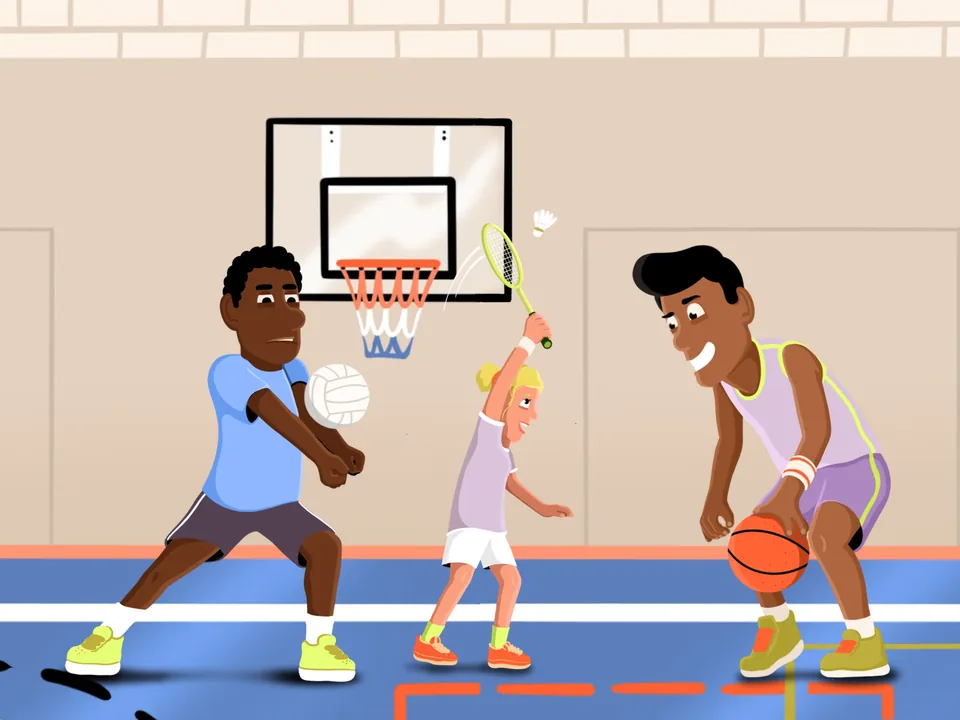
Ten PE final exam ideas fit grades 6–12: four skills tests, three fitness or written finals and three game-play or reflection finals. None needs more than two class periods for a class of 30. Pick one test of movement and one test of knowledge, score both with three or four observable criteria, and give students those criteria a week before exam day.
If your semester ends in December or January and you teach 30 or more students per class with little prep time, these ideas cover skills, fitness, knowledge and game play. Each format lists time and materials for a class of 30. You also get an exam-day station plan, a table of common problems and a worked example for weighting a physical education final exam in the semester grade.
Match the final to what you taught: a skills test after a sport unit, a fitness retest after a fitness unit, and a written or reflection piece for the knowledge outcomes. A PE semester exam works best as two formats, one that measures movement and one that measures understanding. Times in the table assume 30 students and a period of about 45 minutes.
| Idea | Type | Time for 30 students | You need |
|---|---|---|---|
| Station skills circuit | Skills | 1 period | Cones, balls, score cards |
| Partner-scored skills check | Skills | 1 period | Cue cards |
| Target accuracy test | Skills | 1 period | Tape, score sheets |
| Performance routine | Skills | 1–2 periods | Music, rubric |
| Fitness retest against baseline | Fitness | 1 period | Cones, timer, tally sheets |
| Personal fitness plan | Written | Take-home | Template, rubric |
| Written test by standard | Written | 1 period | Printed test |
| Scored game play | Game play | 1–2 periods | Pinnies, checklist |
| Officiating and scorekeeping | Game play | Same periods as game play | Whistle, rule card |
| SMART goal reflection | Reflection | About 20 minutes | Semester log, prompt sheet |
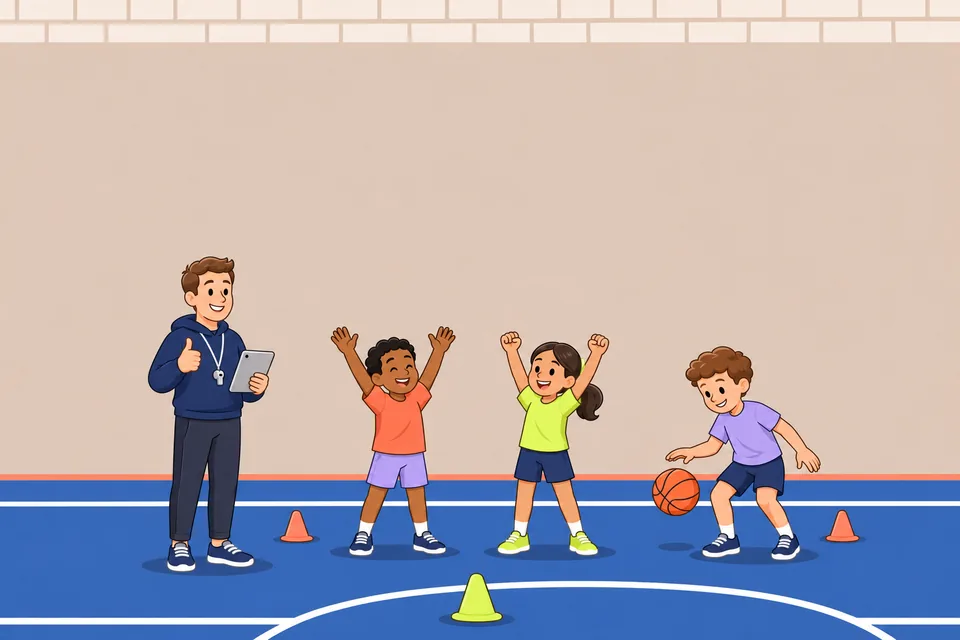
A PE skills test scales to 30 or more students when students are scored in small groups or pairs and the criteria are observable.
For any sport unit, 5 or 6 students per station, one period, with cones, balls and a score card per student. Six stations each test one skill, such as passing to a wall target, dribbling through cones or shooting free throws. Groups rotate on a signal, take three attempts per station, and a partner records the best one.
For small spaces, pairs, one period, with a cue card per pair. Print three or four cues for one skill, for example for a volleyball forearm pass: platform flat, knees bent, eyes on the ball, finish toward the target. The performer takes five attempts while the partner ticks each cue seen, then they swap. You re-score a few pairs yourself to keep partner scores honest.
For net, wall and goal sports, 4 to 6 students per target, one period, with tape and score sheets. Mark three zones worth 1, 2 and 3 points, such as a taped box for a badminton serve or a wall zone for a soccer pass. Each student takes 10 attempts, a partner counts, a ball on a line counts for the higher zone, and a miss scores 0.
For dance, jump rope or tumbling units, groups of 3 to 5, one to two periods, with music and a rubric. Groups perform a routine with required elements, for example four set skills plus a start and an end pose; you score elements, timing and teamwork. Tumbling stays on mats, limited to skills you taught, with you or a trained spotter close by.
Three formats cover fitness data and knowledge: a retest against each student's baseline, a plan project and a written test by standard.
For any class that took a fitness test at the start of the semester, one period, with cones, a timer or shuttle-run audio and tally sheets. Repeat one endurance test, such as the PACER or a timed run, plus push-ups or a plank, and compare each result with the student's own baseline. Grade effort and improvement, let students stop at any time, keep prescribed inhalers within reach and move indoors in high heat.
For grades 6–12, take-home, with a template and rubric. Students write a four-week plan for one goal using FITT (frequency, intensity, time, type) and check it against the Physical Activity Guidelines for Americans: 60 minutes or more of moderate-to-vigorous activity daily for ages 6–17, with muscle- and bone-strengthening activity on at least three days a week. Score FITT accuracy, fit to the goal and a planned rest day.
For the whole class, one period, with a printed test. Organize the questions by the four 2024 SHAPE America standards and mix multiple choice with two or three short scenarios:
Grade game play with three or four observable criteria during small-sided games, then add an officiating practical and a short written reflection.
For a full class, 3 courts, one to two periods, with pinnies and a checklist. Play 3 v 3 or 4 v 4 modified games of the unit sport, so 18 to 24 students play at once while the others officiate or wait for their turn. Score each player on moves to open space, passes to teammates, use of the rules and encouragement of others. Games run to 5 points or until the timer ends, turnovers follow your unit's rules and play restarts from the baseline after each point. Swap roles so each student is scored once as a player and once as an official. The Tournament Planner drafts round-robin schedules for 2 to 10 teams on up to 4 courts.
For the students not playing, pairs per court, the same periods as game play, with a whistle, a rule card and a scoreboard. One student calls the game and the other keeps score. You score correct signals, consistent calls and clear talk with the players, and a disputed call is replayed. The Scoreboard & Game Counter shows points and game time for two teams.
For every class that set a goal early in the semester, about 20 minutes at the end of a period, with the semester log and a prompt sheet. Students restate the goal as Specific, Measurable, Achievable, Relevant and Time-bound, add the starting and ending numbers, name what helped and set the next goal. Score data use, honest analysis and a concrete next step, not whether the goal was met. The prompts tie into physical literacy in PE, and a PE goal setting sheet from the first weeks gives students their starting numbers.
For a class of 30, run exam day as a rotation of six groups of five, with one station per group, one timer for everyone and one score card per student. The plan shows a basketball final with six stations (Wall passing, Dribble cones, Free throws, Layups, Pivot and pass, Defensive slides) and a Scoring table in the center.
More on timing rotations: station timer with rotation alerts.
Plan for four problems: long waits at one station, inflated partner scores, unclear rubrics and absences.
| Problem | Cause | Fix |
|---|---|---|
| Long waits at one station | Tasks differ in length | Give every station the same number of attempts and run one timer for all |
| Partner scores are all perfect | Friends score friends and the criteria are vague | Use three or four observable cues, re-score a few pairs and tell the class you will |
| Students ask what counts | The rubric first appears on exam day | Hand it out a week ahead and practice with it once |
| A student is absent or injured | No make-up plan | Publish a make-up date, and offer the written test or officiating practical to students who cannot perform |
Do not assign extra laps or push-ups for a low score or a missed test. SHAPE America considers exercise as punishment inappropriate.
Your district or state grading policy sets the limits, so check it first; inside those limits, keep the final smaller than the daily work so that one bad day cannot decide the semester. The weights below are an example, not a rule.
| Category | Weight | Score | Points |
|---|---|---|---|
| Participation and effort | 40% | 95 | 38.0 |
| Unit skill assessments | 40% | 85 | 34.0 |
| Final | 20% | 70 | 14.0 |
| Semester grade | 100% | 86.0 |
Without the final, the same student's daily work averages 90 (72 points out of 80), so a weak final lowers the semester grade by 4 points. Publish the weights at the start of the semester, for example in your PE syllabus for grades 6–12. For category ideas and rubrics, see fair PE grading for report cards and assessing PE class without losing time.
One to two periods for the test itself, plus one earlier period to practice the stations and the rubric. Most formats in the table fit one period, while routines and game play can need two. Take-home formats such as the fitness plan need no extra gym time.
No. A short written test is still the most direct way to assess knowledge outcomes such as S2, movement and fitness concepts, in the 2024 SHAPE America standards. Requirements differ by district, so check your handbook. Without a written test, the fitness plan or the goal reflection can cover knowledge.
Follow the accommodations written in the plan and keep the learning target the same while you change the format, for example extra attempts, a partner-assisted station or a written alternative. Ask the case manager if the plan is unclear. This is general information, not advice on a single case.
Give a classroom format: the written test, the personal fitness plan or the SMART goal reflection, which need only paper. Prepare this backup before exam day and tell students it exists, so a rainy or closed-gym day does not push the final back.
Use a 4-point scale for each of three or four observable criteria: 4 means shown on every attempt, 3 on most attempts, 2 on some attempts and 1 not yet. With four criteria the total runs from 4 to 16 points, which you convert to a percentage for the gradebook. Write each criterion as something you can see, such as knees bent or eyes on the target.
No, grade improvement against each student's own baseline and the effort shown, not the raw score. Raw fitness scores depend heavily on growth, body size and health conditions such as asthma, so they say little about what a student learned. The personal fitness plan lets you grade fitness knowledge directly.
Teachers in Grades K–12 can set up goal setting in PE with a goal sheet to copy, example goals for each grade band, a check-in routine…
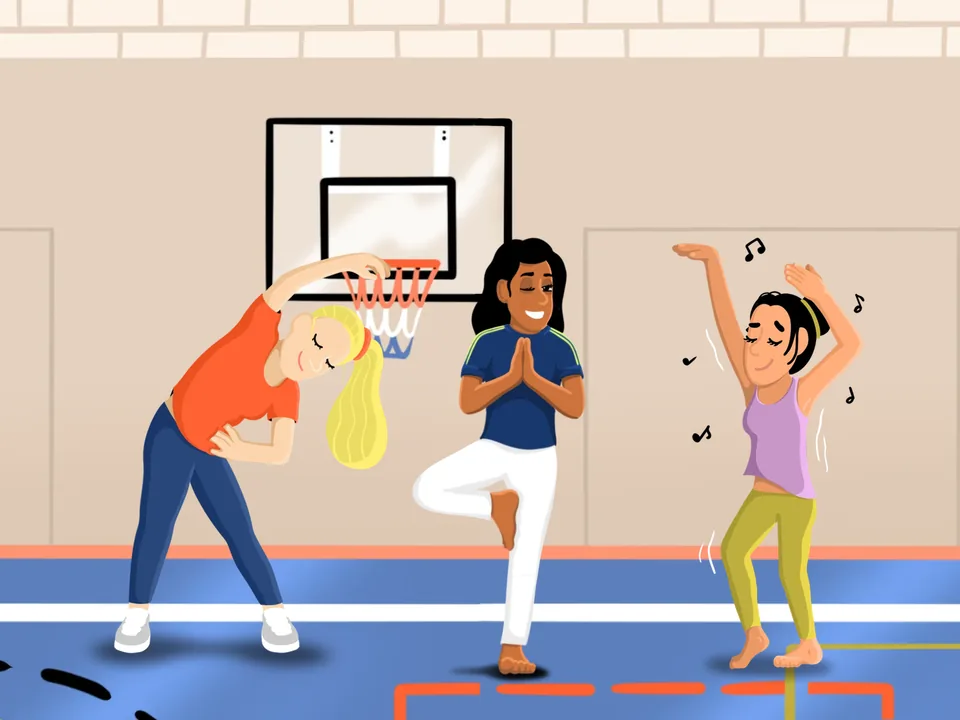
Some students in your class have played a sport for years, and others are touching it for the first time.
Get the app for iOS & Android, build balanced groups with the Team Creator and time every rotation with the Countdown Timer. Start with the 3 free units, no account needed; yearly plans start with a 7-day free trial, and you can see current prices in the app.
App for iPhone, iPad and Android.