Games & warm-ups
8 Gym Games With Balls for PE Class
PE specialists, classroom teachers covering gym, and substitutes often work with a wood floor, a mixed equipment cart, and a class ready…
Eight modified games work for softball in PE class if you use soft balls and only the called batter holds a bat. For throwing, play Step-Back Catch and Around the Horn Race. For batting, use Tee Target Zones and Tee and Shuttle Run. Add Goalie Grounders and Pickle for fielding, then Beat the Ball and Three-Team Softball for game play.
Use the games below if you teach striking and fielding with mixed skill levels and can't have a whole class waiting on one batter. They run from partner catch to a three-team game, each with scoring and restart rules, and a cone layout shows where bats and waiting students belong.
Regulation softball stalls because few students touch the ball at any moment. A fastpitch defense has nine players against one batter, so a class of 30 can start a pitch with about 20 students off the field. That makes it hard to meet the SHAPE America recommendation of moderate-to-vigorous activity for 50 percent of class time. The eight striking and fielding games below use small groups or short turns. Treat the grades as starting points.
| Game | Focus | Grades | Group | Gear |
|---|---|---|---|---|
| Step-Back Catch | Throw, catch | K–8 | Pairs | Soft ball, cones |
| Around the Horn Race | Throw, catch | 3–8 | Teams of 8 | Soft ball, 4 bases |
| Tee Target Zones | Batting | K–8 | Groups of 4 | Tee, bat, hoop, 5 balls, cones |
| Tee and Shuttle Run | Batting, running | 2–8 | 2 teams of 5–6 | Tee, bat, ball, 2 hoops, cones |
| Goalie Grounders | Fielding | 1–6 | Groups of 3 | Soft ball, 4 cones |
| Pickle | Fielding, running | 3–8 | Groups of 3 | Soft ball, 2 bases, cones |
| Beat the Ball | Game play | 3–8 | 2 teams of 6–8 | Tee, bat, ball, 4 bases, 2 hoops |
| Three-Team Softball | Game play | 5–12 | 3 teams of 7–11 | Tee, bat, ball, 4 bases, hoop |
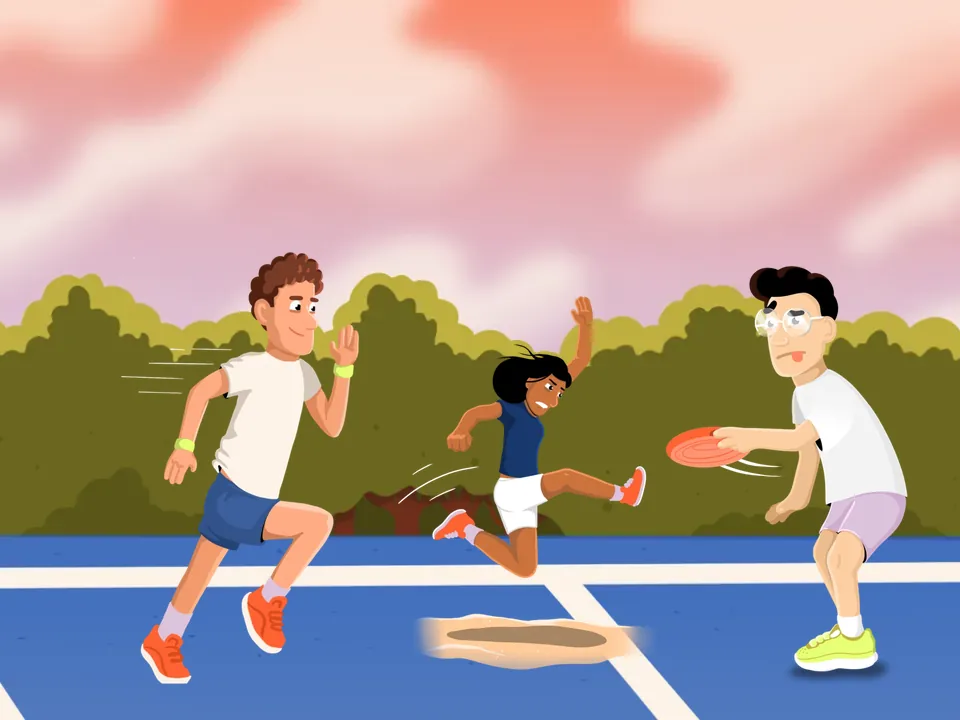
Step-Back Catch and Around the Horn Race build throwing and catching before anyone picks up a bat.
Pairs try to earn the longest throwing distance. Set two cone lines about 10 feet apart, put all A partners on one and all B partners on the other, and leave about 8 feet between pairs. Keep the space behind line B clear for the backward steps. Each time both partners catch cleanly, B takes a big step back. A drop or an unreachable throw moves B one step in, never inside the starting line. If a ball rolls into another lane, wait to fetch it until that pair is holding theirs. After 10 throws each, the pair scores one point per step B stands behind the line, then resets. K–2 classes can roll or toss foam balls underhand.
Teams race to send a soft ball around their own diamond. Set bases about 30 feet apart (45 for older students) with two players per base, and space diamonds so overthrows can't reach another team. On your signal, the ball travels from home to first, second, third and home, thrown only when the receiver shows a target. Each thrower then steps back, and the partner takes the next catch. After a drop or overthrow, the receiver fetches the ball, returns to the base and throws on. Every full lap scores a point, and the first team to five laps wins the round. Reverse direction for the rematch.
Teach batting off a tee set about waist high, using a soft ball and a bat hoop where each batter lays the bat after hitting. In both games below, a turn scores zero if the bat isn't in that hoop.
Batters score by reaching distance zones. Mark lines about 15, 30 and 45 feet from the tee between two sidelines, with three fielders waiting outside the sidelines, about 25 feet or more from the tee. The batter gets five swings. A ball first landing past the first line earns 1 point, past the second 2 and past the third 3. Misses, short balls and balls outside the sidelines score zero. After the fifth swing, the bat goes in the hoop, and only then do fielders collect the balls for the next batter. Once all four players have hit, the highest total wins.
One team bats for runs while the other fields. Fair ground lies between two sideline cones. Place a running cone about 30 feet out on the first-base side and a stop hoop about 30 feet out on the third-base side. The batter hits, lays the bat in the bat hoop and runs from there to the cone and back as often as possible, scoring one run per round trip. Fielders stay out of the running path and pass to a teammate at the stop hoop, who puts the ball inside and yells “Stop!” Unfinished trips don't count, caught fly balls score zero and fumbles stay live. After three misses or fouls, the batter throws the ball into play. Reset the tee for the next batter. Teams swap once everyone has hit; after both have batted, most runs wins.
Goalie Grounders and Pickle run in groups of three, so nobody stands in a long line.
Partners try to roll a soft ball through each other's goal. Make two cone goals about 6 feet wide and 20 feet apart; the third player keeps score. The goalie waits with knees bent and hands low. A ball that gets through scores for the roller, a clean stop scores for the goalie, and a bobble kept out of the goal scores nothing. Retake rolls that miss wide or bounce above the knees. The goalie rolls next. After 10 rolls each, the winner stays on to face the scorekeeper, and the other player takes over the count. Break a tie with one extra roll each, repeated until someone leads.
A runner tries to travel between two bases without being tagged by two fielders. Set the bases about 30 feet apart in a lane about 6 feet wide, with about 15 feet between lanes. The runner starts on one base and the ball at the other, with a fielder at each. The runner may stay on a base no longer than a slow count of five. Each safe arrival at the other base is a point. Fielders tag gently with the ball in hand or glove and never throw it at the runner. Play stays live after a dropped throw. A tag, a step out of the lane, staying on a base past the count or a third point ends the turn: the runner swaps with a fielder, and the new runner starts from a base. After all three have run, most points wins. Allow no sliding.
Run several small games at once and give every player one hit each time their team bats. A class of 32 can fill two Beat the Ball diamonds with teams of eight if space and supervision allow, placed so hits can't reach the other game. Our guide to PE games for large classes adds more formats. For a striking and fielding game without bats, use our kickball rules for PE class.
The runner tries to touch bases before the defense finishes its relay. Set bases about 40 feet apart with a hoop in the middle. The batter hits off the tee, leaves the bat in the bat hoop (or scores zero) and runs to first, second, third and the scoring base. Fielders complete three throws between different players, then put the ball in the middle hoop. Each base touched before that earns a point, up to four. Dropped throws are repeated, and caught fly balls score zero. After three misses or fouls, the batter throws the ball into play. Fielders stay off the base paths. Teams swap after everyone hits; once both have batted, most points wins.
Three teams rotate through batting, infield and outfield and try to score the most runs. Set bases about 50 feet apart. Everyone hits off the tee, or throws the ball into play after three misses or fouls. Force outs, tags and fly catches work as in softball, and reaching the scoring base counts as a run. Runners leave a base only once the ball is in play, with no stealing or sliding. An overthrow out of play gives them one base. A player who is out leaves the bases, but the turn goes on. A bat left outside the hoop is an out. Each new batter waits until the ball is back on the tee. After the last hit, the turn ends when an infielder holds the ball in the middle; runners still on base don't score. Batters move to the outfield, outfielders to the infield and infielders to bat. After all three have batted, most runs wins.
Mark a swing zone around each tee that only the called batter enters, and keep waiting hitters behind a waiting line about 20 feet or more back from it.
In this plan, four swing zone cones box in the tee. The bat hoop sits outside the box on the first-base side, and the scoring base for runners coming home sits on the third-base side. In live-ball games, each fielder starts behind the fielder line, about 25 feet from the tee, or deeper for strong hitters. In Tee Target Zones, fielders wait outside the sidelines.
Most problems come from waiting, loose bats or distances that don't fit the group.
| Problem | Likely cause | Fix |
|---|---|---|
| Long lines at the tee | Too many students share one tee | Add tees or split into more groups |
| Uneven teams | Class doesn't divide evenly | Repeat batters on smaller teams until every team has equal hits |
| Bat flies after contact | Batter hurries to run | Practice laying the bat in the hoop and enforce the penalty |
| Fielders collide | Two players chase one ball | Assign zones; the first to call “Mine!” takes it |
| Throws miss partners | Distance is too long | Move closer and have receivers show a chest-high target |
| Repeated swings and misses | Small ball or poor tee height | Use a larger foam ball and set the tee about waist high |
| Runners cross the swing zone | Scoring base sits too close to the tee | Move it farther to the third-base side |
Once play runs smoothly, freeze it and ask the defense where the next throw should go. Teaching Games for Understanding builds lessons around tactical questions like that one.
Yes, with foam balls, foam or plastic bats and shorter base distances. Aim tees toward an open end of the gym, keep doorways and walkways clear, allow no sliding and call any ball that hits the ceiling dead.
Yes, all eight carry over once you change the ball and bat. Use a foam or reduced-impact baseball for baseball units, and give batters and runners helmets with face guards if it's firmer than foam. For tee ball beginners, choose a larger foam ball, a light plastic bat and shorter base distances.
Make contact easier with a larger ball, a wider foam bat or a paddle, and check the tee height. In Tee and Shuttle Run, Beat the Ball and Three-Team Softball, the student throws the ball into play after three misses and can still run and score.
Move a batter to pitched balls once they make solid contact on most tee swings. Start with a slow underhand toss from you or a partner standing about 15 to 20 feet away with a foam ball. Keep the tee nearby so a batter who misses three tosses can hit off it instead.
Set bases about 30 to 40 feet apart for elementary grades and about 50 feet apart for middle school. Regulation fastpitch uses 60-foot base paths. Shorten the distance if runners rarely reach first, and lengthen it if every hit becomes a home run.
PE specialists, classroom teachers covering gym, and substitutes often work with a wood floor, a mixed equipment cart, and a class ready…
For PE teachers who want a few days of lead-ups before flag football, or a football finale in February.
These kickball rules for PE class come from Playworks and league play, adapted for a full class on a gym floor or field.
Teaching 30 or more students in a single gym or combined class period turns standard single-ball games into long waiting lines and…
Get the app and try the 3 free units without an account. The gym tools come with a plan; yearly and 12-month plans start with a 7-day free trial, and you can see current prices in the app.
App for iPhone, iPad and Android.